The global workforce and employment challenge
The World Economic Forum (WEF) has recently released a report showing that the global labour market has undergone significant upheaval in recent years and is set to change even more rapidly.
#artificial intelligence
Có 31 kết quả
The World Economic Forum (WEF) has recently released a report showing that the global labour market has undergone significant upheaval in recent years and is set to change even more rapidly.
The Au Lac Grand Prize has been launched to recognise artificial intelligence (AI) products and solutions developed and mastered by Vietnamese innovators that deliver strong and lasting socio-economic impact.
Legislative thinking needs to shift from a mindset of “pre-approval” and “absolute safety” towards proactively accepting risks in a controlled manner; stepping up the application of science and technology and artificial intelligence (AI) in law-making. These ideas have attracted considerable attention from experts and the public.
In the context of rapid digital transformation, artificial intelligence (AI) is becoming an important driver of innovation in education and training. Educational institutions, especially higher education institutions, need to intensify reform and effectively harness AI to improve training quality in the new context.
The United Nations Development Programme (UNDP) launched the Regional Human Development Report entitled “The next great polarisation: why artificial intelligence (AI) could widen inequality between countries” on December 2, in Ha Noi, warning that AI could increase global inequality; however Viet Nam is preparing to seize emerging opportunities.
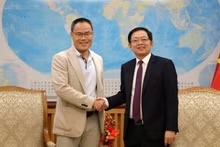
Viet Nam attaches great importance to its traditional friendship and multifaceted cooperation with Belarus and wishes to further advance bilateal ties, Party General Secretary To Lam told visiting State Secretary of the Security Council of Belarus Aleksandr Grigorievich Volfovich on December 3.
Artificial intelligence (AI) is developing rapidly and has become a key factor shaping the global technology landscape. As the AI craze intensifies with no sign of slowing down, the tech world is sparking a debate: whether the AI market is becoming overvalued and showing signs of an emerging bubble.
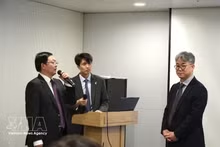
The Science and Technology Dialogue Forum, a flagship event within the Australia–Viet Nam TechFest series hosted by the Vietnamese Australian Scholars and Experts Association (VASEA), was recently held at the University of Technology Sydney (UTS), bringing together senior leaders, innovators, and industry partners from both countries to strengthen cooperation in science, technology, and innovation.
Artificial intelligence (AI) is no longer just a data-analysis tool but is becoming an indispensable component of public governance.
Artificial intelligence (AI) is profoundly affecting every aspect of life. More than merely a tool, AI is becoming a core component in the development strategies of nations, businesses, and global organisations.
Alongside the explosive development of information technology, artificial intelligence (AI) and “green” modes of transport, global demand for electricity is rising rapidly. Ensuring sufficient power supply has become a pivotal task for countries seeking to realise their growth ambitions.
Artificial intelligence (AI) based on open technology and open source is the key strategy for Viet Nam to achieve a breakthrough, said Minister of Science and Technology Nguyen Manh Hung.
State President Luong Cuong proposed some major cooperation directions for the Asia-Pacific Economic Cooperation (APEC) while addressing the second plenary session of the 32nd APEC Economic Leaders’ Meeting in Gyeongju city, the Republic of Korea, on November 1 morning.
Party General Secretary To Lam and a high-ranking Vietnamese delegation attended a seminar with leading strategists on artificial intelligence (AI) and technology in the UK and the world, which was held in London on October 28, within the framework of their official visit to the UK.
The Central Commission for Communications, Education and Mass Mobilisation held a workshop on October 25 to discuss the benefits and challenges of promoting the application of artificial intelligence (AI) in education and training.
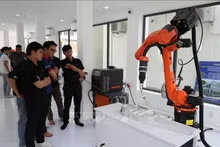
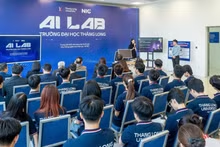
In the fourth industrial revolution, artificial intelligence (AI) has emerged as a core technology shaping the future of all industries and sectors. With its strong scientific and technological potential, Ho Chi Minh City is well-positioned to develop a high-quality AI workforce.
With a young population, a strong pool of tech talent, and strategic direction from the government, Viet Nam’s artificial intelligence (AI) ecosystem is poised for a major leap forward.
Deputy Minister of Home Affairs Cao Huy led a Vietnamese delegation to the ASEAN Socio-Cultural Community (ASCC) High-Level Forum, which opened in Selangor, Malaysia, on October 7 with a focus on an inclusive and sustainable regional community.
The Ho Chi Minh National Academy of Politics (HCMA) organised a workshop on September 15 to discuss the impacts of artificial intelligence (AI) and policy responses.
In recent years, Viet Nam has been severely affected by natural disasters and climate change. Phenomena such as storms, floods, droughts, and landslides have been occurring frequently. Against this backdrop, artificial intelligence (AI) has become a powerful tool to enhance the effectiveness of disaster forecasting, minimise damage, and support timely response.