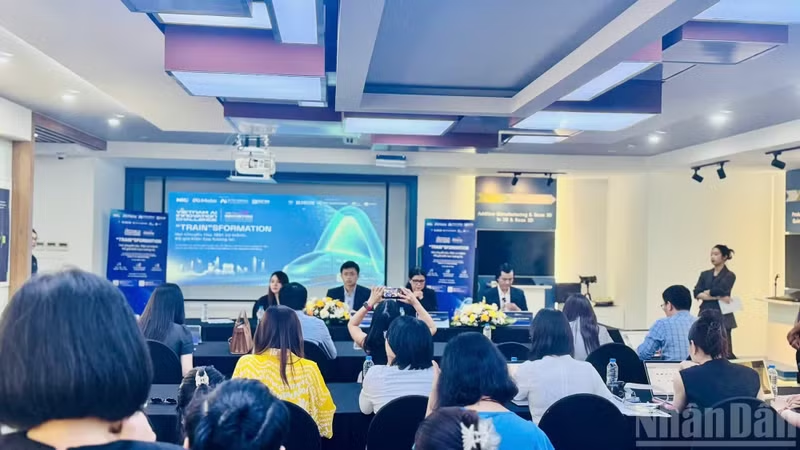
Speaking to Nhan Dan Newspaper, Thao Griffiths, Director of Public Policy for Cambodia, Laos, Myanmar and Viet Nam at Meta, stressed that Viet Nam is currently one of the most dynamic artificial intelligence (AI) communities in Southeast Asia. For the Vietnam AI Innovation Challenge 2026, the biggest goal is to fully tap into that strength.
The organisers hope to turn this creative momentum into practical opportunities, helping young people develop their ideas into concrete products. From this launchpad, Vietnamese AI products will be introduced to the region, with Singapore serving as a hub, before gradually reaching the global market in Silicon Valley, the US.
“Our greatest expectation is to place Viet Nam more prominently on the regional and global AI map,” Thao Griffiths said.
According to Thao Griffiths, Meta is committed to providing comprehensive resources and support capacity. As one of the world’s largest technology corporations with some of the strongest and broadest investments in AI, Meta has established a strategic partnership with the National Innovation Centre (NIC), one of the earliest partnerships formed shortly after the centre was established.
She noted that the remarkable and objective growth of Viet Nam’s AI community is a major driving force behind Meta’s decision to accompany and support the development and completion of the ecosystem, with the aim of maximising AI talent in the country. Therefore, in this year’s Viet Nam AI Innovation Challenge 2026, Meta will focus on its core competitive advantages to provide the most practical support to participating teams.
“It can be said that this competition has all the right conditions in terms of timing, location and human resources. Meta is committed to continuing to work closely with Viet Nam to realise its strategic goals for artificial intelligence in the future,” Thao Griffiths affirmed.
Explaining why Meta decided to partner with the National Innovation Centre to organise the Viet Nam AI Innovation Challenge, Thao Griffiths said this was a very natural step, as Viet Nam has an extremely dynamic community of technology product developers, arguably one of the most dynamic in Southeast Asia.
Through the competition, Meta expects that it will not only create opportunities for young Vietnamese talents to access and use the latest AI technologies, but also place them in the position of developers and solution builders, enabling them to address real problems faced by Vietnamese businesses.
Marking a comprehensive and distinctive six-month journey
According to the organisers, the Viet Nam AI Innovation Challenge 2026 is a comprehensive six-month journey. As a partner, Meta has committed to working with Vietnamese developers to identify solutions and present awards in Viet Nam, before continuing to introduce selected solutions to the Singaporean and US markets.

Specifically, several suitable solutions will be brought to AI Singapore for further research and development. By the end of the year, outstanding solutions will be introduced in the US to connect with the community of Vietnamese AI experts living and working in Silicon Valley.
“This journey carries the mission of taking Viet Nam’s artificial intelligence to the regional and global levels. Meta is honoured to accompany developers in building a stronger and more sustainable AI ecosystem in Viet Nam,” Griffiths said.
Analysing what makes this competition different, Thao Griffiths first emphasised that this is the first AI solution-seeking competition to be held on a nationwide scale, especially with the strategic partnership of the National Innovation Centre.
In addition, when looking at the programme’s logo, one can easily notice the word “Transformation”, representing a powerful transition in the AI era, cleverly combined with the word “Train”, referring to the Thong Nhat train, conveying a broader message of connectivity and modernisation.
Turning this message into concrete action, the organisers will take contestants from Ha Noi and Ho Chi Minh City on two trains to Da Nang, where more than 2,000 contestants will compete in person for 48 consecutive hours in a Hackathon to solve real business problems.
Notably, the programme brings together a network of mentors who are Vietnamese engineers and AI experts working in major technology hubs around the world, such as Silicon Valley in the US, Singapore, Japan and Europe, including Sweden. They will provide training and hands-on guidance to contestants for five weeks before the Hackathon final takes place in Da Nang.
A highlight of the competition is that all topics are based on real problems raised by Vietnamese businesses. Solving these problems will not depend solely on the contestants’ capabilities, but will also be supported by a network of partners that will help apply the solutions and bring them to national and international markets.
Vietnam AI Innovation Challenge 2026 to take place in Da Nang
According to the organisers, Da Nang in particular and the central region in general have witnessed remarkable development in recent years, gradually affirming their position as a major national centre for innovation and technology development.
For many consecutive years, Da Nang has led the country in the ICT Index, which measures readiness for the development and application of information and communications technology, while also making strong progress in innovation indicators.
The organisation of the competition in Da Nang is expected to inspire entrepreneurship and innovation, while promoting technology research activities, especially in AI, among young professionals, intellectuals and students in Da Nang and other central localities.
Statistics show that Da Nang currently has a vibrant start-up ecosystem with more than 1,000 small- and medium-sized companies operating in AI, blockchain and other core technology sectors. These enterprises usually employ between 100 and 300 people, creating a significant internal resource for the city.
Therefore, this competition is expected to serve as a lever to encourage young people, technology engineers and university students in the city to actively participate, accompany and directly contribute to the value chain and overall development of Viet Nam’s AI industry.
Speaking to Nhan Dan, Nguyen Khanh Linh, in charge of investment promotion and strategic technologies at the National Innovation Centre, said that through practical surveys, the organisers found that many Vietnamese businesses are facing highly complex sector-specific challenges. Although they are well aware of the power of AI, their difficulty lies in the lack of specialised personnel and the absence of suitable solutions to effectively apply AI to their business models.
“The Hackathon was created to thoroughly address this bottleneck by connecting real business problems with contestants’ practical creativity,” Linh said.
He emphasised that AI development needs to focus on three main pillars: policy mechanisms, infrastructure and human resources.
“The Hackathon was created to thoroughly address this bottleneck by connecting real business problems with contestants’ practical creativity.”
Nguyen Khanh Linh, National Innovation Centre.
The NIC representative affirmed that contestants will not only gain access to knowledge and information, but also acquire skills to directly solve real market problems, under the guidance and orientation of experts and mentors from the world’s leading technology corporations, including Meta, Google, Yahoo, Viettel and FPT.
For businesses, meanwhile, this is an opportunity to find answers to their problems by investing in potential solutions, supporting contestant teams to develop into technology start-ups, or directly recruiting outstanding and suitable teams to operate their internal AI systems.
The organisers expect this connection to create a long-term journey, including a series of five training sessions and workshops, to ensure that solutions developed after the competition will be applied in practice, deliver real economic value, and help Viet Nam optimise AI technology for economic development and improved quality of life.