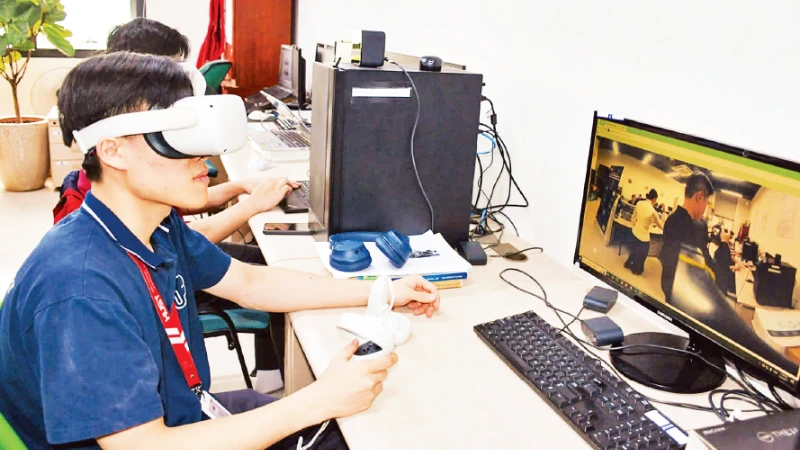
Applying AI to optimise teaching and learning
AI is being deployed by higher education institutions in various models, including personalised learning, teaching assistants, experimental simulations, and academic analysis, delivering practical benefits for both lecturers and students. Dr Kieu Phuong Thuy, senior lecturer at the Faculty of Information Technology, School of Mathematics and Information Technology (Ha Noi National University of Education), said that AI has proved effective in supporting lesson preparation, significantly reducing teachers’ workload. The university is currently promoting the “flipped classroom” model, in which lecturers provide learning materials for students to study beforehand, while classroom time is devoted to addressing outstanding questions. AI also supports students in Q&A directly on the lecture platform. Assessment methods have shifted from testing memorisation to evaluating the ability to apply knowledge and the quality of actual learning products. AI helps students to study more effectively but cannot replace tasks that require analytical or evaluative thinking, while lecturers maintain full control over the teaching process.
AI has proved effective in supporting lesson preparation, significantly reducing teachers’ workload. The university is currently promoting the “flipped classroom” model, in which lecturers provide learning materials for students to study beforehand, while classroom time is devoted to addressing outstanding questions. AI also supports students in Q&A directly on the lecture platform. Assessment methods have shifted from testing memorisation to evaluating the ability to apply knowledge and the quality of actual learning products. AI helps students to study more effectively but cannot replace tasks which require analytical or evaluative thinking, while lecturers maintain full control over the teaching process.
Dr Kieu Phuong Thuy, senior lecturer at the Faculty of Information Technology, School of Mathematics and Information Technology (Ha Noi National University of Education)
Ha Noi National University of Education is also implementing AI applications in assessment to analyse questions, build test banks, and prepare examinations; and is also aiming to use AI to analyse learning outcomes and admission results, thereby providing scientific evidence to support future admission processes.
The University of Social Sciences and Humanities (Viet Nam National University, Ha Noi) is a key contributor to the Ministry of Education and Training in developing the Circular promulgating the Digital Competence Framework for learners in the national education system. Notably, the university has organised a training course on “Breakthroughs with Generative AI in Teaching and Research”, equipping staff and lecturers with skills to apply Gen AI. Students are taught specific skills to apply effectively in their studies and research, such as using Gen AI to summarise materials, brainstorm ideas, and create effective presentation slides. Final-year students also receive support in essential skills to access the labour market for better employment opportunities. In addition, the university has introduced MOOCs e-learning lectures for the Basic Informatics module, integrating multimedia elements such as high-definition video, vivid audio, and easy-to-use interactions, thereby contributing to digitalised and personalised training.
At Ha Noi University of Science and Technology, Dr Nguyen Thanh Hung, Head of Training, said that since 2023, the university has implemented the intelligent virtual assistant HUSTVA, providing personalised experiences for each student and staff member — from learning and research to career orientation. The university is also piloting AI tools that analyse learning data to issue early warnings for students at risk of poor performance, enabling timely support.
AI cannot replace the teacher
Although AI brings many benefits, reality shows that it cannot replace the guiding role of the teacher. MSc Cao Hong Hue, senior lecturer at the Institute of Information Technology and Deputy Director of the Centre for Communication and Learning Materials Production, Ha Noi National University of Education 2, emphasised that AI is ushering in a new learning era in which knowledge is personalised and learning data becomes the foundation for methodological innovation. However, this does not diminish the teacher’s role; on the contrary, it makes it more important than ever. The core value of a teacher lies in humanity, pedagogical emotion, and the ability to guide life values — qualities no intelligent system can replace.
Associate Professor Dr Nguyen Duc Son, Rector of Ha Noi National University of Education, also stated that AI is merely a supporting tool. If teachers depend too heavily on AI, it will reduce logical thinking and pedagogical creativity. Therefore, the use of AI requires a clear understanding of both the strengths and weaknesses of the technology.
According to Dr Nguyen Thanh Hung, applying AI in higher education in Viet Nam currently faces many challenges: student databases, programmes and learning outcomes are still scattered, poorly digitised and lack connectivity. Server systems and data centres supporting AI remain limited, causing implementation to rely on small-scale, fragmented projects. In terms of personnel, the number of lecturers deeply knowledgeable about AI in education is still small, with most using AI merely as a support tool. Current regulations on data security, privacy and academic integrity remain unclear, creating hesitance in AI adoption. Meanwhile, some lecturers and students remain wary of AI, fearing that it might replace the teacher’s role or increase academic dishonesty.
Based on these opportunities and challenges, it is evident that AI in education will only be effective when accompanied by reform in training models, capacity building for staff and the improvement of policies. This is also the requirement for the entire sector in the current phase of digital transformation.
Minister of Education and Training Nguyen Kim Son affirmed that AI cannot replace the role of the teacher, but it poses new requirements: teachers must be lifelong learners; must understand AI to teach humans in the AI era; and must shift from primarily transmitting knowledge to guiding, mentoring, and supporting the development of learners’ learning capabilities for lifelong learning.
AI cannot replace the role of the teacher, but it poses new requirements: teachers must be lifelong learners; must understand AI to teach humans in the AI era; and must shift from primarily transmitting knowledge to guiding, mentoring, supporting the development of learners’ capabilities for lifelong learning.
Minister of Education and Training Nguyen Kim Son
The Ministry of Education and Training is directing educational institutions to strengthen training, raise awareness and enhance understanding and capacity in AI application to lead and master AI deployment; develop AI education programmes beginning at primary level; and improve the regulatory framework by issuing and refining rules and guidelines, including handbooks, codes of conduct, and regulations on data security and privacy. This provides an essential legal corridor to ensure responsible and safe AI application while preserving ethical and humanistic values in education.