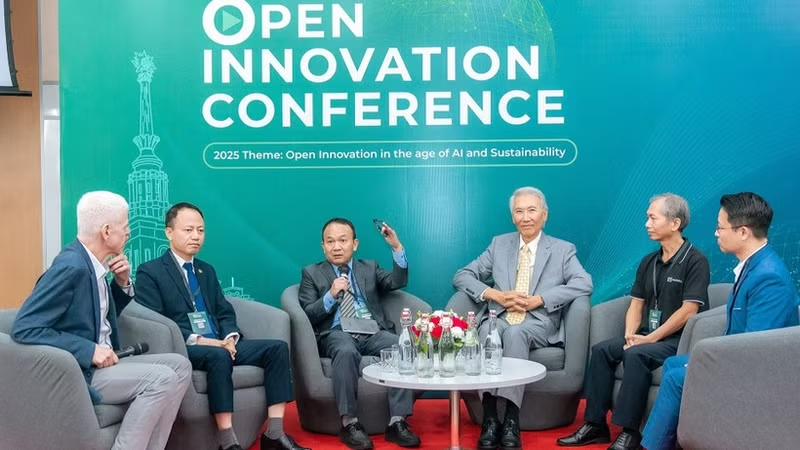
They focused discussions on innovation in the context of accelerating global trends in artificial intelligence, digital transformation, and green development.
With the theme “Open Innovation in the Age of Artificial Intelligence (AI) and Sustainable Development”, the two-day conference continues to expand in scale, delving deeper into multidisciplinary, practical, and strategically oriented discussions.
OIC 2025 is organised by VinUni University, represented by the Smart Green Transformation Centre (GREEN-X), in collaboration with the Ministry of Science and Technology, Saïd Business School (University of Oxford), SC Johnson College of Business (Cornell University), and the Duke University Centre for International Development.
The event reflects VinUni’s commitment to contributing to the development of an open innovation ecosystem, connecting global knowledge with Viet Nam’s sustainable development needs.
A highlight of OIC 2025 is the presence of two globally influential keynote speakers: Professor Chenming Hu, known as the “father of FinFET”, who laid the technological foundation for most modern semiconductor chips, and Professor Wim Vanhaverbeke, one of the world’s leading scholars on open innovation.
In his opening remarks, Professor Ermias Kebreab, Associate Dean for Global Engagement at the College of Agricultural and Environmental Sciences (the US), and Director of the World Food Centre at the University of California, Davis, emphasised the spirit of open innovation, describing it as “a shift from ownership to sharing, from unipolarity to multipolar collaboration”.
He praised VinUniversity as a new beacon of knowledge. Highlighting Professor Chenming Hu’s contribution, he affirmed that FinFET technology is “a breakthrough foundation enabling energy efficiency and ushering in the era of high-performance chips”, while the BSIM model has nurtured the global semiconductor ecosystem.
“Innovation must be human-centred and co-created,” he said, expressing confidence that OIC 2025 will continue to drive positive transformation.
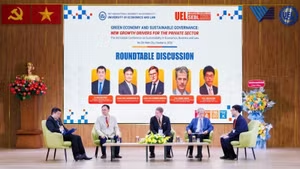
In addition to keynote addresses, OIC 2025 features two roundtable discussions on open innovation in the semiconductor sector and business model innovation in the digital era, with contributions from experts from the Ministry of Science and Technology, the University of California, Berkeley, the University of Antwerp, and Viet Nam National University, Ha Noi.