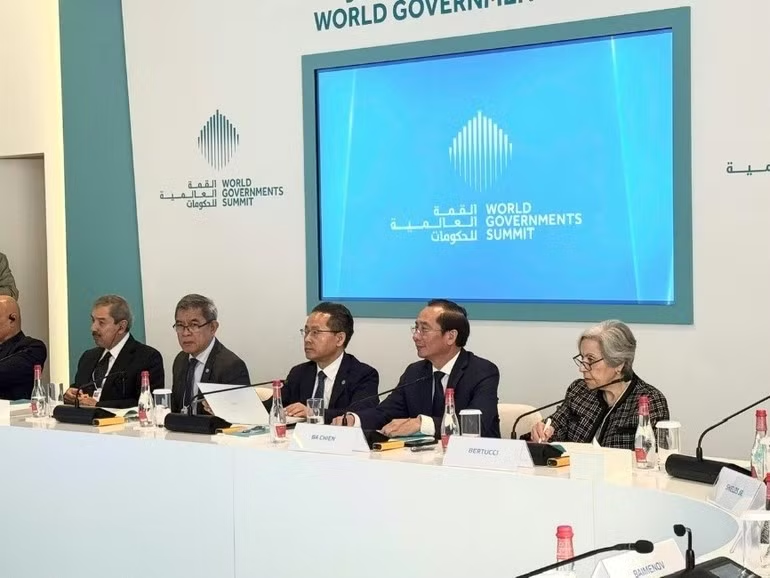
The World Governments Summit 2026 (WGS 2026) took place from February 3 to 5 in Dubai, the United Arab Emirates (UAE), under the theme “Shaping Future Governments”. It is one of the world’s largest political and governance forums, bringing together heads of state, ministers, leaders of international organisations, scholars, and the innovative business community to share strategic visions, policies, and solutions amid profound global transformations.
One of WGS 2026’s key highlights was the ministerial-level roundtable “Shaping Future Governments: Achievements and Challenges in the Global South”, held on February 4. This was a multi-dimensional dialogue space on models of institutional reform and public governance from national, regional, and global perspectives, seeking answers to a “dual pressure”: driving breakthrough growth while ensuring social stability amid variables such as digital transformation, climate change, and population ageing.
Moving beyond theoretical frameworks, the roundtable focused on practical solutions for institutional reform: building flexible governance models that can adapt to the era of AI and big data; optimising public services by strengthening administrative capacity to better serve people, especially in developing countries; and narrowing gaps by reducing inequality and advancing the Sustainable Development Goals (SDGs) in a changing world.
Speaking at the roundtable, Associate Professor, Dr Nguyen Ba Chien — Director of the Viet Nam Academy of Public Administration and Governance — said that in a world undergoing rapid, deep, and hard-to-predict change, the central question for national governance today is not only how to grow faster, but more importantly how to govern in order to develop sustainably, inclusively, and ensure no one is left behind.
Sharing Viet Nam’s experience, Associate Professor, Dr Nguyen Ba Chien stressed that institutional reform is not merely a technical adjustment to management, but a strategic choice of a development path, decisive in opening a new era of national development.
Viet Nam enters 2026 with notable economic achievements, yet it also stands at a structural crossroads: either making a breakthrough towards becoming a developed country, or facing the risk of falling into the middle-income trap as traditional growth drivers have reached their limits.
A distinctive advantage of Viet Nam, according to Associate Professor, Dr Nguyen Ba Chien, is a valuable source of “social capital” — political stability, social consensus, and public trust in the renewal process. This foundation enables Viet Nam to pursue major, difficult, and sensitive reforms, including changes that directly affect the apparatus, people, and traditional governance methods.
Institutional reform in Viet Nam is being implemented in a way that promotes innovation and digital transformation, institutionalises a new growth model based on the digital economy and green transition, shifts legal thinking from “management” to “enabling”, and links institutional reform with deep international integration and strategic autonomy.
Associate Professor, Dr Nguyen Ba Chien — Director of the Viet Nam Academy of Public Administration and Governance
On that basis, Viet Nam has set out a comprehensive and long-term vision for institutional reform, concretised in the strategic resolutions of the 14th National Congress of the Communist Party of Viet Nam, with an overarching philosophy: an enabling State — a market that leads — a society that accompanies — and people at the centre. Institutional reform is being implemented in a way that promotes innovation and digital transformation, institutionalises a new growth model based on the digital economy and green transition, shifts legal thinking from “management” to “enabling”, and links institutional reform with deep international integration and strategic autonomy.
In particular, Associate Professor, Dr Nguyen Ba Chien underscored the linkage between institutional reform and a revolution to streamline the organisational apparatus and enhance the State’s capacity for action. During 2024–2025, Viet Nam undertook a far-reaching restructuring of the administrative system at both central and local levels, alongside decentralisation, delegation of authority, and strengthened accountability. The aim is not merely to streamline in order to cut costs, but more importantly to improve the quality and effectiveness of policy decision-making, bring government closer to the people, enhance the quality of public services, and unlock resources for development and social welfare.
From this practice, Associate Professor, Dr Nguyen Ba Chien affirmed that institutional reform in Viet Nam is directly being transformed into tangible governing capacity, social trust, and new development space, reflected in the removal of many long-standing bottlenecks and the maintenance of high, sustainable economic growth amid global instability.
According to Associate Professor, Dr Nguyen Ba Chien, the government of the future cannot be designed solely around technology, but must be built on three fundamental pillars: the rule of law, public-service ethics, and social trust.
The presence and contribution of the Director of the Viet Nam Academy of Public Administration and Governance at the ministerial roundtable affirmed the academy’s increasingly clear role as a knowledge hub, an academic partner, and a policy bridge between Viet Nam and the world.
According to a representative of the Viet Nam Academy of Public Administration and Governance, this is also an important opportunity for the academy to establish its position as a reputable academic partner and a key policy bridge between Viet Nam and the international community.
Through this forum, the academy not only expands its network of international cooperation, but also creates new value in research and training, promoting a comprehensive and sustainable integration process.