The resolution clearly states that breakthroughs in education and training development must begin with innovation in thinking, awareness and institutions, placing people and students’ learning capacity at the centre of efforts to improve educational quality in a substantive and sustainable manner.
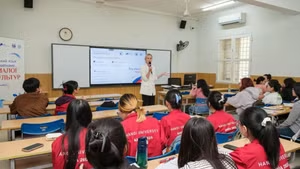
Dr Nguyen Thi Giang from the Institute of Linguistics under the Viet Nam Academy of Social Sciences said that the practical implementation of Resolution No. 71 should focus on enhancing learners’ learning capacity, viewing this as the starting point for renewing teaching and learning toward substance and effectiveness.
From a linguistic perspective, Giang noted that all human cognitive activities, thinking processes and knowledge acquisition are mediated through language. Therefore, without due attention to learners’ language capacity, education reform is unlikely to achieve sustainable effectiveness, regardless of adjustments to curricula, teaching methods or increased application of technology.
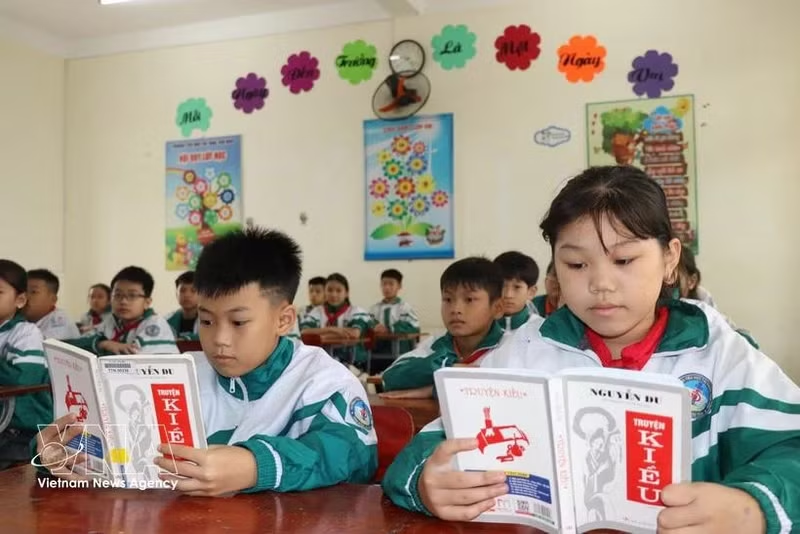
In practice, educational renewal needs to penetrate the quality of language competence, ranging from reading comprehension and expression to reasoning, critical thinking and creativity. Moreover, prioritising the development of language capacity contributes to narrowing educational gaps, particularly for students in disadvantaged areas, those with special needs or those facing language barriers. Investing in language capacity is essentially investing in education and sustainable development, in line with the spirit and objectives of Resolution No. 71.
It also calls for organising teaching and learning toward competency development, whereby learners not only acquire knowledge but also know how to use it for learning, thinking and problem-solving. This approach requires a reorganisation of the teaching process, reducing one-way knowledge transmission and increasing activities that enable learners to actively construct knowledge, thereby fostering self-learning capacity and lifelong learning skills.
According to the expert, for the requirements of this resolution to be translated into reality, it is essential to strengthen knowledge transfer and provide close support to teachers and schools in organising teaching activities, ensuring that policies are concretised into practical solutions.
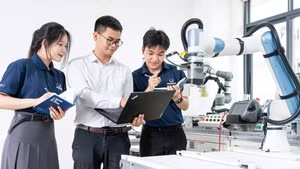
From classroom practice, Nguyen Thi Hang, teacher at Newton High School in Hanoi, said that Resolution No. 71 has provided a clear guiding framework for educational institutions to proactively reorganise teaching and learning activities toward improving substantive quality.
In line with the spirit of “learning associated with practice” emphasised in Resolution No. 71, Hang stressed that general education should continue to link learning content with real-life situations, helping students understand that knowledge is not only for examinations but also for solving real-world problems. This, she said, is also an effective way to build sustainable learning capacity and meet the requirements of human resources development in the new stage.