Retaining and attracting talent
Resolution No. 71-NQ/TW, issued on August 22, 2025, on breakthroughs in education development, establishes a strategic orientation that views education as the foundation, with the development of high-quality human resources identified as the key breakthrough to enhance national competitiveness and internal strength. The Resolution also sets out a comprehensive system of solutions, ranging from attracting and rewarding talent, renewing training programmes, to strongly applying digital technologies and artificial intelligence in teaching and learning.
One of the Resolution’s major breakthroughs is placing people — especially teachers and lecturers — at the centre of the strategy for developing high-quality human resources. Accordingly, the Resolution introduces outstanding incentive policies aimed at retaining highly capable personnel while creating new appeal for intellectual resources at home and abroad.
At the level of higher education, Resolution 71 emphasises the development of programmes to attract outstanding lecturers and scientists, particularly high-quality human resources from overseas, with exceptional incentives in income, research conditions, and the academic environment. This is seen as an appropriate approach amid increasingly fierce global competition for science and technology talent.
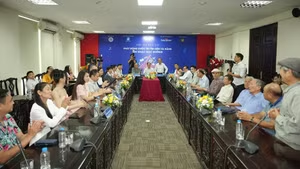
In practice, several major universities have proactively implemented talent attraction models in this spirit. Speaking at a recent forum on talent policy, Associate Professor Huynh Quyet Thang, Director of Ha Noi University of Science and Technology, stressed that higher education is the core of developing high-level human resources in science, technology, and innovation, in which talent plays a decisive role in determining university quality and competitiveness. On that basis, the Ha Noi University of Science and Technology has launched the HUST-Talent Scheme for the 2025–2030 period, continuing previous programmes to attract outstanding lecturers, with the goal of building an elite faculty and scientific workforce capable of leading training and research in line with international standards. The scheme targets three key groups: young PhD holders graduating from leading global institutions; professors, associate professors, and technology experts from enterprises and research institutes; and prestigious scientists and managers from Viet Nam and abroad.
According to Professor Vu Van Yem, Vice Director of Ha Noi University of Science and Technology, in the context of the knowledge economy and digital transformation, universities cannot renew curricula, elevate research capacity, or integrate internationally without a strong contingent of talented lecturers and scientists. Talent attraction is therefore not only an immediate requirement but a prerequisite for universities to exercise autonomy and achieve sustainable development.
A notable feature of HUST-Talent is its competitive remuneration mechanism aligned with international practices, offering monthly incomes ranging from 40 million to 150 million VND, along with policies on housing support, health insurance, research funding, participation in international projects, and clear career development pathways. The university expects the scheme to help form strong research groups and create momentum to enhance teaching quality, scientific research, and innovation.
By early 2026, Phenikaa University had implemented a breakthrough strategy in attracting and rewarding talent, focusing on building a high-level faculty and scientific workforce while nurturing outstanding students. The university prioritises recruiting professors, associate professors, and PhDs with international research capacity, creating a free research environment that encourages innovation and international publication, while providing strong backing for research through investment funds of the Phenikaa Group. Competitive and transparent remuneration mechanisms, together with clear career development pathways, are seen as a “magnet” to attract intellectuals, particularly Vietnamese human resources overseas.
At the same time, Phenikaa maintains a large-scale scholarship system to attract high-quality learners. Many outstanding candidates receive tuition exemptions ranging from the first two years to the entire course, while master’s students and doctoral candidates receive support covering 50% to 100% of tuition fees in key disciplines. The university is also building an “innovation-driven university” ecosystem that closely links training, research, and production, enabling scientific ideas to be realised directly within the enterprise ecosystem, while expanding international cooperation and enhancing academic quality and standing.
Promoting the internationalisation of education
Amid rapid globalisation and digital transformation, Viet Nam National University, Ha Noi (VNU Ha Noi) has identified the internationalisation of education as a strategic breakthrough to improve human resource quality and implement major Party resolutions on education, science, and technology development.
According to Associate Professor, Dr Dao Thanh Truong, Vice Director of VNU Ha Noi, the university’s current internationalisation strategy focuses on two key priorities: restructuring training programmes to meet international standards and creating articulation between general education and higher education, while accelerating the application of technology to shorten undergraduate training to three years in line with European standards, thereby saving social resources.
On that basis, VNU Ha Noi is decisively renewing its disciplinary structure by investing in the training of talent in basic sciences, while strongly expanding programmes in science, technology, engineering, and mathematics. At present, applied and engineering-technology disciplines account for nearly 50% of total enrolment and are expected to rise to around 65% in the coming years, to meet labour market demand for high-quality human resources.
Alongside standardising training content, VNU Ha Noi is learning from advanced models of leading universities worldwide to renew teaching methods and training governance, and develop English-taught programmes. The goal is to equip students with the ability to study and work in international environments, while also attracting foreign students to study and conduct research in Viet Nam.
A key highlight is the strong application of digital technology and artificial intelligence in education. VNU Ha Noi has implemented blended learning models combining in-person and online formats, integrating AI into teaching, assessment, and the personalisation of learning pathways, particularly for talented students. This helps form core digital competencies, enabling learners to develop comprehensively and gain early access to scientific research in line with international standards.
Nguyen Trung Thanh, a third-year student at the University of Engineering and Technology (VNU Ha Noi), shared: “The renewal of training programmes to international standards makes the learning process more substantive and closely aligned with professional requirements. Especially in data science, studying subjects such as artificial intelligence and data analytics, combined with project-based work with enterprises from the third year, helps students feel more confident when entering the labour market, without being ‘shocked’ by real-world demands.”
In the South, Viet Nam National University, Ho Chi Minh City is among the pioneers in implementing interdisciplinary and multidisciplinary training programmes in line with international practices. Fields such as information technology, data science, artificial intelligence, and the digital economy are developed under open frameworks that allow students to choose flexible learning pathways, strengthen connections with enterprises, and engage in applied research projects. University leaders note that renewing training programmes not only improves human resource quality but also creates an innovation ecosystem where students are trained to solve real-world economic problems.
Many students have noted that studying and conducting research with outstanding lecturers and international experts not only helps them update advanced knowledge but also shapes a global-standard mindset. This is a significant advantage when entering the labour market, especially in high-tech fields, the digital economy, and basic sciences.