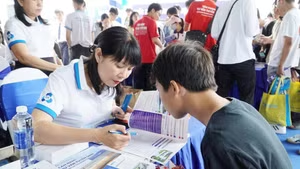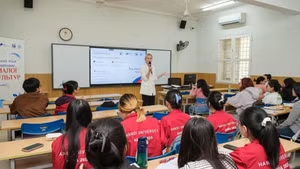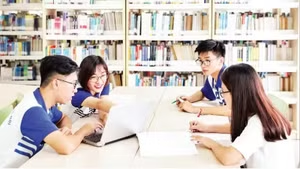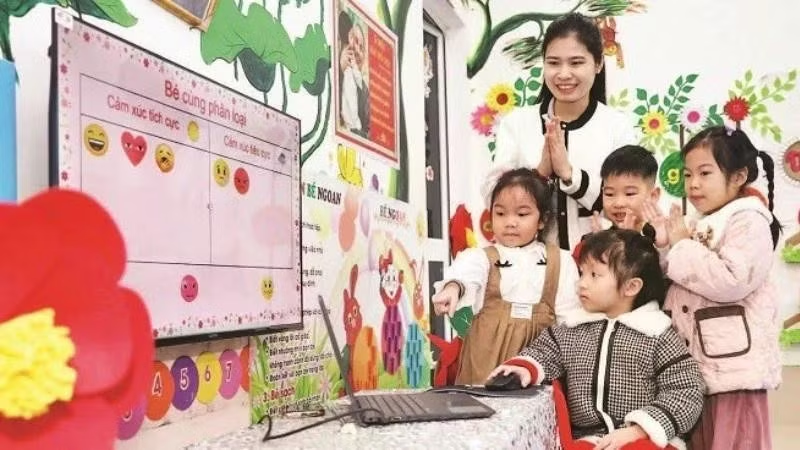
In practice, coordination among schools, families and society in student counselling, support and education in recent years has yielded certain positive results, bringing into play the active participation of various social forces in the cause of education and training.
Party committees and authorities at all levels in general, and the education sector in particular, have paid close attention to directing and organising implementation, adopting many concrete and resolute measures. Parents’ awareness of children’s rights and obligations, as well as of the goal of providing a holistic education for the younger generation, has been enhanced.
Various forms of engagement to attract family participation in school education have been introduced and implemented in a more appropriate manner. Families have shown greater concern for education, proactively meeting, coordinating and exchanging information with schools more frequently in addressing issues related to counselling, support and student education.
Departments of Education and Training have advised provincial and municipal People’s Committees on the issuance of plans to implement coordination work through practical activities aligned with the requirements of education and training, as well as the conditions of schools and localities.
Some Departments of Education and Training have developed coordination regulations involving departments, agencies, mass organisations and local authorities in management and education; strengthened the application of information technology in guidance and direction; and issued documents guiding the implementation of coordination among schools, families and society.
According to Doan Thi Kim Dung, Principal of A Nguyen Hue Upper Secondary School in Ninh Binh province, when developing the school-year plan, the school has been placing emphasis on establishing close links among the school, families and society through homeroom teachers, electronic contact books and social media platforms (Zalo, Facebook, etc.), as well as email. This has enabled the school to regularly grasp students’ circumstances and psychological developments, and to promptly inform parents of their children’s academic results, conduct and psychological changes, thereby facilitating encouragement, sharing and timely adjustment of inappropriate behaviours.
At the same time, the regular practice of holding parent meetings have maintained at the beginning of the school year, at the end of the first semester and at the end of the academic year, in order to update families on their children’s learning progress and discuss coordinated solutions for counselling, support and education.
According to Le Thi Minh Tam, Principal of Tran Phu Lower Secondary School in Hai Phong City, coordination among the “three pillars”—family, school and society—is essential. In this process, teachers play a particularly important role, not only in organising educational activities but also in closely managing and monitoring students’ progress, especially those from disadvantaged backgrounds.
Many dedicated teachers have proactively visited students’ homes, particularly those of students in difficult circumstances, in order to gain a clearer understanding of their living conditions, psychological states and needs, thereby enabling the adoption of timely and appropriate educational measures.
Hoang Duc Minh, Director of the Department of Student Affairs under the Ministry of Education and Training, noted that alongside the positive results achieved, coordination among schools, families and society still faces certain shortcomings.
These include delays in schools informing families—or vice versa—about students’ learning situations and issues arising during the learning process; and the fact that the application of information technology and digital transformation in student management has yet to meet requirements.
To address these limitations, in the coming period the Ministry of Education and Training will review, revise, supplement or newly issue regulations on coordination among schools, families and society in counselling, support and student education. It will also direct, guide and urge localities and educational institutions to develop and promulgate coordination regulations, particularly those governing cooperation among schools, families and society.
At the same time, efforts will focus on effectively implementing the goal of holistic education, with emphasis on the management and education of personality, ethics and lifestyles; psychological counselling, social work and cultural conduct; education on historical and cultural traditions, legal education and civic responsibility for students; building a positive learning and training environment; and ensuring a safe, friendly and healthy educational setting.