The first major milestone came on August 22, 2025, when the Politburo issued Resolution No. 71-NQ/TW on making breakthroughs in the development of education and training. Beyond reaffirming the long-standing view that education and training are a top national policy, this was the first Party resolution to assert that education and training are also decisive factors shaping the future of the nation and a key driving force for the country’s breakthrough development.
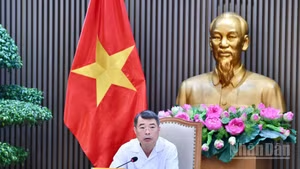
Minister of Education and Training Nguyen Kim Son affirmed that never before has the education sector received such strong attention and high expectations from the Party and the State. In this spirit, in implementing Resolution No. 71-NQ/TW, the Ministry of Education and Training has identified its central task as building and developing the teaching workforce as the core force and central pillar of educational reform, guided by the principle: “Quality as the axis – teachers as the key – technology as the lever”. On that basis, a wide range of tasks and solutions have been rolled out in a coordinated manner.
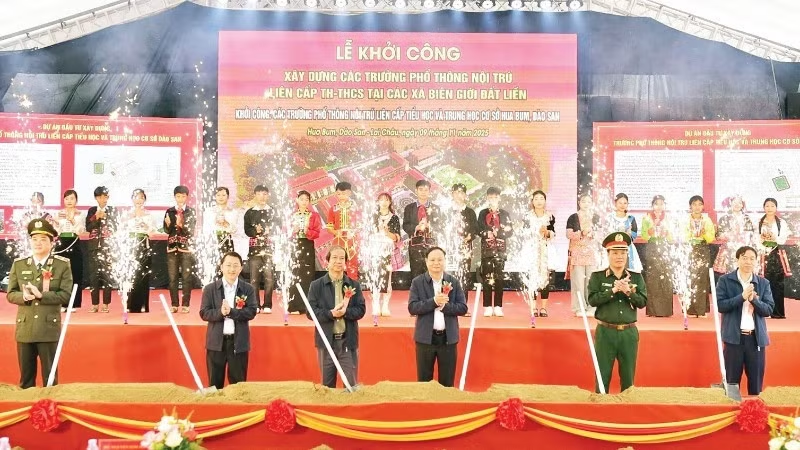
Alongside Resolution No. 71-NQ/TW, education-related social welfare policies continued to be prioritised in 2025, as the Politburo agreed on a number of major strategic guidelines and decisions, clearly reflecting a people-centred and socially equitable approach to education development. These include the decision to fully exempt tuition fees for students from pre-school through to the end of public upper secondary education nationwide; agreement in principle on the development of a National Target Programme for the modernisation and quality enhancement of education and training for the 2026–2035 period; and approval in principle for investment in the construction of 248 inter-level boarding schools for primary and lower secondary education in mainland border communes, with 100 schools to be completed in 2026.
Never before has the education sector received such strong attention and expectations from the Party and the State. In this spirit, in implementing Resolution No. 71-NQ/TW, the Ministry of Education and Training has identified the building and development of the teaching workforce as its central task, positioning teachers as the core force and pivotal factor in the cause of educational reform, under the guiding principle: “Quality as the axis – teachers as the key – technology as the lever”. From this orientation, numerous tasks and solutions have been implemented in a coordinated manner.
Minister of Education and Training Nguyen Kim Son
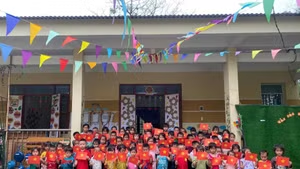
The commencement of construction of inter-level boarding schools for primary and lower secondary education in mainland border communes carries profound political, social, and humanitarian significance, affirming the care and commitment of the Party and the State to ethnic communities, teachers, and students in the nation’s “frontier areas”.
The year 2025 also marked a major step forward in making breakthroughs in building and refining the legal and institutional framework for education. For the first time, within a single year, the National Assembly passed four important bills in the field of education and training: the Law on Teachers; the Law amending and supplementing a number of articles of the Law on Education; the amended Law on Higher Education; and the amended Law on Vocational Education.
At the same time, the Ministry of Education and Training took the lead in advising and submitting to the National Assembly four resolutions: a resolution on universalising early childhood education for children aged three to five; a resolution on tuition fee exemptions and support for pre-school children, general education students, and learners in general education programmes within the national education system; a resolution on the investment policy for the National Target Programme on modernisation and quality enhancement of education and training for the 2026–2035 period; and a resolution on a number of special and exceptional mechanisms and policies to realise breakthroughs in education and training development. These measures constitute the “cornerstones” that lay a solid foundation and a coherent legal corridor for the operation of a modern and effective education system in the years ahead.
In line with the policy of streamlining and restructuring the organisational apparatus, the Ministry of Education and Training issued a series of guiding documents for localities on merging, consolidating, or transforming small-scale educational institutions that fail to meet minimum size requirements.
This streamlining has not only reduced administrative layers and recurrent expenditure, but, more importantly, has helped concentrate resources on professional activities and initially address the imbalance of teacher shortages and surpluses in many localities.
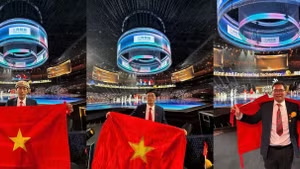
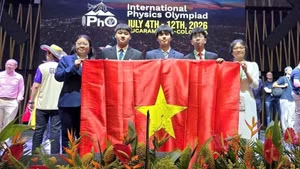
On the international stage, Vietnamese education continued to shine. In 2025, 100 per cent of Vietnamese contestants participating in international and regional Olympiads won prizes, bringing home 13 gold medals, 16 silver medals, and eight bronze medals. Notably, in its first-ever participation in the International Olympiad on Artificial Intelligence, Viet Nam ranked an impressive fourth among more than 60 countries. The Vietnamese delegation also achieved its best-ever results at the Regeneron International Science and Engineering Fair held in the US, winning two second prizes and one third prize. Alongside core academic subjects, Vietnamese students also left their mark in sports, music, and the arts, demonstrating diversity in talent identification and development.
In 2025, 100 per cent of Vietnamese contestants participating in international and regional Olympiads won prizes, bringing home 13 gold medals, 16 silver medals, and eight bronze medals. Notably, in its first-ever participation in the International Olympiad on Artificial Intelligence, Viet Nam ranked an impressive fourth among more than 60 countries. The Vietnamese delegation also achieved its best-ever results at the Regeneron International Science and Engineering Fair held in the US, winning two second prizes and one third prize.
The year 2025 also marked the completion of the full cycle of implementing the general education curriculum and textbooks from Grade 1 to Grade 12, achieving significant results in both breadth and depth, in line with the objectives of the new programme – a comprehensive reform at the general education level.
Against this backdrop, the 2025 upper secondary school graduation examination became an event of historical significance. The examination was held in the context of nationwide administrative restructuring and the implementation of the two-tier local government model.
This was the first year that students studying under the 2018 General Education Programme sat the graduation examination, while a separate set of examination papers was still maintained for students following the 2006 General Education Programme. The success of the examination affirmed the sector’s capacity for flexible “state transition” and the effective coordination across the entire education system.
Another strategic decision implemented during the year was the policy of using a single, unified set of textbooks nationwide from the 2026–2027 school year. Under the roadmap, by 2030, free textbooks will be provided to all students. This is a strategic orientation aimed at standardising general education content, ensuring equity in access to knowledge, and laying the foundation for digital transformation and the development of a national learning resources ecosystem.
Overall, 2025 stands out as a year in which major, breakthrough decisions with deep strategic significance converged. The achievements recorded – from institutional completion and social welfare assurance to tangible quality improvements – not only underscore the strong political determination of the Party and the State, but also demonstrate that Vietnamese education is entering a phase of comprehensive and sustainable reform, oriented towards human development and high-quality human resources to meet the demands of national construction and defence in a new era.