Immediately after the Resolution was issued, the education and training sector, together with localities and higher education institutions, has proactively implemented synchronous solutions to realise these strategic targets.
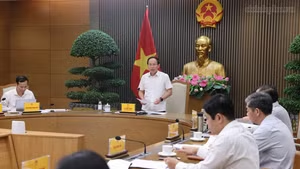
Standing Deputy Minister of Education and Training Pham Ngoc Thuong stressed that the Resolution was issued at a time when the country is entering a new stage of development, requiring education to become a driving force for sustainable development and a decisive factor in national productivity, quality, and competitiveness.
Education and training are identified as the top national policy, determining the future of the nation, and concretised through breakthrough viewpoints, goals, and solutions that are aligned with the requirements of international integration and comprehensive human development.
Education and training are identified as the top national policy, determining the future of the nation, and concretised through breakthrough viewpoints, goals, and solutions that are aligned with the requirements of international integration and comprehensive human development.
The Resolution identifies three key breakthroughs: renewing thinking, perfecting institutions, and mobilising resources. In terms of thinking, education is considered as the responsibility of the entire society, requiring unified awareness and action across the whole sector. In terms of institutions, the Ministry of Education and Training is coordinating efforts to finalise major draft laws and resolutions, creating a legal framework for open education, lifelong learning, decentralisation, and autonomy, closely linked with the application of information technology and artificial intelligence (AI).
Regarding resources, the state plays the leading role in investment while mobilising social resources, expanding the national scholarship fund, and attracting talent in basic sciences, key engineering fields, and strategic technologies.
The Resolution sets out specific targets until 2030, 2035, and a vision to 2045, including: 80% of general education schools and vocational education institutions meeting national standards; 100% of higher education institutions meeting national standards; at least eight universities ranked among the top 200 in Asia, and one university among the top 100 worldwide.
“Creating breakthroughs in education development is a political task of the whole sector. It requires cadres, Party members, teachers, and learners to act aggressively and concretely to bring the Resolution to life through practical results, and to create strong improvements in education quality and effectiveness,” Standing Deputy Minister Pham Ngoc Thuong affirmed.
With this spirit, higher education institutions have swiftly translated the Resolution’s orientations into clear action strategies suited to their contexts and strengths.
At Viet Nam National University, Ha Noi, many comprehensive and sustainable policies have been implemented to promote high-quality human resource development, international integration, and enhanced scientific research quality.
The Viet Nam National University, Ha Noi, has been at the forefront of implementing the Politburo’s resolutions on developing the intellectual workforce, fostering breakthroughs in science, technology, and digital transformation, laying the foundation to become an innovative university and one of the leading research universities in the region and the world.
The university is currently drafting an Action Plan to implement Resolution No. 71-NQ/TW and Resolution No. 281/NQ-CP of the Government on the action programme for implementing Resolution No. 71-NQ/TW. The plan sets the goal of becoming an elite, leading research university in Viet Nam, ranked among the top 500 universities worldwide, with at least two fields in the top 100 globally by 2030; and striving to enter the top 200 universities worldwide, with at least eight fields in the top 100 by 2045. In the same spirit, the University of Transport and Communications has also identified Resolution No. 71-NQ/TW as opening a historically significant transformation period for Vietnamese higher education.
Assoc. Prof. Dr. Nguyen Van Hung, Rector of the university, said that higher education must become an innovation ecosystem that nurtures talent, creates new knowledge, deciphers key technologies, and serves as a pillar for spreading the spirit of innovation, science, and quality to enterprises, communities, and the nation.
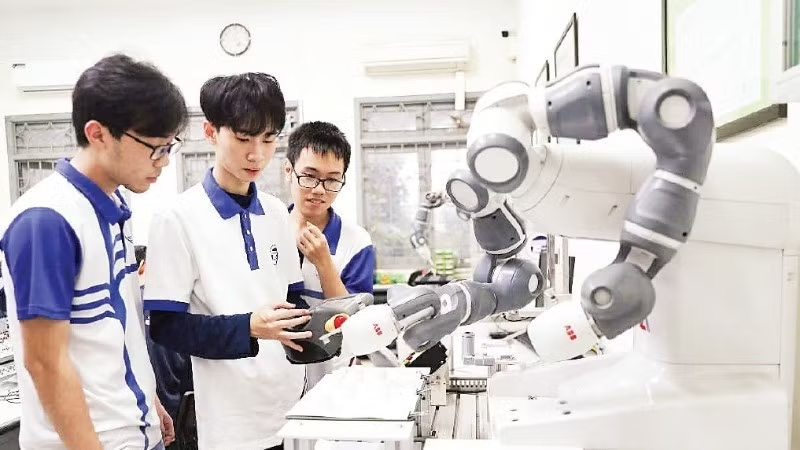
The University of Transport and Communications is synchronously implementing development tasks aligned with quality assurance in all areas, from upgrading facilities and organising training activities to improving human resource quality and perfecting governance mechanisms to create development momentum. The university is also expanding new training programmes that meet market demand, such as Robotics Engineering, Traffic Safety Engineering, Computer Science, and Smart Transportation Systems, along with workforce training programmes for the semiconductor industry, a key sector in the new development phase.
Minister of Education and Training Nguyen Kim Son emphasised that Resolution No. 71-NQ/TW reflects strategic vision and national development aspirations, while positioning education and training as a decisive factor for the nation’s future. The Resolution is action-oriented, practical, and feasible; it does not avoid existing challenges but focuses on breakthrough solutions and sustainable development.
According to the Minister, the foremost requirement is to change thinking and awareness about education and training. “Correct thinking and awareness lead to correct action, and only then can reality change. Renewing thinking and awareness about education will reposition the role and position of education in the overall development of the country,” he stressed.
Minister Nguyen Kim Son also noted that, for the first time, all education-related laws have either been newly promulgated or are being revised and supplemented. If conditions are favourable, all these laws will take effect on January 1, 2026. Along with this, guiding and directive documents will be issued, forming a fundamentally new institutional framework for education.
Therefore, raising awareness and changing thinking about the position of education and training in the country’s overall development, and creating consensus across the whole society, is important and necessary.
For localities, the minister called for a strong focus on leadership, direction, and thorough implementation of the resolution; and on developing specific, breakthrough policies and mechanisms for education and training development at the local level.
At the same time, they should pay attention to building teachers and facilities that meet standards; to improving the quality of preschool and general education; to enhancing the quality of human resource training, especially high-quality human resources; and further promoting international cooperation and integration in education and training.