On December 10, the Ministry of Education and Training stated that Law on amendments and supplements to several articles of the Law on Education has created a policy foundation that is both modern and flexible, oriented towards building an open, practical, substantive, and internationally integrated education system. Within this broader picture, several provisions are regarded as breakthroughs in policy thinking and design.
A unified national set of textbooks
A key highlight creating the “breakthrough” character of this amendment is the provision on a unified national set of textbooks. After implementing the policy of “one curriculum, multiple textbook sets”, positive outcomes have emerged, but various issues have also arisen that require adjustment. Resolution No. 71-NQ/TW of the Politburo mandates that the State ensure the provision of a unified set of textbooks nationwide, guaranteeing standardisation, stability, fairness, and quality.

The amended law adopts an open approach, allowing the Ministry of Education and Training to decide on either developing a new textbook set or selecting and revising existing sets, depending on practical conditions and the decisions of the competent authorities.
This provision ensures flexibility in implementation while maintaining the stability of the Law amid ongoing detailed study and assessments on organisational options.
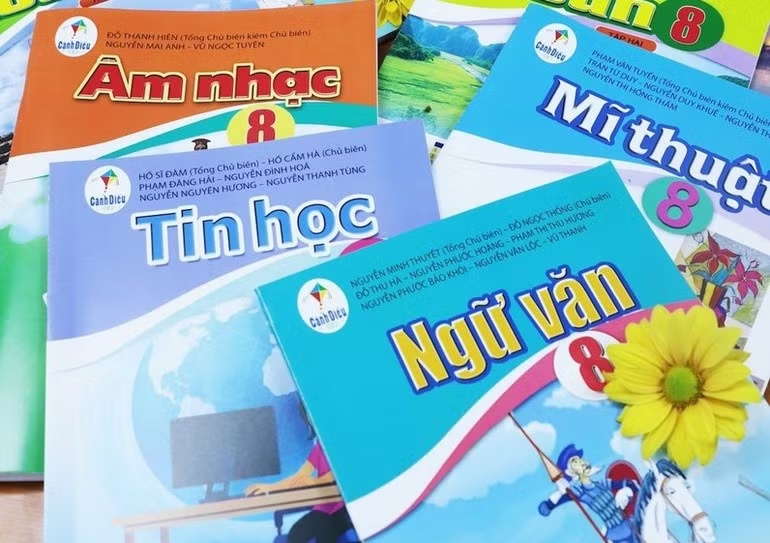
The Ministry of Education and Training is developing a plan for a unified national set of textbooks from the 2026–2027 school year, ensuring transparency, objectivity, cost-effectiveness, and the minimisation of waste; while inheriting and promoting the strengths of existing textbook sets, minimising disruption to teachers and students, and avoiding disturbances to teaching and learning activities.
The National Scholarship Fund expands learning opportunities and nurtures talent
The National Scholarship Fund is a completely new mechanism intended to broaden learning opportunities and nurture talent. In addition to annual State budget allocations, the Fund may receive legal sponsorships, voluntary contributions, and donations from organisations and individuals.
With a model similar to science and technology funds, the National Scholarship Fund will serve as a channel for strongly mobilising social resources, helping address the current shortage of scholarships relative to learner needs — particularly for gifted students or those in difficult circumstances.
New mechanisms added for scientific research, technology and innovation
Whereas the 2019 Law on Education only recognised science and technology activities as a task of educational institutions — without adequately reflecting development requirements in the new context or clarifying mechanisms, responsibilities, and specific powers — the amended law introduces a series of new mechanisms.
“This marks a major shift in policy thinking. For the first time, concepts such as innovation, controlled application of artificial intelligence, digital transformation in education, and national databases are legally defined,” the Ministry of Education and Training noted.
These new provisions help establish a legal corridor enabling the education sector to implement modern governance methods, enhance training quality, ensure transparent and effective management, and improve scientific research capacity within educational institutions.
Recognition of digital diplomas and certificates
Aligned with national digital transformation, the amended Law on Education has made a significant advancement by recognising diplomas and certificates within the national education system in either paper or digital form.
Recognising digital diplomas and certificates helps the education sector quickly improve transparent management systems, prevent forgery and fraud, and enable learners to easily verify and access their qualifications in accordance with international standards.
Notably, instead of issuing lower-secondary graduation certificates, the Law stipulates that learners who complete the lower-secondary education programme and meet the conditions set by the Minister of Education and Training will receive confirmation in their school records from the school principal or head of the educational institution.
This approach aligns with the orientation of compulsory lower-secondary education — similar to primary education, where no graduation certificate is issued but programme completion is confirmed — while reducing administrative procedures, avoiding unnecessary examinations, lowering pressure on students, and aligning with international practice.
Defining “educational support personnel”
Another significant policy highlight is the formal definition of “educational support personnel” within the national education system. In reality, for many years, positions such as librarians, equipment officers, social workers, and school counsellors have played essential roles in educational institutions, yet their duties, salary regimes, and allowances have not been adequately regulated.
As a result, educational institutions have faced difficulties due to the absence of a legal framework for this workforce, forcing teachers to assume multiple non-specialist tasks. The amended law formally defines “educational support personnel”, creating a basis for determining job positions, standardising duties, and forming appropriate remuneration policies. At the same time, it allows localities and educational institutions to develop additional special policies according to local conditions to attract and retain personnel, thereby improving support for learners.
Training in specialised arts, physical education and sports disciplines
The amended law also marks important progress in training for specialised disciplines in the fields of arts, physical education, and sports.
It empowers the Prime Minister to regulate enrolment age, training duration, and minimum study load to ensure flexibility and suitability for talent-based training. The Minister of Education and Training is also authorised to regulate the teaching of general education content in these specialised programmes. These provisions help resolve one of the major bottlenecks in training artistic and athletic talent, while creating favourable conditions for identifying and nurturing young talent.
Streamlining administrative procedures
The amended law revises Article 44 by empowering the Minister of Education and Training to regulate the implementation of lower-secondary education programmes and programmes leading to qualifications within the national education system at general education institutions, vocational education institutions, and higher education institutions — removing the previous requirement for approval from the competent State education authority. This reflects a shift from pre-check to post-check, reducing bureaucratic “permit–granting” procedures and facilitating flexible, integrated training models while maintaining quality assurance.
Beyond its policy contents, the amended law significantly contributes to administrative reform. According to the Ministry of Education and Training, around 55% of current administrative procedures in the education sector will be streamlined, with many provisions shifted from the Law to Government decrees to ensure both stability of the Law and policy flexibility.
The Law also strengthens decentralisation to local authorities in establishing educational institutions and carrying out management procedures, helping reduce the burden on central agencies, enhance governance effectiveness, and provide maximum convenience for learners, schools, and enterprises investing in education.