However, the sector also carries potential risks of negative impacts on the environment and human health. “Greening” the chemical industry is therefore both an inevitable requirement and a long-term task, aimed at improving efficiency and strengthening competitiveness in the market.
In practice, enterprises face numerous challenges in implementation, including technological constraints, high investment costs, and a lack of incentive mechanisms for investment and development. Meanwhile, major export markets are imposing increasingly stringent requirements on green origin and low carbon emissions.
Investment costs for green and clean technologies remain high. The technological level and management capacity of some enterprises have yet to meet requirements; technological innovation remains slow and heavily dependent on imported technologies.
In addition, awareness of green chemistry and sustainable development in some enterprises is still limited. Support mechanisms and policies such as green credit, tax incentives, support for technological innovation, and human resources training remain insufficient, creating barriers to business development.
To fulfil Viet Nam’s commitment to achieving net-zero emissions by 2050, Viet Nam National Chemical Group has issued a green transition programme for 2025–2030, with a vision to 2050.
By 2030, the group aims to reduce CO2 emissions by at least 5% compared with 2024 and raise the share of renewable energy to 5–10% of total energy consumption. By 2050, it targets a reduction of at least 20% in CO2 emissions and progress towards carbon neutrality, with renewable energy accounting for 20–30%.
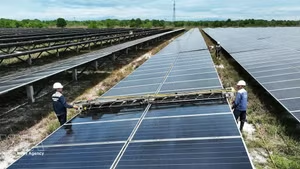
To achieve these goals, chemical enterprises have implemented various measures, including transitioning input fuels and materials; applying new technologies, equipment, and production processes; adopting circular economy models and waste recycling; installing rooftop solar power systems; using biomass energy; researching the partial replacement of coal with lower-carbon fuels such as liquefied natural gas (LNG); and exploring new fuels such as green ammonia and green hydrogen, in line with the national energy transition roadmap.
The sector is also stepping up research into carbon capture, storage, and utilisation, while piloting projects to generate carbon credits through fuel switching, renewable energy use, and afforestation.
The Party and the State have issued a range of important policies and guidelines, laying the groundwork for the green transformation of the chemical industry.
The 2025 Law on Chemicals marks a significant institutional step forward, providing a legal basis for promoting the development of the chemical industry and the circular economy.
It requires the application of green chemistry principles in the design and selection of technologies and production processes, and provides preferential mechanisms for key chemical projects that utilise renewable energy and clean technologies.
Nevertheless, chemical sector enterprises hope that the State will continue refining the institutional framework and introduce specific mechanisms and policies, including support for green credit, the mastery of clean technologies, enhanced international cooperation, and incentives for investors to develop green chemical projects and circular industrial parks.