Q: The impressive export results in 2025 suggest that reaching around 100 billion USD for the 2026–2030 period is feasible. How do you assess the 2025 outcome, and could you share the centre’s direction to achieve this goal?
Director Nguyen Minh Tien: 2025 delivered remarkable results for the agricultural sector, particularly in export turnover. While the Government’s target was 65 billion USD, the final figure reached 70.09 billion USD. Strong growth was also recorded in commodities such as coffee and fruit, with Vietnamese products gaining credibility in major markets including the US, China, and Europe.
This success reflects the collective efforts of the agricultural and environmental sector, farmers, cooperatives, businesses, and agencies, especially in the context amid administrative restructuring and the merger of the Ministry of Agriculture and Rural Development with the Ministry of Natural Resources and Environment.
Encouraged by these results, the Prime Minister has set a new target of 100 billion USD in agricultural exports in the coming years. This presents both opportunities and challenges. As the leading unit in market expansion, the Viet Nam Trade Promotion Centre for Agriculture must intensify trade promotion activities, create new value, and open fresh potential for the sector.
Facts show that the potential remains vast. In China, for instance, in recent years, exports have largely focused on southern provinces, while populous inland regions such as Yunnan, Hubei, Zhejiang, Shanghai, and Beijing remain underexplored. Consumer trends there increasingly favour high-value products, meaning competitiveness must now be built on quality and sustainability rather than price alone.
2025 delivered remarkable results for the agricultural sector, particularly in export turnover. While the Government’s target was 65 billion USD, the final figure reached 70.09 billion USD.
Climate change is also impacting agricultural supply worldwide in general and Viet Nam in particular, requiring the agricultural and environmental sector to provide proactive support for businesses, cooperatives, and farmers to adapt cultivation processes and seed breeding. This ensures both output and quality are maintained to meet export requirements.
Particularly, in the context of the global agricultural value chains are being restructured, we need to quickly adapt to major market shifts. Coffee illustrates this well: while Arabica once dominated, younger consumers now favour Robusta. In 2024–2025, Viet Nam’s Robusta exports commanded prices equal to or higher than Arabica, driving export revenue to 8.6–8.7 billion USD in 2025, a 52% increase from 2024. This trend highlights Viet Nam’s advantageous position.
Similarly, high-value fruits such as passion fruit, bananas, and jackfruit are entering a new growth cycle. Strategic product lines—coffee, aquaculture, and fruit—must be developed with added value, including emission reduction and green economy initiatives.
For example, Japan is willing to pay premium prices for rice grown under Viet Nam’s one-million-hectare low-emission rice project. Promoting such initiatives globally demonstrates Viet Nam’s proactive adaptation to climate change and commitment to sustainability.
Q: Could you share more about trade promotion and market expansion for the Halal market?
A: It can be said that The Halal market, with over 2 billion Muslim consumers, is expanding rapidly. While Viet Nam has tapped parts of the Middle East, Halal standards vary by country, posing challenges. Nonetheless, opportunities are immense.
Within ASEAN, Indonesia and Malaysia are key markets, while the Middle East offers vast potential.
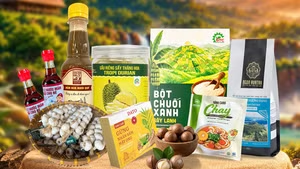
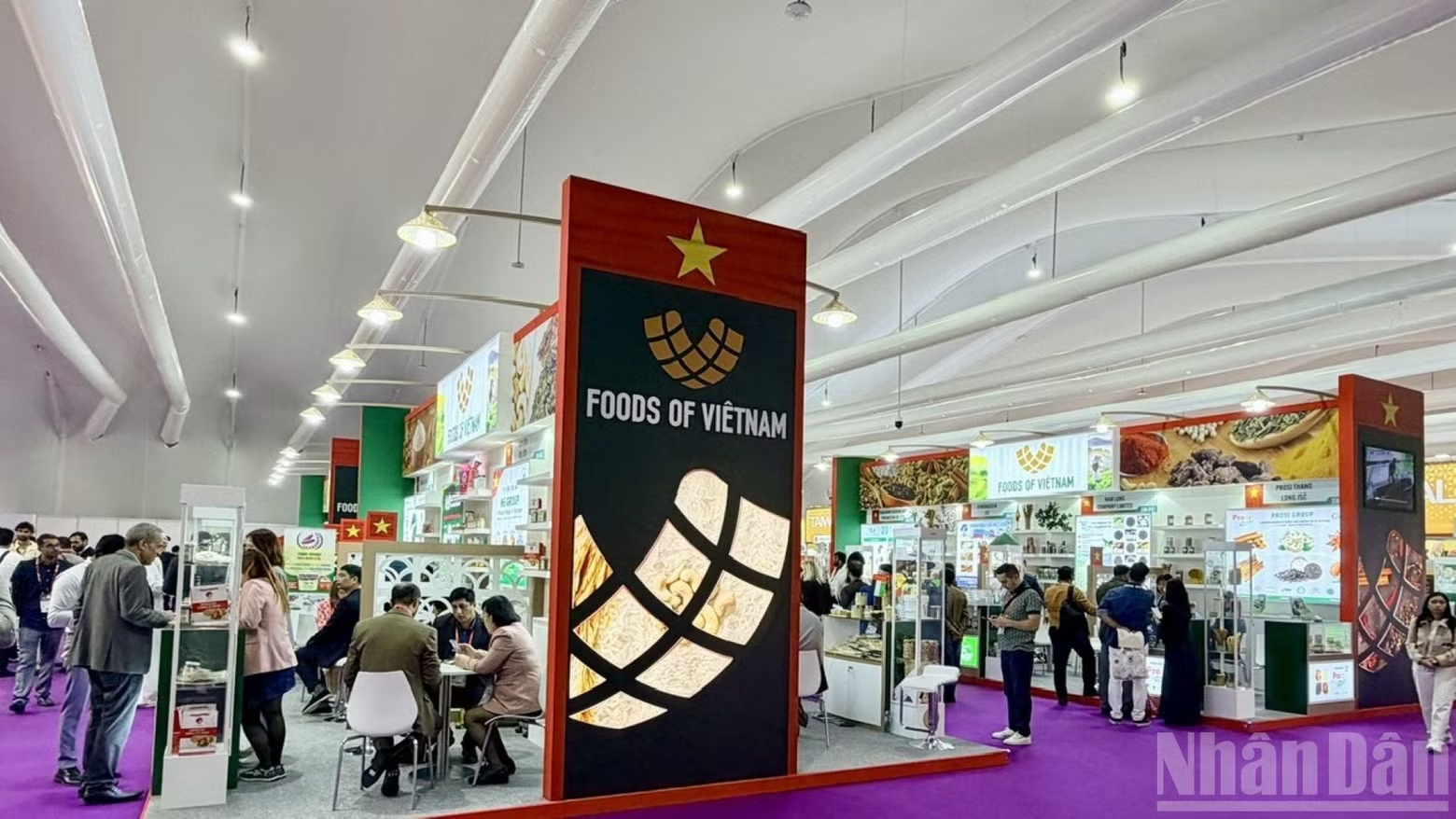
Given that situation, the Viet Nam Trade Promotion Centre for Agriculture is currently focusing on exploiting the Middle East market, for instance participating in the Gulfood – the world’s largest annual food & beverage trade exhibition – in Dubai, the United Arab Emirates, with an expanded presence highlighting nuts, rice, tea, and coffee.
The crucial task is ensuring compliance with diverse Halal standards, especially the Middle East market. Disseminating this knowledge to businesses and farmers will enable them to refine planting, harvesting, processing, and logistics to meet stringent requirements.
Over the next five years, the Centre will prioritise the Middle East and ASEAN. We hope that the Government will create further favourable conditions for the Ministry of Agriculture and Environment along with the Ministry of Industry and Trade and the Ministry of Foreign Affairs to further strengthen the presence of Vietnamese agricultural products in the Halal market, mainly in the Middle East and ASEAN regions.
Q: In your view, how will trade promotion and market opening contribute to achieving the 100 billion USD export target?
A: Trade promotion is central. We are determined to increase participation in major fairs and organise supply-demand connection sessions with distribution systems to boost visibility.
For example, Viet Nam plans to join Green Expo in Yokohama in 2027, affirming its commitment to green values and strengthening its reputation among Japanese consumers, who prize sustainability.
Recently, the Ministry of Agriculture and Environment signed several key protocols with China's General Administration of Customs (GACC) to continue opening doors for new agricultural products, such as jackfruit, passion fruit, and coconut. Previously, Vietnamese durian and bananas have also basically penetrated deeply into the Chinese market.
As the head of the Agricultural Trade Promotion Centre, I firmly believe Vietnamese products will continue to penetrate deeper into Chinese localities, offering businesses opportunities to expand both product and market scale.
Q: Market forecasting is always difficult. In your opinion, what needs to be done to strengthen advisory work and implement trade promotion activities to expand markets for Vietnamese agricultural products?
A: The greatest challenge lies in human resources. We must train personnel capable of meeting the demands of modern trade promotion, which now requires addressing high added value, green economy, and digital transformation.
Developing a skilled workforce to meet these dual transformation requirements is essential. Only then can the Viet Nam Trade Promotion Centre for Agriculture truly act as a bridge between businesses, cooperatives, and farmers, serving as a launchpad for Vietnamese agricultural products to reach the global market.
Thank you so much for sharing!