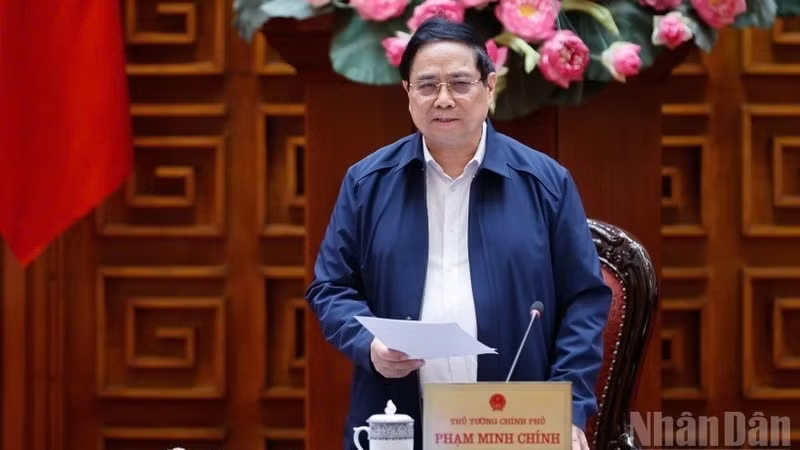
Prime Minister Pham Minh Chinh on March 18 requested ministries, sectors and localities to act more proactively, flexibly and effectively in implementing railway projects, stressing the need to swiftly resolve bottlenecks while closely following directions from the Politburo, the National Assembly and the Government.
Chairing a meeting of standing Government members in Ha Noi, the PM reviewed progress and urged faster implementation of a series of key railway projects, including the North–South high-speed railway, the Lao Cai–Ha Noi–Hai Phong line, planning for the Ha Noi–Lang Son and Hai Phong–Mong Cai routes, and urban railway systems in Ha Noi and Ho Chi Minh City.
The Government leader acknowledged improved progress since the seventh meeting of the Steering Committee for key national railway projects, noting that tasks have been carried out more effectively and proactively, and with greater efficiency.
He added that Ha Noi and Ho Chi Minh City have taken active and timely steps to advance their urban railway projects.
However, he stressed that ministries and localities must make greater efforts, enhancing proactiveness, flexibility and efficiency while addressing obstacles in line with higher-level directions to accelerate the project progress.
Looking ahead, the PM asked for urgent completion of railway standards, criteria and procedures based on international practices but tailored to Viet Nam’s conditions, ensuring uniform and coordinated implementation nationwide.
Projects must be carried out on schedule and in compliance with regulations, with quality improvements and adequate and well-controlled funding, he said, ordering strict inspection, supervision and auditing throughout implementation, with a firm stance against corruption, negative practices and vested interests.
Local authorities were urged to speed up land clearance and resettlement, ensuring affected residents enjoy better living conditions, with improved infrastructure, environment and livelihoods.
The Ministry of Construction and Viet Nam Railways Corporation were tasked with developing detailed plans for workforce training to meet development requirements.
The PM also emphasised the need to diversify funding sources, including public investment, private capital, public-private partnerships, loans and bonds, while avoiding waste. He ordered adopting the most advanced construction technologies to speed up progress and better the quality of projects.
For the North–South high-speed railway, the Ministry of Construction was asked to present clear recommendations on technology selection, develop standards and finalise the feasibility study as a basis for choosing investors, consultants and contractors.
Regarding the Lao Cai–Ha Noi–Hai Phong rail route, involved localities must expedite land clearance and complete the feasibility study in March while developing connecting infrastructure, the PM said.
Relevant localities were urged to support planning work for the Ha Noi–Lang Son rail line. Meanwhile, for the Hai Phong–Ha Long–Mong Cai route, procedures must be finalised to assign a local authority as the project’s managing agency, with support from the Ministries of Construction and Finance if needed.
Regarding urban rail routes in Ha Noi and Ho Chi Minh City, most obstacles have been addressed, but remaining issues must be removed promptly, with the Ministry of Finance assisting in handling challenges related to loan funding.
The PM said Ho Chi Minh City must give top priority to projects linking Long Thanh and Tan Son Nhat international airports with the city centre.
He added that for the Ben Thanh–Can Gio and Ha Noi–Quang Ninh lines, which are privately invested, relevant agencies must conduct inspections and supervision, and proposing appropriate mechanisms and policies to competent authorities.
The Ministry of Finance was assigned to expedite the restructuring plan for Viet Nam Railways Corporation, while the Ministry of Industry and Trade was asked to finalise procedures for approval of a railway industry development scheme in March 2026 and continue proposing relevant policy mechanisms.