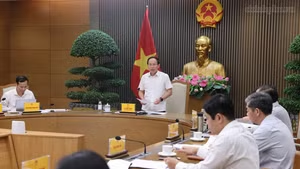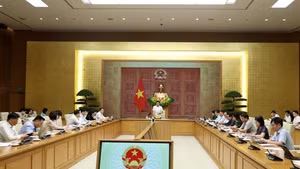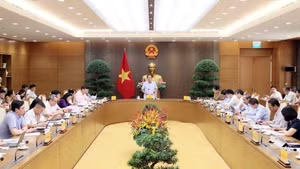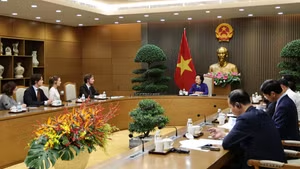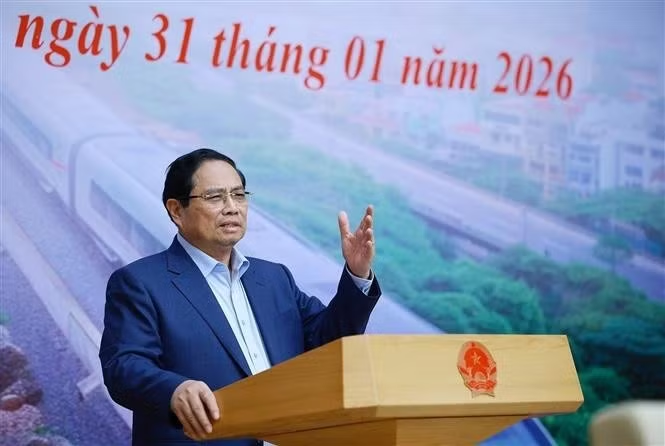
The meeting reviewed major projects, including Component Projects 1 and 2 of the Lao Cai–Ha Noi–Hai Phong standard-gauge railway; negotiations on a cross-border rail connection agreement with China; surveys and feasibility studies for the North–South high-speed railway; urban railways in Ha Noi and Ho Chi Minh City; and other lines such as Ben Thanh–Can Gio, Ha Noi–Bac Ninh, Yen Tu–Ha Long, and Lang Son–Ha Noi. Participants also discussed the development of a railway industrial complex, institutional and policy frameworks, workforce training, technical standards, technology selection, and investment models involving the State, enterprises, and public–private partnerships.
Since the fifth meeting on January 6, the PM, who is also head of the committee, and deputy prime ministers have assigned 36 tasks to ministries and localities to remove obstacles and speed up investment preparation. Most tasks are on schedule, with only one delayed due to procedures involving foreign partners. Key decrees guiding railway projects have been issued, while Ho Chi Minh City broke ground on Metro Line No.2 (Ben Thanh–Tham Luong) on January 15.
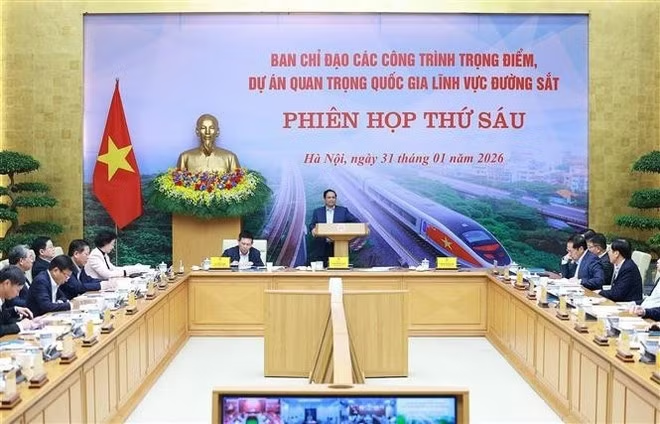
Concluding the meeting, PM Chinh called on ministries, sectors, localities, and steering committee members to act proactively within their authority, uphold self-reliance, and strictly apply the “six clarities”: clear responsibilities, tasks, timelines, accountability, outputs, and authority. He stressed resolute action, focusing only on implementation, not retreat.
Regarding land clearance, the PM instructed localities to step up the work, ensure lawful and fair compensation, improve resettled residents’ living conditions, and prevent corruption. He also directed coordination with the Ministry of Finance to secure funding.
For the Lao Cai–Ha Noi–Hai Phong railway, he ordered faster construction of Component Project 1, prompt completion of feasibility studies, timely selection of design consultants, acceleration of loan negotiations if needed, and progress in cross-border railway agreement with China. Localities were encouraged to take the lead in the Ha Noi–Lang Son and Hai Phong–Mong Cai lines.
On the North–South high-speed railway, PM Chinh underscored its urgency for achieving double-digit growth, urging rapid completion of pre-feasibility and feasibility studies, parallel land clearance, and consideration of all three investment models—State, private, and PPP—ensuring balanced interests.
He also highlighted urban rail development, called for national technical standards, and emphasised the “five transformations”: digitalisation, green growth, efficiency optimisation, smart governance, and harmonised interests.
The implementation of these projects is required to ensure benefits of the State, the people, and businesses, while must avoid corruption or negative practices, loss or waste of public assets, effort, or money.