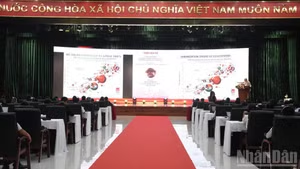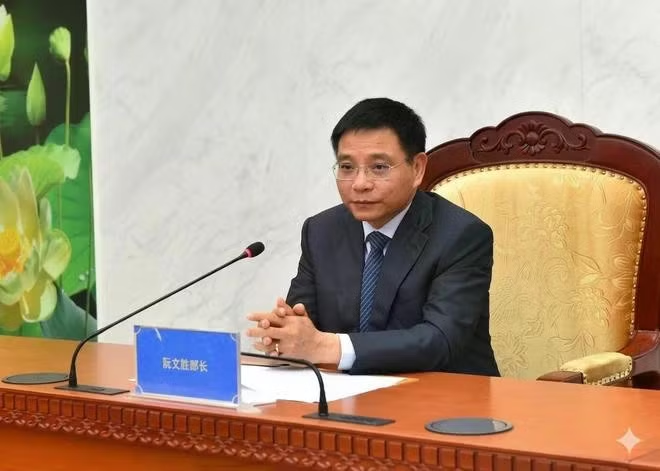
Vietnamese Minister of Finance Nguyen Van Thang held talks with Liu Jun, President, Vice Chairman and Executive Director of Industrial and Commercial Bank of China (ICBC) in Ha Noi on March 17 to discuss prospects for expanding bilateral economic cooperation, particularly in the financial and banking sectors.
At the meeting, Thang highlighted ICBC’s position as one of the world’s largest financial institutions and noted its longstanding presence in Viet Nam. He acknowledged the bank’s comprehensive engagement in financial services, including participation in government-guaranteed loans and the provision of payment services for infrastructure projects financed by preferential loans from China. These contributions have supported the steady development of Viet Nam–China economic ties, he said.
Outlining Viet Nam’s development strategy, the minister referred to the goals set by the 14th National Congress of the Communist Party of Viet Nam, which target achieving upper-middle-income status with a modern industrial base by 2030 and becoming a high-income developed country by 2045. To realise these ambitions, Viet Nam aims to mobilise up to 80% of development resources from domestic and foreign enterprises as well as the public, while making effective use of fiscal policy tools to attract international financial capital.
Against this backdrop, Thang emphasised that Viet Nam represents a highly attractive market for foreign investors and international banks. He encouraged ICBC to explore participation in the Viet Nam International Financial Centre by sharing capital, expertise and management experience to contribute to the country's development in general and its financial market in particular.
He also underscored the Vietnamese Government’s continued prioritisation of infrastructure development, particularly connectivity projects, as an area offering significant opportunities for ICBC to engage as a financing partner.
With Viet Nam–China trade relations expanding robustly, and Viet Nam offering increasingly competitive investment incentives, the country is expected to attract more Chinese enterprises. This, in turn, presents further opportunities for ICBC to support Chinese businesses operating in Viet Nam, especially in export credit services, he stressed.
For his part, Liu noted that ICBC currently holds total assets of approximately 140 trillion yuan (20.3 billion USD), ranking among the top global banks in both scale and profitability. The bank has cooperated closely with Vietnamese and Chinese partners in successfully launching cross-border QR code retail payment services, enabling consumers in both countries to make transactions in local currencies.
Both sides exchanged views on policy orientations and the role of finance in supporting key industries, major projects and improvements in the investment climate, while underscoring the importance of international resources in achieving Viet Nam’s long-term development goals.
Affirming Southeast Asia, including Viet Nam, as a strategic market, Liu pledged that ICBC will continue to bring its capabilities into full play to support projects in Viet Nam, thereby contributing to deepening Viet Nam–China economic relations.