Miss from the highlands excelling in agriculture
Located in the far northern highlands, Dong Van Commune in Tuyen Quang Province enjoys a cool climate well suited to the cultivation of temperate fruit trees and valuable medicinal plants. Although the area available for farming is limited, the land has been largely untouched by industrial chemicals, making it ideal for clean and organic agriculture.
Recognising these advantages, Luu Thi Hoa, a Farmers’ Union member from Hamlet 2, boldly embarked on a business venture based on clean, locally sourced agricultural products. Few people know that the farmer, born in 1992, graduated from the University of Social Sciences and Humanities under the Viet Nam National University, Ha Noi, and was crowned Miss of the first Highland Plateau Beauty Contest.
After earning a degree in International Studies, she decided to return to her hometown. “My father is from the Co Lao ethnic group and my mother is from the Pu Peo ethnic group. I wanted to use my knowledge and youthful energy to contribute to the development of my homeland and create more jobs for people in the highlands,” she said.
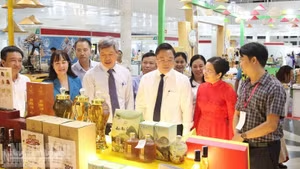
Following graduation in 2015, she became involved in various activities supporting agricultural product distribution to gain practical experience. In 2017, she began developing two flagship products: mint honey and Ha Giang speciality pears. By 2019, her production and business model had expanded to include more than 2,000 perennial fruit trees and a range of local specialities such as walnuts and seasonal vegetables.
In addition to selling products through e-commerce platforms, she has introduced them to online 3D storefronts to enhance customer experience. Her business now provides regular and seasonal employment for dozens of workers, with average incomes of nearly 5 million VND per person per month. As a member of the Executive Committee of the Tuyen Quang Farmers’ Union, she actively shares her production experience with local farmers.
From a bicycle selling fish sauce door to door
In Tinh Gia Ward of Thanh Hoa Province, Ms Le Thi Lieu’s seafood-processing facility now provides employment for nearly 100 workers, with some earning tens of millions of dong each month. Few would imagine that the enterprise, which occupies thousands of square metres and generates annual profits of around 2.5 billion VND, began with nothing more than a bicycle.
Born into a family with a long tradition of working at sea, Lieu became familiar with the seafood trade from an early age. In 2003, following an exceptionally abundant anchovy harvest, she decided not to sell all the catch fresh but instead experiment with producing fermented seafood products, including shrimp paste, fish sauce and fermented fish paste.
Lacking capital, she personally delivered and sold the products using an old bicycle. The image of a woman travelling from village to village carrying jars of fish sauce gradually became a familiar sight. As the quality of her products gained recognition, her market steadily expanded.
Today, her family has developed seven products recognised under the One Commune One Product (OCOP) programme. The business has adopted the HACCP food safety management system, upgraded its packaging and established dedicated bottling and packing facilities to ensure food safety standards.
Beyond business development, she has provided more than 400 million VND in interest-free loans to 50 local households to help them expand production. Each year, the company also contributes between 100 million VND and 150 million VND to charitable and social welfare activities.
Ensuring the role of a “companion to farmers”
According to Bui Thi Thom, Vice-President of the Viet Nam Farmers’ Union, despite global instability, changes in tariff and import policies, as well as adverse impacts from natural disasters and disease outbreaks, Viet Nam’s agricultural sector has continued to affirm its role as a pillar of the national economy, achieving new export records.
Vietnamese farmers are increasingly demonstrating their role as the central actors in agricultural development, rural economic growth and new-style rural development. The work of the Viet Nam Farmers’ Union and farmers’ movements has continued to achieve important results and notable breakthroughs, with 16 out of 18 targets being met or exceeded. Several particularly challenging targets were surpassed by a wide margin.
At the same time, efforts to streamline and consolidate the organisational structure and personnel of Farmers’ Union bodies at all levels have been carried out decisively and comprehensively. Preparations for Farmers’ Union congresses at all levels for the 2025–2030 term were completed on schedule and to a high standard.
The Union’s content and methods of operation have been renewed in creative ways, shifting from simple mobilisation towards guidance and support. Farmers’ movements have been organised more effectively and practically, combining broad participation with deeper impact while emphasising quality. The Union’s core role in building a strong farmer class has become increasingly evident, while the quality of membership, political awareness, production and business skills of farmers have improved, alongside their material and spiritual well-being.
Viet Nam’s economy is transitioning towards digital, green and circular economic models. Rapid advances in science, technology and innovation are opening up unprecedented opportunities for breakthroughs while simultaneously reducing the advantages traditionally associated with low-cost labour.
Deeper international integration offers opportunities to absorb knowledge, expand production and business activities, and access export markets. At the same time, it poses challenges relating to competitiveness, agricultural product quality and the limitations of small-scale, traditional production models.
These intertwined opportunities and challenges require Farmers’ Union organisations at all levels to rise to new heights and contribute to the country’s rapid and sustainable development in the new era. The Union must become leaner in structure, stronger in political resolve, organisation and action, serving as the core force of farmers’ movements and the building of the farmer class. It must place members and farmers at the centre—as the subjects, objectives and driving force of innovation in its activities—while fulfilling its role as a trusted companion to farmers.
During the previous period, the Viet Nam Farmers’ Union received approval from the Prime Minister for four major projects: participation in developing agricultural collective economic models through 2030; training Farmers’ Union officials, grassroots leaders and outstanding farmers for the 2025–2030 period; consolidating the organisation and operations of the Supporting Fund for Farmers; and promoting the production and business of safe agricultural products and food for community health during the 2026–2030 period.
These initiatives provide a solid foundation, as well as the motivation and institutional framework, for Farmers’ Union organisations at all levels to achieve breakthroughs, renew their activities and strengthen farmers’ movements in this new era of national advancement.