However, to overcome challenges related to logistics costs, raw material resource, labour, and technical barriers to successfully achieve the target of double-digit growth in 2026, the seafood industry cannot rely solely on its existing strengths. It must also unlock constrained resources, release production capacity, and gradually enable the private sector to become a strong and sustainable driver of growth.
Key product lines affirm their position
During the first six months of the year, shrimp remained the leading export product of Viet Nam's seafood industry. Cumulative shrimp export turnover in the first six month reached 2.3 billion USD, up more than 13% year on year, accounting for 40% of the industry's total export value. Shrimp is expected to remain a key driver in helping the seafood industry achieve its export target in 2026.
Pangasius remained the second-largest export product, generating 1.1 billion USD in export revenue during the first half of the year, marking an increase of more than 12% over the same period in 2025 and accounting for nearly 20% of total seafood export turnover. This increase reflects continued demand for reasonably priced whitefish, as consumers in many countries continue to reduce spending. Seafood experts believe Vietnamese pangasius maintains advantages in terms of price, stable supply, and flexible processing, making it suitable for a wide range of distribution channels.
During the first six months of the year, shrimp remained the leading export product of Viet Nam's seafood industry. Cumulative shrimp export turnover in the first six month reached 2.3 billion USD, up more than 13% year on year, accounting for 40% of the industry's total export value. Shrimp is expected to remain a key driver in helping the seafood industry achieve its export target in 2026.
Growing demand across many import markets, including the key US market, has helped Vietnamese seafood exports exceed 1 billion USD in June, an increase of around 20% compared with the same period last year. However, Le Hang, Deputy Secretary General of the Viet Nam Association of Seafood Exporters and Producers (VASEP), said that the double-digit export growth recorded during the first half of the year was driven by recovering consumer demand. This also reflects Vietnamese enterprises' ability to adjust their markets and product structure while making better use of geographically advantageous export markets.
Although the positive results achieved during the first half of the year have created a favourable foundation for achieving the full-year growth target, businesses remain cautious, as uncertainties are expected to increase during the second half of the year. According to seafood enterprises, the main pressure is no longer coming from market demand but is increasingly related to transport costs, raw material sources, and labour.
Removing "bottlenecks" to accelerate business growth
Many experts believe that institutional reform, reducing business conditions, and unlocking resources for enterprises are essential to achieving high growth target in the coming period. Nguyen Hoai Nam, Secretary General of VASEP, said that Viet Nam is currently among the world's top three seafood exporting countries.
In 2026, the industry aims to achieve seafood exports of more than 12 billion USD, an increase of around 10–11%. However, to reach this target, businesses require coordinated solutions to address bottlenecks relating to labour, maritime transport costs, and procedures for certifying export raw materials.
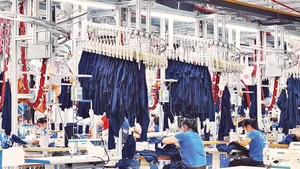
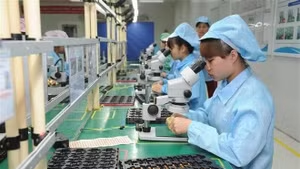
More specifically, Phan Van Tam, Deputy General Director of Minh Phu–Khanh An Seafood Processing Company Limited in Ca Mau Province, said that the company is currently facing difficulties in recruiting workers, with demand for around 3,000 unskilled workers to operate at full production capacity. As labour shortages have forced production lines to operate below capacity, the company has proposed that the Ca Mau provincial authorities introduce measures to support the recruitment of unskilled workers.
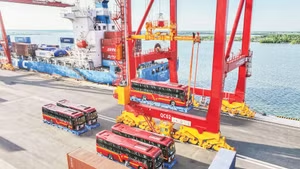
As export orders continue to increase, logistics costs remain a major challenge for seafood exporters. International container freight rates are now approaching their highest levels in almost two years. At the same time, stronger demand from US importers, driven by concerns over possible new tariffs, has caused the year-end import season to begin earlier than usual.
With approximately 1 million export containers shipped each year, rising logistics costs will significantly reduce businesses' value-added margins, particularly for long-distance shipments to the US and the European Union (EU), where additional surcharges are more likely to arise. Furthermore, seafood export-related procedures and regulations also need to be simplified to fully utilise Viet Nam's seafood processing capacity.
Nguyen Hoai Nam noted that some enterprises have purchased hundreds of tonnes of raw materials and stored them in warehouses. In practice, they often encounter difficulties with the raw material verification procedures when preparing export documents. If these bottlenecks are resolved, the seafood industry will have greater room for develop and make a stronger contribution to the overall growth targets of the agricultural sector and the national economy.
Regarding the global container shipping market in the coming months, VASEP has advised businesses to closely monitor freight rates on individual shipping routes, proactively book shipping space, and diversify their shipping partners. Companies should also develop flexible logistics plans, prepare contingency scenarios, and regularly update market information to minimise supply chain risks.
Au Anh Tuan, Deputy Director General of the General Department of Viet Nam Customs, said that the government's reform policies — such as reducing administrative procedures, simplifying business conditions, and promoting digital transformation — have helped to reduce costs, improve competitiveness, and facilitate export activities. The customs sector is accelerating data connectivity with domestic agencies and international partners to reduce compliance costs for businesses while ensuring transparency, effective control, and the prevention of trade fraud. Customs authorities are also reviewing all regulations relating to animal and plant quarantine and food safety inspections in order to eliminate unnecessary procedures and thereby reduce both time requirements and costs for businesses.
To further strengthen seafood exports in the coming time, Dr Nguyen Si Dung, former Vice Chairman of the National Assembly Office, said that instead of focusing on increasing production volume, the seafood industry should increase added value through deep processing and better utilisation of by-products based on the circular economy model. The strategy of "global raw material sourcing" is regarded as a breakthrough approach. By making full use of its world-leading capacity for value-added seafood processing, the industry can import high-quality raw materials from other countries for deep processing and re-export, enabling faster capital turnover and optimising factory capacity.
The positive performance of seafood exports during the first six months of the year has laid a solid foundation for achieving double-digit growth targets in 2026. If existing bottlenecks are addressed promptly, the target of more than 12 billion USD in seafood exports will represent a new historic milestone, marking the transition of Viet Nam's seafood industry to a higher-quality stage of development based on greater added value, technological innovation, and sustainable growth.