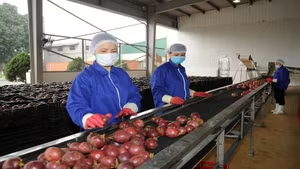
However, to achieve the target of double-digit growth in the coming years, exports will need to gather greater momentum, particularly as global trade comes under mounting pressure.
Viet Nam's exports remain heavily dependent on a limited number of key markets and product groups, making them vulnerable to economic fluctuations and changes in international trade policies. Meanwhile, the domestic value added of many export products remains modest due to the heavy reliance on imported materials and components.
Mounting pressures
Seafood exports emerged as a bright spot in the first half of the year, with export turnover estimated at 5.7 billion USD, up 11% year-on-year. However, growth began to lose momentum in the second quarter amid market volatility in the US, Viet Nam's key export destination, where tuna exports fell by 8–10%.
Commenting on the challenges ahead, Nguyen Hoai Nam, Secretary General of the Viet Nam Association of Seafood Exporters and Producers (VASEP), said the rising trend of trade protectionism was eroding the benefits derived from free trade agreements (FTAs).
In the US, in addition to trade defence measures such as anti-dumping and anti-subsidy duties on shrimp, new regulations and legislation with a greater tendency to restrict imports have also emerged. At the same time, three domestic bottlenecks — labour shortages, limited access to finance and rising costs — are hampering the growth efforts of most businesses as the Government strives to achieve double-digit economic growth.
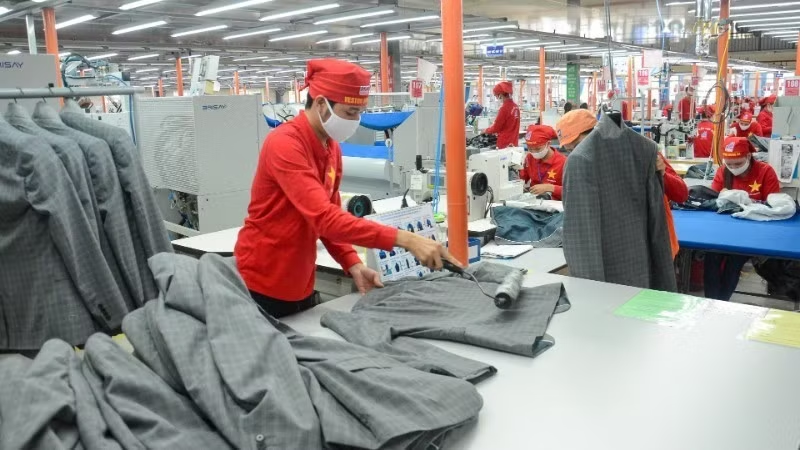
As one of Viet Nam's key export industries, the textile and garment sector recorded export turnover of nearly 19 billion USD in the first half of the year. Behind this encouraging figure, however, businesses are facing mounting pressure as rising input, logistics and compliance costs continue to erode profit margins.
The global competitive landscape is also shifting and becoming increasingly intense. Low-cost labour is no longer the industry's core competitive advantage. Instead, competitiveness now depends on the ability to meet delivery deadlines, ensure raw material traceability and comply with Environmental, Social and Governance (ESG) standards.
Truong Van Cam, Vice Chairman and Secretary General of the Viet Nam Textile and Apparel Association (VITAS), acknowledged that the industry's heavy dependence on imported raw materials and accessories, which account for 60–70% of total inputs, is preventing many businesses from fully benefiting from trade agreements such as the EU–Viet Nam Free Trade Agreement (EVFTA) and the Comprehensive and Progressive Agreement for Trans-Pacific Partnership (CPTPP). Since the beginning of the year, the sector has spent more than 13 billion USD on importing raw materials, including 5.53 billion USD worth of fabric from China alone.
Exports in the first half of the year continued to provide a solid pillar of support, demonstrating the resilience and adaptability of the economy amid a subdued global economic environment. Nevertheless, the outlook for the remainder of the year remains challenging, with weak demand in major markets, intensifying competition and falling commodity prices weighing on growth prospects.
Nguyen Thu Oanh, Head of the Department of Service and Price Statistics under the National Statistics Office of the Ministry of Finance
According to Nguyen Thu Oanh, Head of the Department of Service and Price Statistics under the National Statistics Office of the Ministry of Finance, exports in the first half of the year remained a key pillar of the economy, reflecting its resilience and adaptability despite a sluggish global economy. She noted, however, that the second half of the year would present significant challenges, as demand in major markets has yet to recover, competition remains fierce and declining commodity prices continue to weigh on growth.
Moreover, Viet Nam's exports remain heavily concentrated in a limited number of markets and product categories, while the proportion of domestic value added remains low. The expansion of trade defence measures and technical barriers is also increasing risks for exporters. At the same time, persistently high global interest rates and soaring logistics costs are putting pressure on exchange rates, imported inflation and supply chain stability.
A comprehensive policy response
One notable feature of the trade picture in the first half of the year was the trade deficit of 16.65 billion USD, compared with a trade surplus of 7.95 billion USD in the same period of 2025.
Explaining this development, Tran Thanh Hai, Deputy Director General of the Agency of Foreign Trade under the Ministry of Industry and Trade, said the main reason was the sharp increase in imports of electronics, computers and components, as well as machinery, equipment, tools and spare parts, which together accounted for around 51% of total import turnover. These imports mainly consisted of machinery, equipment and production materials. Imports of other raw materials, including steel, chemicals and materials for the textile, garment and footwear industries, also increased significantly.
He acknowledged that a trade deficit would inevitably have a certain impact on gross domestic product (GDP).
However, as most imports consist of production materials and equipment, they are expected to provide an important foundation for expanding production capacity and boosting exports in the coming period. In addition, pressure on foreign exchange has been effectively eased by strong inflows of foreign direct investment (FDI), remittances and tourism revenue, helping to keep the overall situation under control.
In response to these developments, the Ministry of Industry and Trade will continue to work closely with relevant ministries and agencies to monitor the situation and adopt timely, flexible policy measures.
To sustain strong export growth in the second half of the year, the ministry will implement a range of key measures.
First, it will help businesses make full use of free trade agreements, particularly by translating opportunities arising from the recently concluded FTA negotiations with the European Free Trade Association (EFTA) into tangible commercial benefits.
Second, it will step up trade promotion activities while working to remove obstacles in key export markets. Third, it will strengthen efforts to combat trade fraud and origin fraud by enhancing inspections and verification of product origin, especially for billion-dollar export categories.
Fourth, it will closely monitor market developments to manage imports of energy and fuel more flexibly, preventing large-scale imports when global prices are at their peak in order to safeguard import values.
With the country's total import-export turnover now exceeding 900 billion USD, improving logistics capacity to reduce costs has become more urgent than ever.
With the country's total import-export turnover now exceeding 900 billion USD, mproving logistics capacity to reduce costs has become more urgent than ever.
Tran Tien Dung of the Viet Nam Logistics Business Association (VLA) pointed out that the national merchant fleet has yet to develop in line with its potential. Vietnamese shipping companies continue to operate mainly on short regional routes, meaning that only a small proportion of the country's import and export cargo is carried by vessels flying the Vietnamese flag.
The VLA has therefore called on the Government to adopt stronger policies to encourage businesses to invest in their own fleets and operate international shipping routes directly, rather than primarily leasing vessels to foreign shipping lines.
Referring to the Republic of Korea's successful experience, supported by substantial State funding, Dung said the model could provide valuable lessons for Viet Nam's maritime transport sector, enabling it to expand its global presence and strengthen its position in international shipping.
According to experts, exports are expected to remain a major driver of economic growth in the coming period as orders recover in manufacturing, agriculture, seafood processing and labour-intensive industries, thereby supporting production, logistics and employment.
Nevertheless, close attention should be paid to the trade deficit. If imported inputs are swiftly channelled into production and exports, they will reinforce economic growth. Conversely, a prolonged trade deficit would reduce the contribution of net exports.
At the same time, proactively developing response strategies to increasingly stringent technical barriers and trade defence investigations has become essential to safeguarding Viet Nam's export achievements.