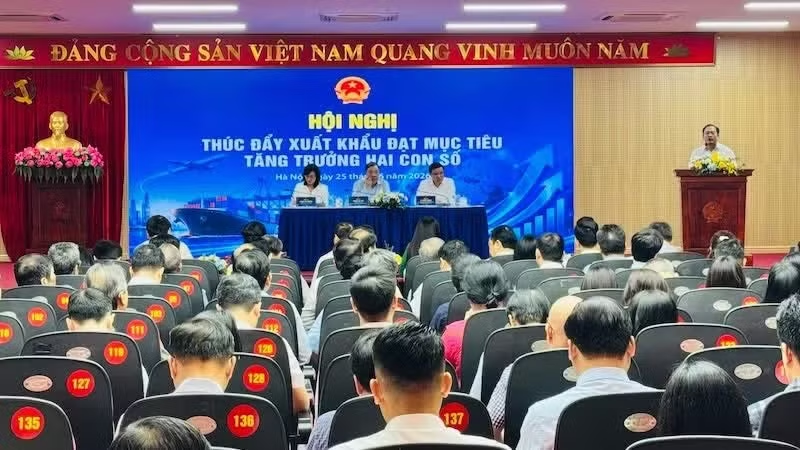
Speaking at a conference on promoting exports to meet the double-digit growth target, Tuc stressed that export promotion remains one of the most important drivers for fulfilling the development goals set in the Resolution of the 14th National Party Congress and others issued by the Party Central Committee, and its Politburo and Secretariat.
He noted that Viet Nam’s economy is facing increasing external challenges amid rapid and unpredictable global developments, including tensions in the Middle East and trade and tariff policy changes in major economies, particularly the US. These factors have created headwinds for both global growth and Viet Nam’s export – import activities.
Despite the uncertainties, the Government remains committed to achieving GDP growth of at least 10% in 2026 as part of its broader strategy to maintain double-digit growth over the next five years, he said.
To support export expansion, the Permanent Deputy PM asked the Ministry of Industry and Trade to work closely with ministries, sectors and localities to closely monitor market developments and regularly update production, business and trade data in order to make timely and effective policy responses.
He identified seven priority areas for action, including removing bottlenecks affecting production resources and sectoral development; improving compliance with technical standards, traceability rules and sustainable development requirements; and addressing challenges related to finance, logistics and export-supporting infrastructure.
The others are accelerating administrative reforms to reduce compliance costs for businesses; strengthening market development, trade promotion and early-warning systems; enhancing coordination among ministries, localities, business associations and enterprises; and improving import – export management and analysis.
Tuc also urged the State Bank of Viet Nam to maintain proactive and flexible exchange-rate governance to support growth and ensure macroeconomic stability. He called for stronger monetary and banking connectivity in line with international law to aid investment and trade ties with foregn partners, as well as for expanded access to credit for businesses and households to stimulate production and import – export activities.
For business associations and enterprises, he emphasised the need to modernise governance practices, embrace advanced technologies and improve product quality and branding. He also encouraged firms to proactively meet new requirements in export markets, particularly those regarding traceability, the circular economy, green growth and sustainable development.
At the conference, Minister of Industry and Trade Le Manh Hung reported that Viet Nam’s exports remain resilient despite slowing global trade growth, which is forecast to ease to 1.5–2.5% from about 4.7%.
By mid-June, Viet Nam’s export turnover had reached nearly 240 billion USD, up more than 21% year-on-year and exceeding the annual growth target. Imports rose faster, increasing over 33% to more than 256 billion USD, resulting in a trade deficit of approximately 16.8 billion USD.
However, Hung said the deficit largely reflects expanding production capacity rather than rising consumption. Nearly 88% of imports consist of machinery, equipment, raw materials, energy products and components serving manufacturing activities.
He noted that major global corporations, including Samsung, LG, Foxconn, Lenovo and BYD, are scaling up operations in Viet Nam, reinforcing the country’s position as a key destination in the restructuring of regional and global supply chains.
According to the ministry, the long-term objective is not only to accelerate export growth but also to transform export expansion into stronger national production capacity.