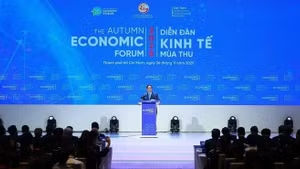
On June 12, in Ho Chi Minh City, the Import-Export Agency under the Ministry of Industry and Trade organised a seminar entitled “Opportunities and Solutions to Promote Exports of Key Commodities to Middle Eastern and South Asian Markets in the Context of New FTAs”, attracting representatives from industry associations, exporting enterprises and international trade experts.
New-generation FTAs create new growth space
Opening the seminar, Tran Thanh Hai, Deputy Director General of the Import-Export Agency under the Ministry of Industry and Trade, said that the Middle East and South Asia have long been regarded as highly promising markets for Vietnamese products. However, it was not until the 2024–2026 period that this potential began to be fully realised through a series of major advances in trade institutions.
The Viet Nam-Israel Free Trade Agreement (VIFTA) came into force at the end of 2024 and began implementation in early 2026. More notably, the Comprehensive Economic Partnership Agreement (CEPA) between Viet Nam and the United Arab Emirates officially entered into force on February 3, 2026, becoming Viet Nam’s first FTA with a Gulf country.
At the same time, preparations for negotiations on a free trade agreement between Viet Nam and the Gulf Cooperation Council (GCC), along with the review and upgrading of the ASEAN-India Trade in Goods Agreement (AITIGA), are expected to further expand market access opportunities for Vietnamese exports.

Tran Thanh Hai emphasised that, for the first time in trade history, Vietnamese products can access the UAE market with extensive tariff preferences, opening a gateway to the Middle East region, home to more than 400 million people and a combined GDP exceeding 4 trillion USD.
Under CEPA commitments, the UAE will eliminate tariffs on nearly 95% of tariff lines for Vietnamese goods. Beyond being a large consumer market with strong purchasing power, the UAE is also regarded as a major logistics hub connecting the Middle East, Africa and South Asia.
Experts at the seminar noted that tariff preferences are only a necessary condition. The sufficient condition for successfully utilising new FTAs lies in businesses’ ability to meet increasingly stringent technical requirements.
To benefit from CEPA tariff preferences, enterprises must fully comply with rules of origin stipulated in Circular No. 24/2026/TT-BCT. Many products are required to satisfy tariff classification change criteria or achieve a regional value content of at least 35% of the ex-works price, accompanied by valid certificates of origin.
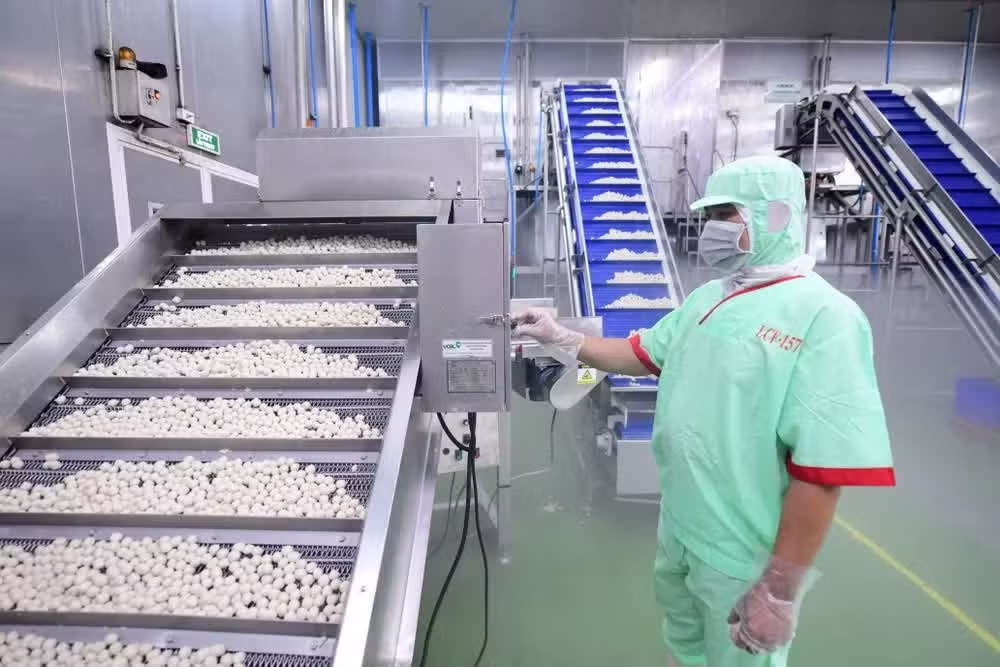
According to Hai, although this may appear straightforward, many businesses still face difficulties in meeting and proving compliance with origin requirements.
“Negotiating FTAs is only the first step. Their actual effectiveness depends on enterprises’ ability to take advantage of them. This requires thorough preparation, from production processes and traceability systems to compliance with importing countries’ standards,” he stressed.
In addition to rules of origin, businesses must also address specific technical standards, distribution systems and consumer preferences in each market across the region.
Halal Becomes an Essential “Passport”
One of the topics receiving significant attention at the seminar was Halal certification requirements for food exports. The Middle East and South Asia are currently at the centre of the global Halal market, with consumer spending exceeding 2.7 trillion USD in 2024 and continuing to grow at an annual rate of 8–9%.
Although Viet Nam possesses strong advantages in agricultural and food products, exports of Halal-certified agricultural and seafood products to the Middle East currently amount to only around 700 million USD, a modest figure relative to market potential.
Experts noted that in the UAE, Halal certification is not merely a competitive advantage but a mandatory requirement for products to enter the market. Products lacking Halal certification recognised by UAE authorities are not permitted to clear customs.
Similarly, other countries in the region, including Saudi Arabia, Indonesia and Malaysia, operate their own Halal certification systems and rigorous inspection procedures.
To support businesses, Viet Nam is gradually developing a national Halal ecosystem through the National Halal Industry Development Project to 2030, the establishment of a National Halal Certification Centre and the development of national Halal standards.
Vietnamese spices strengthen their position in Middle East and South Asia
Among Viet Nam’s key export sectors, pepper and spices are considered to have substantial growth potential in the Middle East and South Asia. According to figures presented at the seminar, Viet Nam’s pepper and spice exports reached more than 2.1 billion USD in 2025, the highest level ever recorded. In the first five months of 2026 alone, exports of these products exceeded 982 million USD, an increase of 9.5% compared with the same period last year.
Notably, Viet Nam currently accounts for approximately 60% of pepper imports into the Middle East and supplies up to 90% of cinnamon demand in South Asia, particularly in India and Bangladesh.
With more than 111,000 hectares of pepper plantations, around 200,000 hectares of cinnamon cultivation, nearly 200 exporting enterprises and hundreds of thousands of farming households, Viet Nam has established itself as one of the world’s leading spice suppliers.