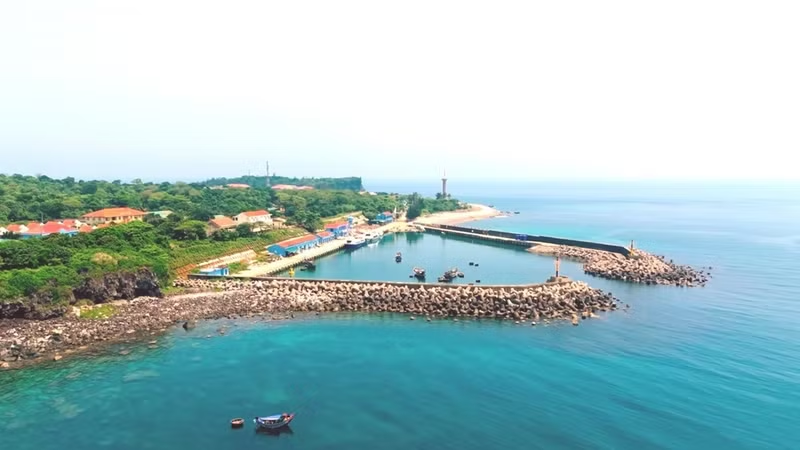
The integration of science and technology in management, together with collective efforts to protect the island’s landscape and marine environment, will enable Con Co to realise its full potential.
Situated at the convergence of distinctive oceanographic conditions, the waters surrounding Con Co boast exceptional biodiversity, abundant fisheries resources, and spectacular marine landscapes.
Established in 2009, the Con Co Island Marine Protected Area covers more than 4,300 hectares and comprises three functional zones: a strictly protected zone, an ecological restoration zone, and a service-administration zone.
Conservation must create new value for the local community
Surveys conducted by the Research Institute for Marine Fisheries between 2007 and 2018 documented 954 marine species in the area. Coral reef ecosystems remain relatively intact and are considered among the most biologically diverse in the Gulf of Tonkin.
Researchers have identified 137 coral species distributed around the island, with reefs covering approximately 274 hectares and an average live coral cover of 32.63%. In addition to coral reefs, Con Co’s marine ecosystem encompasses seaweed, phytoplankton, zooplankton, reef fish, and numerous benthic species.
This rich biodiversity forms a highly valuable ecological network that provides habitats, feeding grounds, breeding sites, and nursery areas for many aquatic species.
These natural assets hold immense value for scientific research, environmental education, and the development of marine eco-tourism products. Several coral species and other marine organisms of high conservation value are currently prioritised for monitoring and protection.
However, like many other marine ecosystems, Con Co faces mounting pressures from climate change, fishing activities, and marine litter. Lost fishing gear and the cumulative impacts of human activities have increased significantly, while collecting and transporting waste from the island to the mainland remains a major challenge.
Tran Khuong Canh, Deputy Director of the Management Board of the Con Co Island Marine Protected Area, recounted that during numerous underwater inspections he had witnessed first-hand plastic waste, fishing lines, and discarded nets that threatened to break, smother, and kill coral reefs and marine life.
In recent years, the management board has therefore collaborated closely with local authorities, relevant agencies, and fishing communities to organise waste collection campaigns, remove fishing nets from coral reefs, and promote reductions in plastic waste.
These measures are aimed at developing a waste management model tailored to the conditions of a small island.
According to Canh, the priority now is to transition from a closed-door approach to conservation towards marine resource governance based on science, community participation, and the rational allocation of marine space.

If conservation deprives local people of their livelihoods, achieving sustainable development will remain elusive. In marine conservation, people and nature must become partners that benefit together rather than being opposing interests.
One approach that should be encouraged is the gradual transition from livelihoods that place heavy pressure on marine ecosystems to more environmentally friendly activities, such as fisheries logistics services, environmentally sustainable marine aquaculture, tourist transport, guided visitor experiences, diving services, and well-managed eco-tourism.
After more than 15 years in operation, the protected area is gradually evolving from a model focused solely on conservation to one that integrates conservation with sustainable development.
Modernising management to develop the marine economy
Nguyen Van Hoa, Director of the Management Board of the Con Co Island Marine Protected Area, noted that management is being modernised by expanding the use of digital technologies, including geographic information systems (GIS), spatial databases, remote sensing imagery, and artificial intelligence tools to support the analysis of coral reef images.
At the same time, the development of an integrated database will make it possible to monitor ecosystem changes, provide early warnings, and improve management efficiency.
Although digital technologies cannot entirely replace patrols, underwater monitoring, or field surveys, they have reduced reliance on manual methods while improving data storage, comparison, and the identification of priority areas requiring inspection.
Once data are standardised and updated regularly, resource management can gradually shift from responding to incidents to proactive, evidence-based risk management.
Recently, the Quang Tri Provincial People’s Committee approved the management plan for the Con Co Island Marine Protected Area for the 2026–2030 period.
The plan establishes a crucial foundation for implementing coordinated measures to protect key ecosystems, restore fisheries resources, strengthen management capacity, promote sustainable livelihoods, and mobilise social resources as well as domestic and international cooperation for conservation.
Nguyen Huu Vinh, Deputy Director of the Quang Tri Department of Agriculture and Environment, asserted that marine conservation should be regarded as the foundation for developing a green economy and sustainable tourism.
The province is also studying a proposal to expand the Con Co Island Marine Protected Area to approximately 10,000 hectares. If approved, the expansion would strengthen ecological connectivity and provide better protection for spawning grounds, nursery areas, feeding habitats, and migration corridors for marine species.
The expansion would also create a sufficiently large management area to better integrate conservation with the sustainable development of the marine economy.
Achieving this goal will require close coordination among management authorities, the Con Co Special Zone, maritime law enforcement agencies, the fishing community, scientists, businesses, and supporting organisations.
A marine protected area can only be truly sustainable when its ecosystems are effectively protected, marine resources are able to recover, and local people recognise the long-term benefits of conserving natural resources.