This orientation requires a strong shift towards a modern, unified, and integrated marine governance model, thoroughly overcoming the fragmentation and disjointedness between coastal sectors and localities; considering the sea as a space for survival and new economic development to connect domestic and international economic corridors, creating new growth drivers for the country.
Reaching out to the open sea
With its unique advantage of being surrounded by the sea on three sides and its strategic location at the southernmost tip of the country, Ca Mau province is realising its aspiration to rise through a comprehensive, modern, and sustainable marine economic development strategy, gradually affirming its role as one of the key marine economic centres of the Mekong Delta region.
According to Pham Van Muoi, Deputy Director of the Department of Agriculture and Environment, with a coastline of over 300km, an exploitable sea area of approximately 120,000km², and a diverse and rich marine and island ecosystem, Ca Mau has favourable conditions for the strong development of marine economic sectors such as fisheries, renewable energy, seaports, and marine ecotourism.
For many years, fisheries have always been a leading economic sector, making a significant contribution to growth, job creation, and income improvement for the people of Ca Mau.
Seafood processing output in the 2021-2025 period reached over 1.49 million tonnes, bringing in export revenue of over 10.4 billion USD, affirming the position of Ca Mau’s seafood brand in the international market.
With over 435,000 hectares of shrimp farming area, the locality is also the largest shrimp production centre in the country.
Identifying the development of the marine economy as a strategic, central, and long-term task, Ca Mau aimed for an average GRDP growth rate of 10% or more during the 2026-2030 period; with marine economic sectors contributing approximately 40-45% of total budget revenue.
By 2045, Ca Mau aspires to become a province with a strong marine economy, developing in a modern, green, and sustainable direction.
In a resolute effort to shift the mindset from “marine economy” to “national marine development space”, Quang Ninh province is accelerating the restructuring of its marine economy towards sustainability, with environmental and marine ecological protection as its foundation, aiming to become a model marine economic centre of the Northern coastal region.
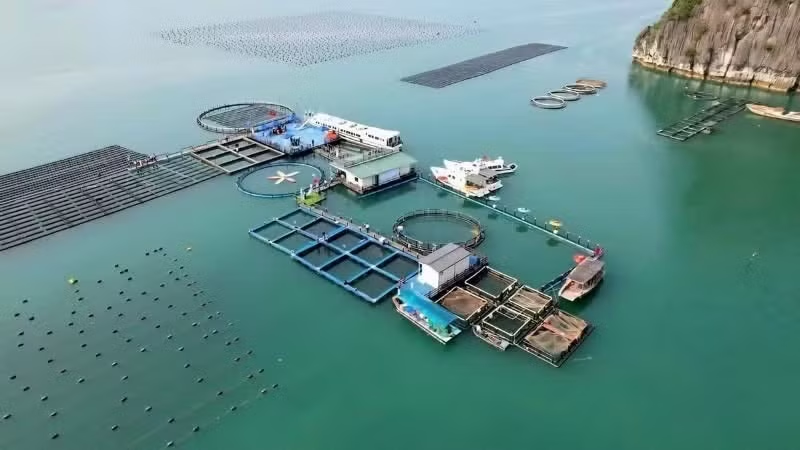
According to the provincial plan for the 2021-2030 period, Quang Ninh has allocated over 45,000 hectares for aquaculture, with the goal of having industrial aquaculture account for over 75% of production by 2030, achieving an average growth rate of 8-10% per year.
To date, the province has planned thousands of hectares of sea surface area and accelerated the development of concentrated aquaculture zones in many key areas. By the end of June 2026, the province had allocated over 5,200 hectares of sea surface area to 57 organisations and over 800 individuals for aquaculture.
The allocation of sea areas not only completes the legal framework but also facilitates access to bank loans for people and businesses, attracts large-scale infrastructure investment, and promotes the development of modern, industrial-scale aquaculture.
However, Quang Ninh currently has over 50 pending applications for the allocation of sea areas for aquaculture due to obstacles in the procedures for approving investment projects according to some current legal regulations.
Removing these bottlenecks in the allocation of sea areas will contribute to strongly unlocking marine economic resources, creating conditions for the sustainable development of high-tech aquaculture, and maximising the province’s particularly important strategic economic position.
Accelerating institutional improvement
According to Dau Anh Tuan, Deputy Secretary General and Head of the Legal Department of the Viet Nam Chamber of Commerce and Industry (VCCI), although Viet Nam has over 3,260km of coastline and many advantages for developing the marine economy, its potential has not yet been utilised to its full potential. One of the key reasons is institutional bottlenecks.
Many businesses investing in offshore wind power, high-tech aquaculture, marine tourism, or land reclamation still face difficulties because property rights to the sea area have not been clearly established.
When the right to use the sea area is not yet eligible for transfer, capital contribution, or mortgage, businesses find it difficult to access credit and raise capital for projects with lifespans of decades.
Although Viet Nam has over 3,260km of coastline and many advantages for developing its marine economy, its potential has not been untilised to its full potential. One of the important reasons is institutional bottlenecks.
Dau Anh Tuan, Deputy Secretary General and Head of the Legal Department of the the Viet Nam Chamber of Commerce and Industry
To create a breakthrough for the development of the marine economy, Bui Tuan Anh, Deputy Secretary General of the Viet Nam Aquaculture Association (VSA), said that all levels of government need to soon have a comprehensive plan for infrastructure serving the aquaculture industry, simplify procedures for granting long-term sea areas, and simultaneously issue standards, insurance mechanisms, and financial systems for the aquaculture industry.
To accelerate institutional reform and contribute to realising the goal of making Viet Nam a strong maritime nation, the Director of the Viet Nam Department of Marine and Islands, Nguyen Quoc Toan, stated that the Government has issued Resolution No. 182/NQ-CP approving the policy dossier for the draft Law on Marine and Island Resources and Environment (amended).
This is an important basis for the Ministry of Agriculture and Environment to continue refining the draft law and submit it to the National Assembly in the near future.
“One of the key contents of the draft is the policy on building preferential mechanisms and policies to provide special and superior support to promote sustainable marine economic development. This is considered a breakthrough to concretise the Party’s guidelines on marine economic development, while creating a sufficiently strong legal framework to effectively exploit marine potential in the new phase,” Toan affirmed.
Creating a transparent and stable legal framework with truly outstanding incentives is expected to generate a new wave of investment, making the marine economy a crucial driving force in helping Viet Nam achieve double-digit economic growth in the new development era.
The eight years since Resolution No. 36-NQ/TW on the strategy for sustainable development of Viet Nam’s marine economy to 2030, with a vision to 2045, officially came into effect have demonstrated the significance of a correct and strategically important decision.
As a result, awareness of the importance and role of the sea has been raised. The institutional and policy system has been gradually improved. Many marine economic sectors have developed significantly. The lives of people in coastal areas have improved.
National defence, security, foreign relations, and the protection of maritime sovereignty have achieved many important results. However, objectively speaking, the marine economy is still not developing in proportion to its potential, advantages, and the development requirements of the country.
With a new mindset and vision for maritime development in the new era, shifting strongly from a “maritime economy” mindset to a “strong national maritime development space” mindset, Viet Nam’s sea is no longer just a place for resource exploitation or the development of certain economic sectors.
It has been identified as a strategic national development space, a convergence point for development interests, national defence, security, science and technology, and international integration.
All maritime development plans, strategies, and programmes must simultaneously serve the requirements of protecting national sovereignty, sovereign rights, and jurisdiction, maintaining a peaceful and stable environment, enhancing defense capabilities, and protecting national interests at sea.
Every economic project at sea must contribute to strengthening the potential for national development and defence...In this new strategic vision, the sea is a gateway to the world, a space for national survival and development.