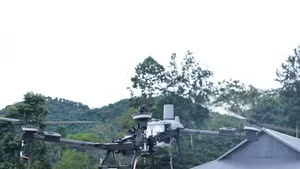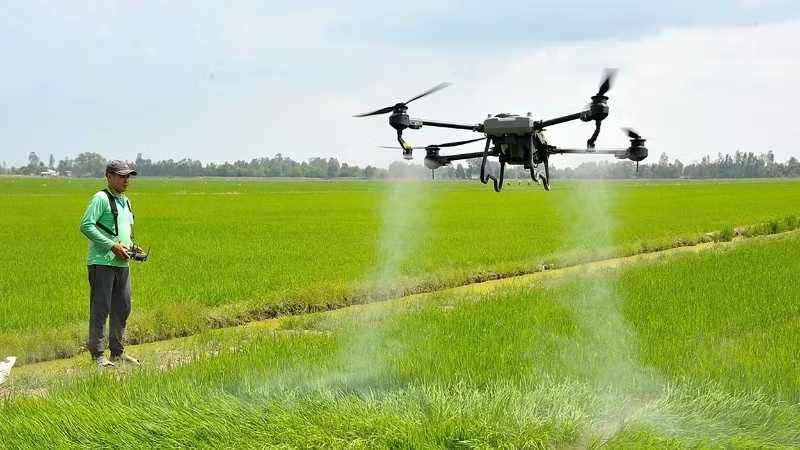
The low-altitude economy should be viewed as an economic space driven by flight activities at low altitudes, integrating multiple industries, from the manufacture of aerial vehicles and ground infrastructure to operational services, technical support, and insurance. In Viet Nam, the low-altitude economy has vast potential for applications across a wide range of fields, notably smart agriculture, industry and infrastructure development, surveillance and rescue operations, as well as automated delivery services.
Facing multiple challenges
The rapid advancement of science and technology, artificial intelligence, big data, and high-speed networks is providing a solid foundation for the low-altitude economy to expand globally. The American Bank Research Institute forecasts that the market will grow dramatically, surging from 4.6 billion USD in 2024 to a record 210 billion USD by 2045.
In Viet Nam, the low-altitude economic ecosystem is experiencing a major shift from individual applications towards an integrated value-chain structure, laying the groundwork for the formation of technology alliances. A notable example is the launch of the Viet Nam Low-Altitude Economy Alliance (LAEP) in October 2025, co-founded by FPT Corporation, VinaCapital, and the Viet Nam UAV Network. LAEP serves as a connector linking resources throughout the value chain, from research and development (R&D) to hardware manufacturing and the operation of flight management systems.
However, Viet Nam’s low-altitude economy continues to face numerous challenges. A major barrier is posed by stringent regulations and lengthy administrative procedures. All commercial and experimental flights must obtain approval from the Ministry of National Defence, with the licensing process carried out manually and requiring strictly defined flight coordinates.
For example, in terms of flight licensing times, China can process applications within minutes via a cloud platform, while the process in the US is almost instantaneous within designated airspace. In Viet Nam, however, it often takes several days. This compromises the flexibility and responsiveness of commercial delivery and emergency rescue services.
In addition, discrepancies in technical and information technology infrastructure remain another obstacle. The absence of a digital low-altitude traffic management system (UTM) has limited automated monitoring capabilities, while the existing 5G network is not yet robust enough to provide optimal coverage of this airspace.
In terms of physical infrastructure, essential facilities such as landing and parking areas, and charging stations for next-generation aerial vehicles remain unincorporated into urban planning. Viet Nam also faces a shortage of highly skilled human resources, including operators, core software engineers, and specialists in spatial data analysis.
Unlocking resources
The potential of the low-altitude economy is immense, yet we do not currently have sufficient tools to harness it. Mechanisms and infrastructure that remain inadequate are creating bottlenecks for businesses. It is therefore time to introduce breakthrough policies to remove these obstacles. Although the low-altitude economy is expected to generate a stronger growth impetus for the economy, its development in Viet Nam is currently constrained by an incomplete legal framework.
To unlock these resources, regulators need to adopt a more open approach, shifting the focus from “pre-inspection” to “post-inspection”. Businesses need “Free-fly zones” as launchpads for testing innovative solutions. At the same time, new legislation should embrace an “enabling” approach, combined with the comprehensive digitalisation of licensing procedures through the National Public Service Portal.
Alongside institutional reform, expediting investment in low-altitude digital and physical infrastructure is also essential to building a complete ecosystem. Key priorities at this stage include rapidly establishing a national digital air traffic management system; focusing on telecommunications infrastructure and optimising 5G connectivity for low-altitude airspace; and implementing integrated urban planning, particularly by urgently adding networks of landing sites for vertical take-off and landing aircraft (Vertiports) in strategically advantageous localities.
Next, a sandbox mechanism should be swiftly introduced to pilot the development of the low-altitude economy. This model would provide a safe regulatory framework for businesses to test new services within controlled spatial and time limits before considering wider deployment. In the initial stage, priority should be given to key applications such as high-tech delivery and emergency medical transport.
Finally, no ecosystem can function without people. A comprehensive human resources training strategy, forged in close cooperation with international partners to provide flight and specialised vocational certification, will be the decisive missing piece needed for Viet Nam’s low-altitude economy to truly take off.
The low-altitude economy is opening up a promising new space for development. Although the sector still faces difficulties, it is regarded as an emerging field that could enable Viet Nam to accelerate and seize a golden opportunity for development. The sector’s rise will create a ripple effect, vigorously promoting technology adoption and digital transformation, thereby creating a new launchpad for the country’s goal of rapid and sustainable growth.