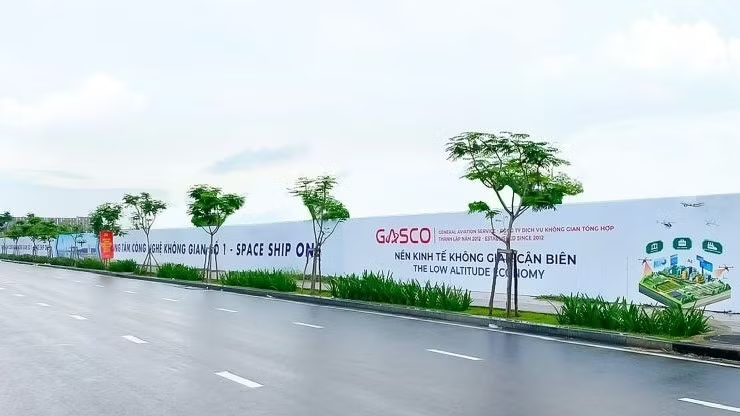
The LAE Centre project of ASEAN - Space Ship One (SS1) is located adjacent to Terminal 3 at Tan Son Nhat Airport, Ho Chi Minh City.
Catching up with LAE trend
The rapid development of unmanned aerial vehicles (UAVs), artificial intelligence (AI), big data, the Internet of Things (IoT), aircraft, balloons, space stations, and spatial management systems for monitoring, operations, and services is opening a new economic layer under 3,000 meters of altitude. This layer, known as LAE, aggregates all human and machine activity from terrestrial economic sectors into the airspace, achieving significantly higher efficiency.
Currently, only a few countries are strongly developing the Low Altitude Economy, including Japan, Belgium, the US, and China. China stands out, having officially launched its LAE initiative in 2023 with an initial scale of approximately 69.8 billion USD, and forecasts suggest that by the end of 2025, the total direct and indirect markets related to LAE will reach around 550 billion USD, demonstrating staggering growth in this sector.
Globally, companies such as Unifly (Belgium) and Aloft (USA) are striving to map the skies, from U-Space and LAANC to UTM/USS services.
In UAV logistics, Chinese companies like SF Express, JD.com, and Meituan are making bold advances. In the eVTOL sector, Vertical Aerospace (UK) is pursuing a long-term certification pathway with global aviation partners for passenger UAVs.
Meanwhile, cloud and AI platforms such as UCloud, Huawei Cloud, and Baidu Apollo are becoming critical infrastructure for flight data, simulation, and operational intelligence. Terra Drone, a leading LAE company in Japan, has expanded its inspection and monitoring ecosystem to Indonesia but faced setbacks due to a fire at its Jakarta office, creating opportunities for younger nations to rise in the sector.
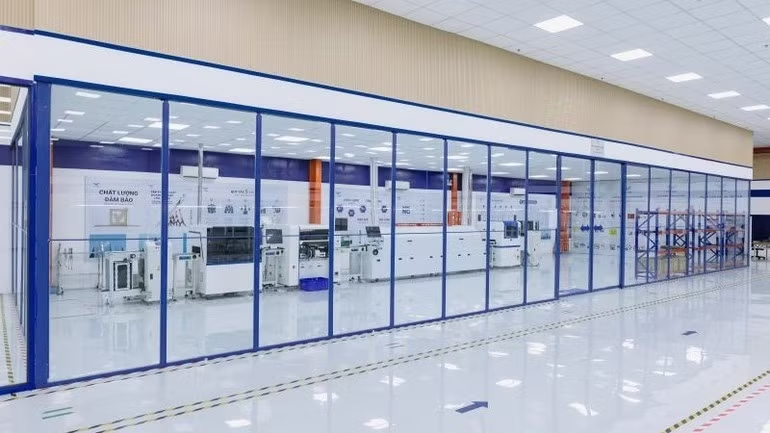
In Viet Nam, GASCO, the Integrated Space Services Company (a member of CT Group), has remained a consistent name since 2012, positioning itself as a natural pioneer in the space economy.
In 2024, GASCO, via CT Group, surprised the market by presenting a proposal for the development of the low altitude economy to regulatory authorities, while quietly preparing a global LAE headquarters. The Space Ship One (SS1) project, originally launched in 2012, is a 500,000 square metres integrated research, testing, and training facility adjacent to Tan Son Nhat Airport Terminal 3. It hosts thousands of specially trained engineers divided into over 600 departments, providing more than 600 LAE services across 16 sectors and 72 subsectors worldwide.
Positioning Viet Nam on global high-tech map
Thanks to its scale and strategic location, the SS1 project serves as a strong “launchpad” for integrated R&D, testing, training, and international logistics, shortening commercialization cycles, accelerating logistics, and enhancing Viet Nam’s global demonstration capabilities in the LAE sector.
GASCO’s comprehensive technology ecosystem combines core technologies—AI, semiconductors, aerospace, automation, satellite systems, 5G/6G—with digital infrastructure technologies such as UTM for UAV traffic, UAM for urban air mobility, and a 15-layer national digital twin (NDT 15). This makes GASCO the first fully integrated LAE company in Viet Nam, capable of independently managing the entire chain from research and production to large-scale LAE applications.
Another distinguishing factor is GASCO’s global deployment capacity. With hundreds of experts worldwide, the company can implement LAE models internationally—a feat not yet achieved by many major regional tech corporations.
The clearest demonstration of GASCO’s strength came in early 2025 with a strategic national-level partnership with Indonesia, the “awakened dragon” of Southeast Asia in the G20. The Indonesian government entrusted GASCO with implementing its Low Altitude Economy, marking the first time a Vietnamese enterprise has been entrusted to deploy LAE initiatives for a foreign government.
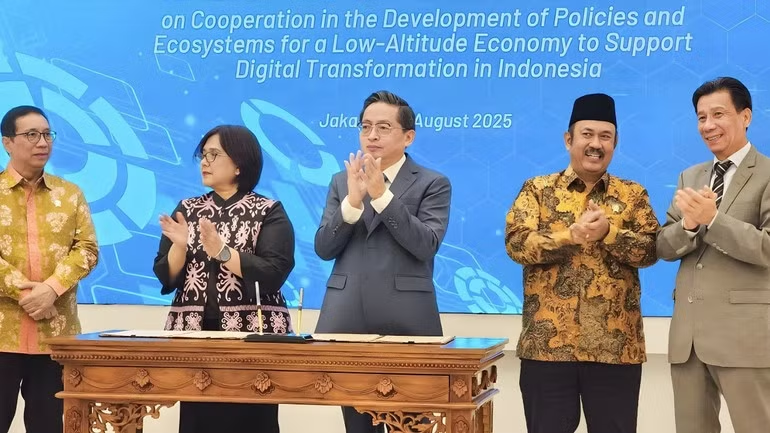
Nguyen Tuan Au, GASCO’s Deputy Director of Business Development, stated: “LAE is a completely new economy with the potential to generate exponential GDP growth. CT Group and GASCO now fully control the ecosystem, from core technologies to infrastructure, applications, and services, and with the support of relevant authorities, we can achieve breakthrough development. We are committed to advancing LAE across all 34 provinces and cities in Viet Nam, making it a national high-tech priority and contributing to strategic national development in the new era.”
GASCO is gradually realizing its “Go-Global” vision, serving as Viet Nam’s pioneer and flag-bearer in the LAE sector, fully capable of competing on equal footing with the world’s most advanced technology nations, and positioning Viet Nam prominently on the global high-tech map.