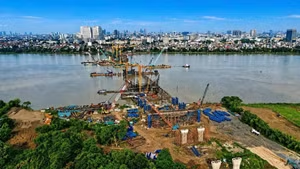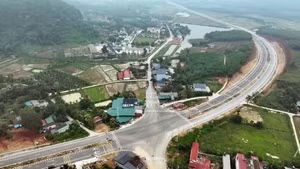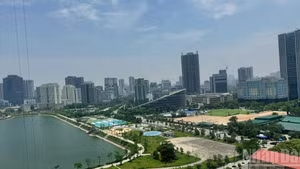
The Thu Thiem–Long Thanh railway will be nearly 46.5km long and is expected to have 18 stations, six of them in Ho Chi Minh City. The line is designed for a maximum speed of 120km/h, with a capacity of nearly 47,000 passengers per hour, and will integrate with several other railway lines in the regional network.
A mass transit corridor
The key railway line will traverse a number of residential areas and major transport hubs in eastern Ho Chi Minh City and Dong Nai. The project will employ GoA4 automated technology, the highest level of automation under European standards. The system will operate without drivers, striving to comprehensively automate the railway’s operations. The project is expected to create a high-capacity transport corridor linking central Ho Chi Minh City with Long Thanh International Airport.
Notably, the line has been studied as part of a wider railway network rather than as a standalone route. The Thu Thiem–Long Thanh line will therefore not only facilitate travel between its two termini but will also form part of a broader transport network, with multiple interchange points connecting it to other lines.
With a maximum capacity of nearly 47,000 passengers per hour, the Thu Thiem–Long Thanh railway has been designed to accommodate robust passenger demand, with an average of more than 23,400 passengers potentially transported in each direction every hour. Trains are expected to operate at speeds of 80–120km per hour depending on the section. At these speeds, journeys from central Ho Chi Minh City to Long Thanh International Airport are expected to be substantially curtailed once the major Southeast Asian aviation hub enters operation.
The estimated total investment for Phase I is approximately 134.169 trillion VND, excluding site clearance costs, which is lower than the previous proposal. The project is expected to be finalised by 2030.
The entire line is expected to have 18 stations, excluding Thu Thiem Station, comprising 16 elevated stations and two underground stations. Phase I is expected to prioritise 14 stations. In Ho Chi Minh City, the line will transit through six stations: Binh Trung, Do Xuan Hop, Ring Road 2, Phu Huu, Long Truong, and Vuon Dua, before continuing to the remaining stations in Dong Nai: Long Tan, Phu Thanh, Tuy Ha, Nhon Trach, Phuoc Thien, Xom Goc, and Long Thanh.

From Thu Thiem Station, passengers will be able to connect with the Ben Thanh–Thu Thiem line. The Ring Road 2 and Phu Huu areas are also planned to connect with Metro Line 6, while Long Truong Station will connect with Metro Line 10. In Dong Nai, the line will continue to integrate with other railway routes and the transport network at Long Thanh Airport.
Of the six stations located in Ho Chi Minh City, Binh Trung Station will be positioned within the eastern part of the city, an area undergoing rapid infrastructure and residential development. Palm City, a residential development covering approximately 30.6 hectares in the Binh Trung area, is one of the urban developments within this growth zone. According to information provided by the developer, the development is planned as a mixed-use area incorporating residential, commercial, and service facilities, as well as urban amenities.
With its long riverside frontage and a low- to mid-rise master plan interspersed with green spaces, Palm City stands to capitalise on improved connectivity provided by major transport infrastructure while retaining a private and tranquil living environment, without being directly affected by noise or dust from major public infrastructure projects.
Within Palm City, the Palm River apartment subdivision is the latest component to commence construction, continuing the development of the urban area in Binh Trung. The emergence of the new subdivision, alongside infrastructure projects currently under investment, indicates that the area is continuing to attract additional residential and urban amenity projects.
The addition of a railway station in the area could furnish local residents with another option for travelling to other parts of Ho Chi Minh City and to Long Thanh International Airport. However, the convenience it offers will depend on how well the station is connected to surrounding residential areas, the local road network, and the completion of the wider area’s infrastructure.
The development of the Thu Thiem–Long Thanh railway, with additional stations and connections between multiple railway lines, will broaden accessibility to eastern Ho Chi Minh City while providing a further direct transport link between the city and Long Thanh International Airport.