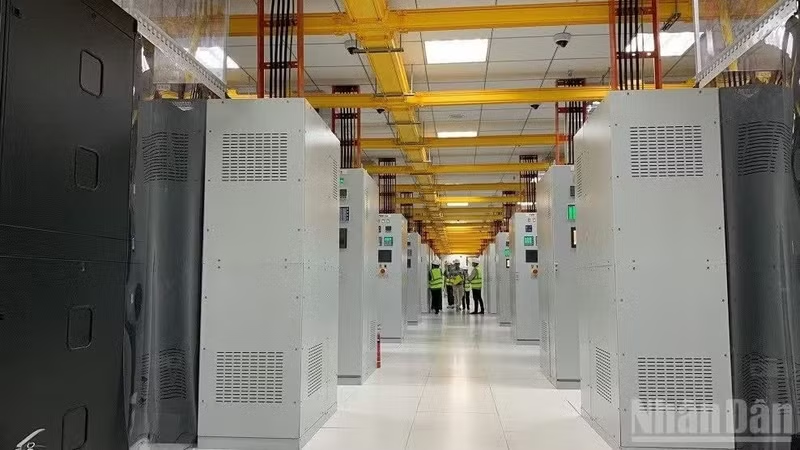
The development of AI is creating a new source of demand within Viet Nam’s industrial real estate market. Beyond high-tech manufacturing facilities, data centres are increasingly attracting investor interest—bringing with them specialised requirements for power supply, digital connectivity, and scalable capacity.
In this context, the value of an industrial site is no longer determined primarily by its location or land lease costs; rather, it depends on the site’s ability to meet specific operational requirements.
According to preliminary statistics, as of August 2026, Ho Chi Minh City has 20 operational data centres, with another 9 projects proposed. Meanwhile, research by Arizton published in September 2026 estimated that revenue from colocation services in Viet Nam reached 212 million USD in 2025, with a projected increase to 760 million USD by 2031.
These figures highlighted the growth potential for the data centre services market, though the extent to which this demand is realised will depend on the implementation progress of individual projects.
Infrastructure determines competitive advantage
For data centres, power supply is not merely a utility; it is the foundational requirement for all operations. Investors must carefully evaluate the actual available power capacity, the timeline for grid connection, the stability of the power supply, and the scalability to accommodate future expansion.
The mere proximity of an industrial park to transmission lines—or the existence of a general commitment to provide electricity—does not guarantee that a project will be connected on schedule, nor does it ensure sufficient capacity to support subsequent phases of development.
Beyond electricity, fiber-optic infrastructure, international connectivity, and data latency directly influence operational quality. Other critical factors—such as cooling system design, drainage, flood risk, and accessibility for maintenance—must also be considered in an integrated manner.
Given their requirement for continuous operation, data centres demand higher levels of redundancy and resilience against disruptions compared to many other types of industrial real estate. This necessitates a different approach to evaluating total investment costs.
A site with a lower land lease rate may not necessarily be more economically efficient if it requires the investor to install additional infrastructure, leads to prolonged approval processes, or creates difficulties in the procurement and installation of specialised equipment. Consequently, the ability to execute a project according to its planned schedule becomes a key component of a site’s commercial value.
For industrial park developers, the competitive advantage lies not only in their available land bank but also in their proven capacity to provide infrastructure. Sites with clear plans for power grid integration, robust digital connectivity, and feasible expansion strategies are more likely to attract interest from prospective tenants.
However, the extent to which these influences land rental rates remain contingent upon actual demand and the costs associated with infrastructure investment; there is currently insufficient evidence to conclude that AI has driven a nationwide trend of rising industrial land prices.
Infrastructure capacity shapes competitive advantage
Data centres and high-tech manufacturing facilities have distinct real estate requirements. While data centres prioritise a stable power supply, digital connectivity, and continuous operational uptime, manufacturers in sectors such as semiconductors, electronic components, or precision engineering require access to a skilled workforce, a network of suppliers, and appropriate logistics infrastructure.
This necessitated that industrial park developers clearly define their target tenant segments, allowing them to plan and develop infrastructure tailored to the specific needs of each industry.
In terms of location, Ho Chi Minh City and Ha Noi offer advantages in terms of commercial demand and the digital infrastructure required for data centre development.
Meanwhile, Bac Ninh stands out for its cluster of electronics, semiconductor, and supporting industry enterprises, and Thai Nguyen is also a notable location for electronics manufacturing.
Nevertheless, these regional advantages serve only as a preliminary basis for identifying potential sites. The ultimate suitability for a given project depends on factors such as power supply capacity, infrastructure connectivity, human resources, and the progress of project implementation at each specific location.
In this context, the development strategy for industrial zones must shift from a focus on land bank preparation to ensuring implementation and operational capacity. Infrastructure—such as power supply, digital connectivity, cooling systems, and scalability—must be factored in as early as the planning stage.
Furthermore, these elements should be aligned with the specific needs and investment plans of tenants to mitigate the risks associated with speculative, ill-founded infrastructure investments.
Moreover, the announcement or formal approval of an investment project does not equate to an immediate increase in operational supply. A project only truly impacts the market once it has secured a reliable power supply, completed all necessary administrative procedures, finalised capital arrangements, and commenced operations.
The key differentiator among industrial zones lies in their ability to deliver infrastructure on schedule and maintain high operational standards throughout the duration of a tenant’s investment.
As the demand for computing power continues to surge alongside the advancement of AI, the capacity to translate infrastructure commitments into tangible operational capabilities will increasingly define the competitiveness of industrial real estate.