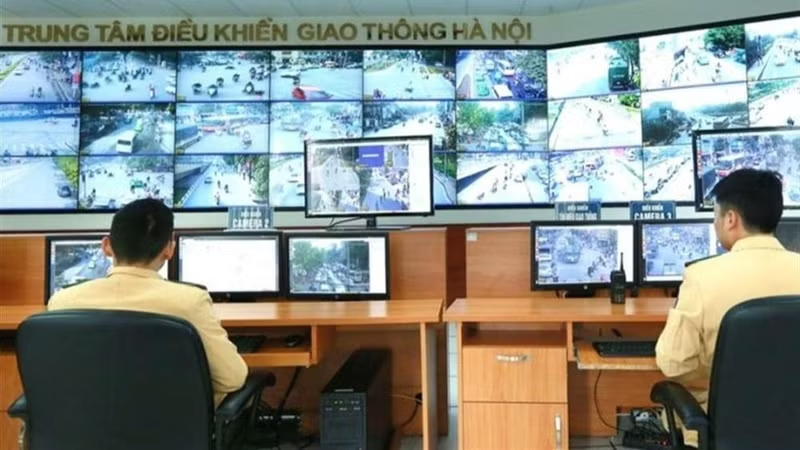
On behalf of the Government, Standing Deputy Prime Minister Pham Gia Tuc has signed Resolution No. 298/NQ-CP on the implementation plan for Resolution No. 05-NQ/DU, dated June 12, 2026, issued by the Government Party Committee on the adoption of mechanisms and policies to execute the scheme entitled “Establishing a data centre for traffic management, monitoring, violation handling, and operational control for 2026–2030, with a vision to 2050.”
The plan aims to translate Resolution No. 05-NQ/DU of the Government Party Committee and Decision No. 456/QD-TTg of the Prime Minister, ensuring their coordinated and seamless execution. It also clearly defines the responsibilities, authority, and coordination mechanisms of relevant ministries and agencies, and the People’s Committees of provinces and centrally governed cities in implementing the scheme.
Under the plan, the Government directs ministries, sectors, and local authorities to enforce the approved mechanisms and policies consistently, while swiftly resolving bottlenecks relating to investment procedures, resources, data, technology, and inter-agency coordination.
The objective is to synchronise key tasks and gradually establish a nationwide system for traffic management, monitoring, violation handling, and operational control. This will entail building a national transport data platform to support modern traffic governance, the advancement of digital government, and the provision of digital services to citizens and businesses.
Seven key tasks
The plan identifies seven key tasks: disseminating and developing implementation plans; completing the institutional, regulatory, and policy framework, as well as technical standards and regulations; establishing a unified architecture, data, and technology platform; executing investment mechanisms; mobilising, allocating, and coordinating resources; rolling out component projects; and strengthening organisational structures and developing human resources.
To ensure thorough dissemination and planning, ministries, sectors, and local authorities are responsible for aligning on the objectives and tasks set out in Resolution No. 05-NQ/DU and Decision No. 456/QD-TTg. They must also clearly define the responsibilities of officials, civil servants, and public employees in executing annual plans.
For each task, the plan assigns specific responsibilities to relevant agencies, units, and individuals, tied to clearly defined objectives and performance targets.
To refine the institutional, regulatory, and policy framework, Resolution No. 298/NQ-CP tasks relevant agencies with reviewing, amending, and supplementing existing legal instruments, or submitting them to competent bodies for promulgation, alongside technical standards and operational procedures. These measures will establish the legal basis for investment in, management, and operation of the National Transport Data Centre.
In parallel, data governance, artificial intelligence governance, and the management of electronic evidence chains are prioritiesed throughout deployment. Requirements governing data classification, access permissions, personal data protection, state secrets, cybersecurity, and data security must be established and rigorously updated. The aim is to ensure unified and secure data management, lifecycle control, and the legal validity of electronic evidence chains supporting state management.
Standardising technology architecture and developing domestic technologies
The plan requires the implementation of an overall architecture for the National Transport Data Centre as a unified basis for the planning, appraisal, interconnection, and operation of component projects.
Transmission infrastructure, a shared data dictionary, and an integration platform will be deployed to ensure seamless interoperability among Level 1 centres, Level 2 centres, traffic monitoring systems, regional processing and storage clusters, national databases, and specialised databases.
Alongside accelerating operational digitasation and artificial intelligence adoption, the plan emphasises research and domestic production of digital technology products and security industry hardware. Priority will be given to foundational technologies, camera systems, transmission equipment, storage solutions, and security technologies.
Encouraging domestic businesses to pioneer technology products and solutions is intended to bolster technological self-reliance, reduce dependence on foreign platforms, ensure system security and safeguard national data sovereignty.
Ministries, sectors, and local authorities are required to synchronise the rollout of component projects, in accordance with approved objectives and timelines. They must also establish monitoring and appraisal mechanisms to promptly rectify and lapses in interoperability or non-compliance with the overarching architecture.
Organisational structures will also be streamlined by designating clear focal points across relevant agencies and local authorities. Training and professional development programmes for officials, civil servants, and public employees will be conducted to ensure they can effectively master and operate the systems over the long term.
The Government also mandates reviewing and introducing competitive policies to attract, recruit, and remunerate specialists in data, artificial intelligence, information technology, and cybersecurity.
Rolling out the plan under Resolution No. 05-NQ/DU and Decision No. 456/QD-TTg will provide the foundation to establish the National Transport Data Centre. It will gradually forge an integrated national transport data and operational management system to support state governance, improve road safety, and expand digital services in the transport sector.














![[Video] Renewal and growth milestones of Ha Noi through the lens](https://en-cdn.nhandan.vn/images/1XgBTSIw0KyfD4abQsg-hd4ly6fBUHXC7_OAKyN4YwPfAhBw0Xs6rVX3rF0up9Tr6rLNn30Muc4bzp90E7yOqg/10-10-hanoi-cover.jpg.avif)