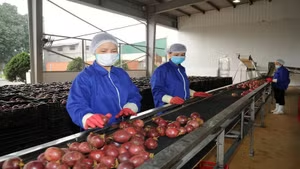
However, behind the growth figures lie many issues the industry still has to tackle, including market risks, the capacity to adapt quickly and the need for effective strategies.
A new bright spot
Viet Nam’s tilapia exports are entering a fast-growth phase, with export turnover reaching 99 million USD in 2025, up more than 140% from 2024. In the first quarter of 2026 alone, the figure had already reached 35 million USD, equivalent to an increase of nearly 190% over the same period of 2025. Notably, growth is no longer concentrated in only a few traditional markets, but is increasingly spreading across multiple regions.
Market specialist Phuong Linh of the Viet Nam Association of Seafood Exporters and Producers (VASEP) said that in the first two months of the year, tilapia exports posted strong growth in many countries and across most regions. Exports to the Dominican Republic rose by more than 600%, while exports to the Netherlands increased by more than 200% compared with the same period of 2025.
In the Middle East, growth even reached four digits, rising by more than 2,300% year on year and making the region a dream market in terms of growth. The ASEAN bloc also recorded growth of nearly 400% over the same period last year, clearly reflecting rising demand in many markets worldwide for alternatives to traditional white-flesh fish products.
Yet despite the strong growth, the structure of Viet Nam’s tilapia export market still carries risks that should not be overlooked. One is the heavy dependence on just a few markets, all of them geographically distant across the Pacific. At present, Vietnamese tilapia exports are still concentrated mainly in two major destinations, the US and Brazil. Brazil, meanwhile, is one of the world’s leading tilapia producers and is investing heavily in science and technology to build a tilapia industry with strong international competitiveness.
The fact that nearly half of the sector’s export turnover in the opening months of the year was concentrated in this market points to a sharp upturn, but also highlights potential vulnerability if policies or demand were to change. By contrast, the US market, another key destination, is recording a decline.
Beyond that, the export picture for tilapia is also being shaped by a range of external factors. US tariff policy, geopolitical volatility in the Middle East, and rising fuel prices and logistics costs could all directly affect trade flows.
Towards a “third pillar”
To rebalance market structure and ensure sustainable growth, tilapia exporters are now looking towards markets with logistics advantages, making use of preferential treatment under free trade agreements, and focusing on product segments that match real consumer demand. At the same time, the domestic market of more than 100 million people is increasingly being seen as a highly favourable home base.
Nguyen Dang Ngoc, Deputy General Director of Viet Nhat Group, said that besides its export strategy, the company places special emphasis on the domestic market, as tilapia is a familiar, healthy food that suits Vietnamese tastes. Simultaneously developing both domestic and international markets, by meeting export standards while supplying high-quality products to local consumers, is an important strategy that can expand value, raise the profile of Vietnamese tilapia and provide a sustainable path for long-term growth.
Under the fisheries development strategy to 2030, the Ministry of Agriculture and Environment has identified tilapia as a species with strong farming potential alongside shrimp and pangasius. Restructuring programmes in the fisheries sector are also encouraging the expansion of tilapia farming areas on an industrial scale, with high technology application and compliance with sustainability standards.
Tran Dinh Luan, Director General of the Department of Fisheries and Fisheries Surveillance under the Ministry of Agriculture and Environment, said that with suitable natural and climatic conditions and a large water surface area, estimated at around 1.3 million hectares nationwide for aquaculture, tilapia farming is developing strongly and still has considerable room for expansion.
Global demand for tilapia is projected to grow by about 13% a year, reaching 20 billion USD by 2030. The ministry has directed localities to strengthen management of farming areas, control broodstock quality, and develop farming models that comply with VietGAP, GlobalGAP and other international certifications. Building stable raw material zones has been identified as a key factor in export development.
From being a familiar fish on the Vietnamese dinner table, tilapia is gradually entering the global value chain and is increasingly seen as having the potential to become the fisheries sector’s third pillar, alongside shrimp and pangasius. The strong export growth recorded in the opening months of 2026 not only reflects rising global demand, but also shows the ability of farmers, exporters and regulators to adapt quickly to international fluctuations.
If Viet Nam can make good use of its natural advantages, improve technology and increase export value, tilapia will make an even stronger contribution to the fisheries sector’s target of achieving 14-16 billion USD in export value by 2030.


![[Infographic] Viet Nam's 16 Comprehensive Strategic Partners](https://en-cdn.nhandan.vn/images/nyM650OGFWrOVWc-xajqN-rTZ68Rlmc1fiGJOhBRYHHdkBILL2hAdMw_FHcqH-128bTaQBSOAMd0_NcTypwz7H-j_NBZzuSdgF8ETMmVl1xLtdcCjym8rCUyKZqQgOZtC4ouMEzxlJoQ-MllehtjehDxIkn58uqaoaCRy4fSY54/1792513260540-1528117236743671738-1528117236743671738-9e797c256fe32c7c7b9c1cc03b0ca64e.jpg.avif)