With the current tax policy framework, Viet Nam needs to focus on supporting domestic businesses capable of joining the supply chains of multinational corporations investing in Viet Nam, while also creating momentum for technological innovation, higher value added, stronger exports and a greater role in global supply chains.
Le Thi Duyen Hai, Vice Chairwoman and Secretary General of the Viet Nam Tax Consultants Association
Changing the way businesses are supported
For Viet Nam, the shift in supply chains not only offers businesses an opportunity to reposition themselves within production and trade networks, but also creates opportunities to attract investment, expand markets, strengthen competitiveness, adopt new technologies, improve governance and participate more deeply in international value chains.
In this context, Le Thi Duyen Hai, Vice Chairwoman and Secretary General of the Viet Nam Tax Consultants Association, said tax policies need to create new growth drivers to help domestic businesses strengthen their capabilities. Over many years, the tax policy system has used preferential policies and incentives to promote business development, contributing to the attraction of foreign direct investment (FDI) and generating substantial capital for businesses to establish and expand their operations and adopt new technologies, while creating opportunities for Vietnamese businesses to join supply chains and boost exports.
However, the Vice Chairwoman of the Viet Nam Tax Consultants Association also pointed out frankly that, under current policies, preferential corporate income tax rates are facing significant changes in the context of the application of top-up tax under the global minimum tax rules. Further lowering preferential corporate income tax rates will no longer be an important advantage for attracting FDI enterprises as it was in the past.
In reality, current policies aimed at encouraging and supporting businesses have undergone a significant shift. The Law on Corporate Income Tax No. 67/2025/QH15, together with Decree No. 320/2025/ND-CP detailing a number of articles and measures for the organisation and implementation of the Law on Corporate Income Tax, has introduced new approaches and solutions to support businesses.
“This is the first time a mechanism has been introduced allowing businesses to count expenses on scientific and technological research at twice their actual value. It is also the first time that such a mechanism has been incorporated into corporate income tax incentives, instead of relying mainly on lower tax rates as has traditionally been the case,” Le Thi Duyen Hai noted.
Under the Law on Corporate Income Tax, since 2025, many eligible sectors and business lines have been subject to preferential tax rates, such as a 10% rate for periods of 10 or 15 years, together with tax exemption policies for priority sectors and business lines.
“As a business that began focusing early on applying science and technology to developing growing areas and producing raw materials for the pharmaceutical industry, we have benefited from a number of important incentives added to the Law on Corporate Income Tax. These policies provide clear directions for supporting businesses in adapting to digital transformation and developing a green economy,” said Nguyen Van Thang, General Director of Kim Hoang Agriculture Joint Stock Company.
“Opening up” FDI supply chains to domestic businesses
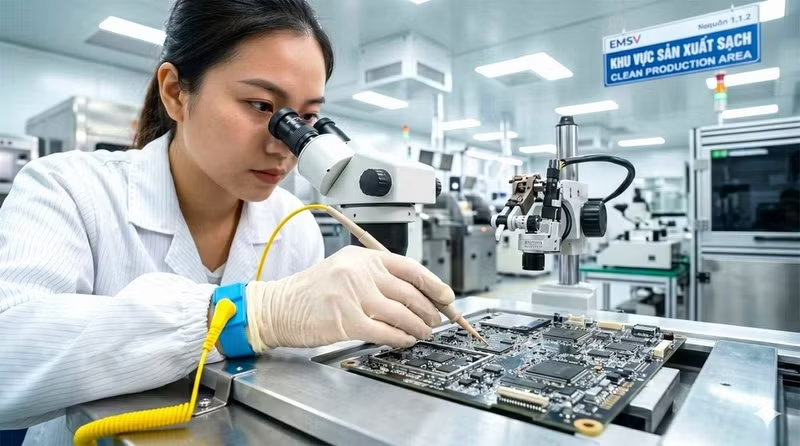
In practice, policies implemented in recent years have not only broadened support mechanisms for domestic businesses, but have also had a significant impact on attracting FDI. The number of FDI enterprises in Viet Nam currently stands at more than 30,000. Although they account for less than 3% of the total number of businesses operating in Viet Nam, the FDI sector contributes more than 30% of total state budget revenue from the business sector, particularly through FDI enterprises in areas such as electronic component manufacturing and large-scale manufacturing.
Strong growth in FDI inflows is creating more opportunities for Viet Nam to improve its position in global production chains. However, the ability to turn these capital inflows into a broader source of spillover growth will increasingly depend on the capabilities of domestic businesses.
According to Associate Professor and Dr Nguyen Thuong Lang, Senior Lecturer at the Institute of International Trade and Economics under the National Economics University, FDI attraction and domestic business development need to be addressed as part of the same equation. To ensure that FDI generates the fastest and most sustainable spillover effects, the capabilities of domestic businesses must be strengthened first.
However, when reviewing the expectations placed on the tax policy system in recent years, particularly the goal of adapting to shifts in global supply chains and developing the green and digital economies, there are still areas where tax policies have fallen short of expectations.
“There is a particularly noteworthy reality: although FDI investment in Viet Nam continues to increase, domestic businesses remain largely outside the production chains of the FDI sector. Therefore, Viet Nam needs additional impetus from tax, technology and innovation policies to strengthen the competitiveness of the business community,” Le Thi Duyen Hai analysed.
In principle, tax incentives should not merely reduce businesses’ tax liabilities but also create incentives for new growth models. Therefore, the policy framework needs to focus on key areas, with selective and targeted priorities.
With regard to corporate income tax and value-added tax policies, a number of provisions have been introduced in recent years, including tax-exempt categories, tax refunds for exported goods, and tax incentives, exemptions and reductions for high-tech sectors and investment in scientific and technological research.