Implementing Resolution 19 requires the entire political system — and specifically officials involved in urban planning, construction, and development management — to take the lead and act decisively.
It demands a fundamental shift in mindset from “administrative management and control” to “facilitating and steering development,” ensuring that urban areas serve not only as key engines of economic growth but also as safe, humane, sustainable, and inclusive living environments for Vietnamese families.
New strategies and driving forces
To realise the new strategies and driving forces for urban development envisioned in Resolution 19, accelerating urbanisation and urban development must first become a vital growth engine.
Development spaces must be restructured in alignment with economic corridors to establish growth poles, innovation hubs, and green, smart urban areas capable of competing internationally.
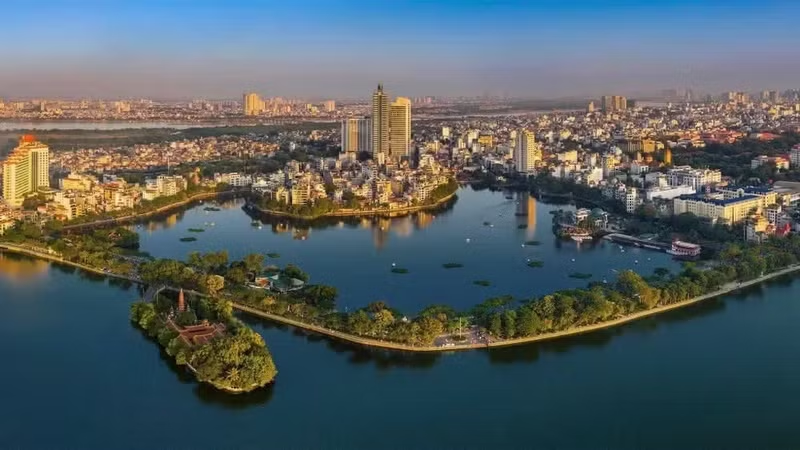
Concurrently, regional and sectoral linkages must be effectively strengthened to interconnect urban areas, creating a mutually supportive urban network that drives socio-economic development. In this context, major urban centres — acting as regional and national growth poles — must serve as green, smart, modern, and multi-sectoral cities that pioneer efficient land use and sustainable development.
Furthermore, establishing a modern, smart, and green strategic infrastructure system — characterised by multimodal connectivity and a priority on climate change adaptation — is crucial for creating a synchronised nationwide urban network.
Implementation must be strategic and focused, prioritising essential infrastructure that generates significant spillover effects while ensuring economic, social, and environmental sustainability.
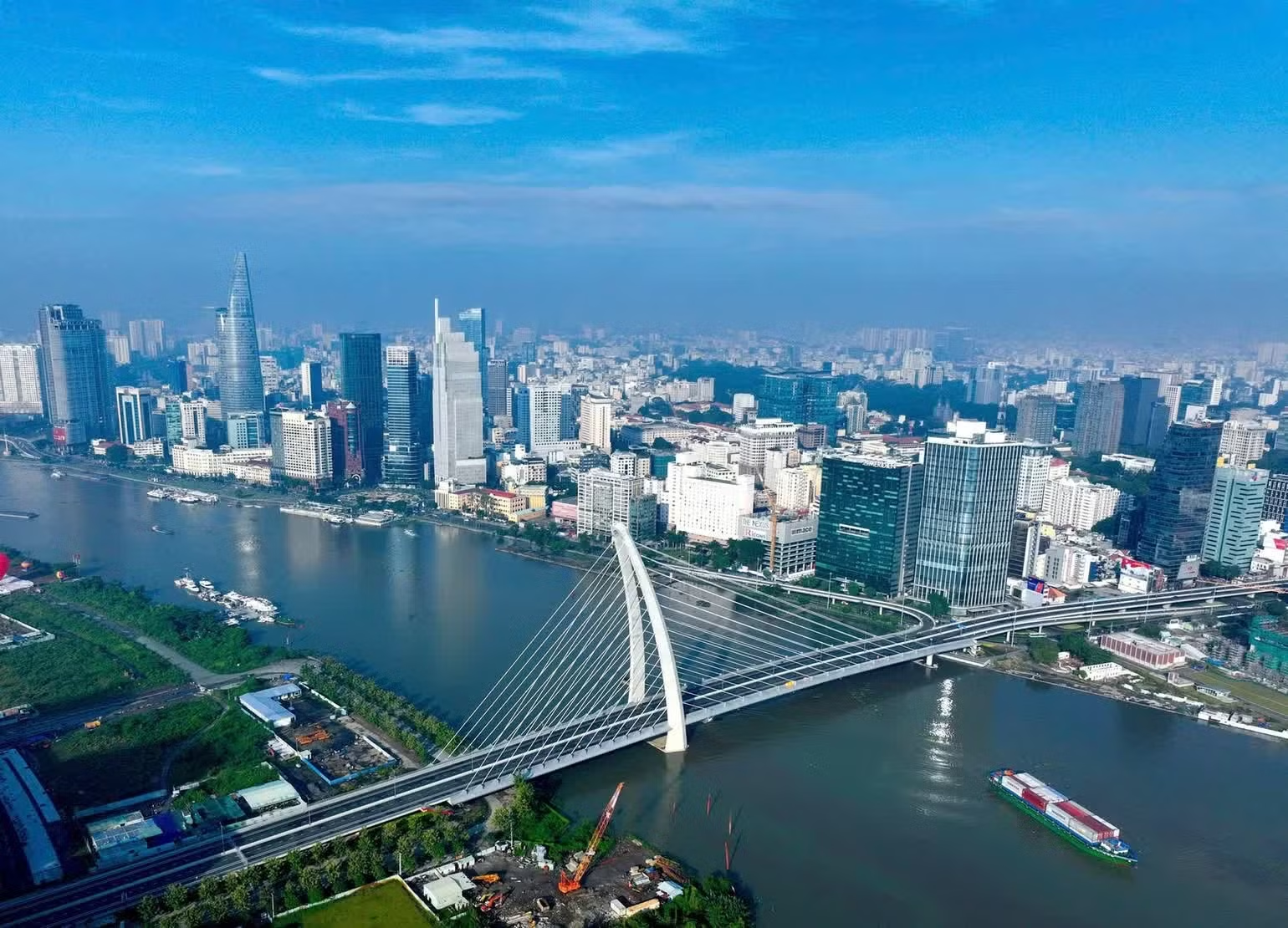
Resolution 19 establishes a mechanism for significant decentralisation in environmental protection in major cities through the use of financial instruments; it empowers these cities to proactively determine and implement environmental fees, issue green bonds, and establish low-emission zones to address long-standing pollution issues.
Resolution 19 serves to pave the way and reshape the entire mindset and approach to national spatial organisation. It acts not only as a guiding framework but also establishes a solid political foundation for removing bottlenecks and fostering the creation and development of green, smart, and sustainable urban areas.
The overarching principle of Resolution 19 is to organise urban development within an integrated, multi-layered, and interconnected spatial framework to generate strong linkages and spillover effects, while closely integrating this with the task of strengthening national defence and security — from strategic planning to physical planning and resource allocation.
Priority areas for implementation
Practical experience from recent urban development efforts indicates a need to concentrate resources on five key task groups:
Firstly, to review the entire planning system based on a multi-layered urban spatial organisation mindset, while simultaneously developing growth poles and innovation hubs linked to major economic corridors. Concurrently, it aims to establish an urban network with synergistic strength that enhances competitiveness, transforming urban areas into genuine growth poles that drive and spread prosperity throughout the region and the entire country.
Secondly, urgently formulate plans and finalise the legal framework for the management and utilisation of underground space, prioritising investment in major cities, financial–commercial hubs, and public transport interchanges in alignment with the TOD (Transit-Oriented Development) model.
Developing underground space represents a strategic growth opportunity; planning must utilise spatial analysis tools to optimally arrange underground commercial and service areas that seamlessly integrate with surface infrastructure.
This approach aims to curb urban sprawl, enhance land and infrastructure efficiency, gradually shift habits from private vehicle use to public transport, and reduce emissions.
Thirdly, implement specific financial mechanisms and decentralisation policies for major cities to empower them to take the initiative in environmental protection, green bond issuance, and — crucially — piloting “Low Emission Zone” models in special-class cities.
Fourthly, invest in the development of smart and climate-resilient urban infrastructure. Amidst increasingly extreme weather events and climate change, modern urban governance must adopt a proactive, data-driven forecasting approach.
It requires the deep integration of physical and digital infrastructure — incorporating digital data, the Internet of Things (IoT), and artificial intelligence (AI) — to enable real-time urban management, while simultaneously focusing on building urban systems resilient to natural disasters and flooding.
Fifthly, comprehensively upgrade urban quality in conjunction with the development of financial and logistics hubs, as well as high-value-added service networks. Furthermore, investing in the synchronised development of social infrastructure — particularly social housing and housing for low-income earners — must be regarded as a crucial task that helps narrow the development gap between urban and rural areas.
This ensures that all citizens share in the fruits of urbanisation and urban development and enjoy equal access to education, healthcare, and housing, thereby affirming the deeply humane nature of this new development model.