Providing an important policy foundation and significant confidence among the Vietnamese community abroad
As a Vietnamese living and working in New Zealand, Nguyen Lam Giang, Head of Southeast Asia and East Asia External Relations at the University of Waikato and Co-Chair of the Vietnamese Knowledge Network in New Zealand, said the Politburo’s issuance of Resolution No. 23-NQ/TW (August 2, 2026) on overseas Vietnamese affairs (Resolution 23) does not alter the ideological foundation of Resolution No. 36-NQ/TW, but comprehensively inherits the spirit of great national unity and advances it to a new level.
According to Nguyen Lam Giang, Resolution 23 provides an important policy foundation and strong confidence, enabling Vietnamese people abroad to integrate successfully into their host countries while maintaining their identity, staying connected with their homeland and better promoting their role as a bridge between Viet Nam and the world.
In particular, with Viet Nam and New Zealand having upgraded their ties to a comprehensive strategic partnership, the Vietnamese community in New Zealand can become a highly effective bridge, helping translate bilateral relations from commitments at the Government level into concrete cooperation in education, research, the economy, innovation, and people-to-people exchanges.
As Co-Chair of the Vietnamese Knowledge Network in New Zealand, Nguyen Lam Giang said the organisation was established in July 2026 to connect and promote the intellectual resources of the Vietnamese community, strengthen community ties, promote people-to-people cooperation as well as cooperation between the two countries, and make positive contributions to the shared development of Viet Nam and New Zealand.
The establishment of the Vietnamese Knowledge Network in New Zealand is a highly practical and timely initiative, particularly as Viet Nam is placing increasing importance on knowledge, science and technology, and high-quality human resources in the country’s development process.
Accordingly, the Vietnamese Knowledge Network in New Zealand serves as a platform to connect and promote Vietnamese intellectual resources in New Zealand. The network aims not only to bring together scientists, academics, lecturers, experts, and entrepreneurs but also to connect more broadly with Vietnamese people studying and working in New Zealand and those with practical experience there. Through this, the network can serve as a channel for sharing New Zealand’s knowledge and experience with Viet Nam, while also bringing Viet Nam’s practical needs and challenges to the Vietnamese community of experts in New Zealand.
“The Vietnamese intellectual community in New Zealand holds a very special position because we understand Viet Nam while also having experience and networks in New Zealand. This is precisely the advantage that enables us to serve as a bridge for promoting joint research programmes, academic exchanges, training partnerships, knowledge transfer, and cooperation among universities, research institutes, and businesses in the two countries,” Nguyen Lam Giang stressed.
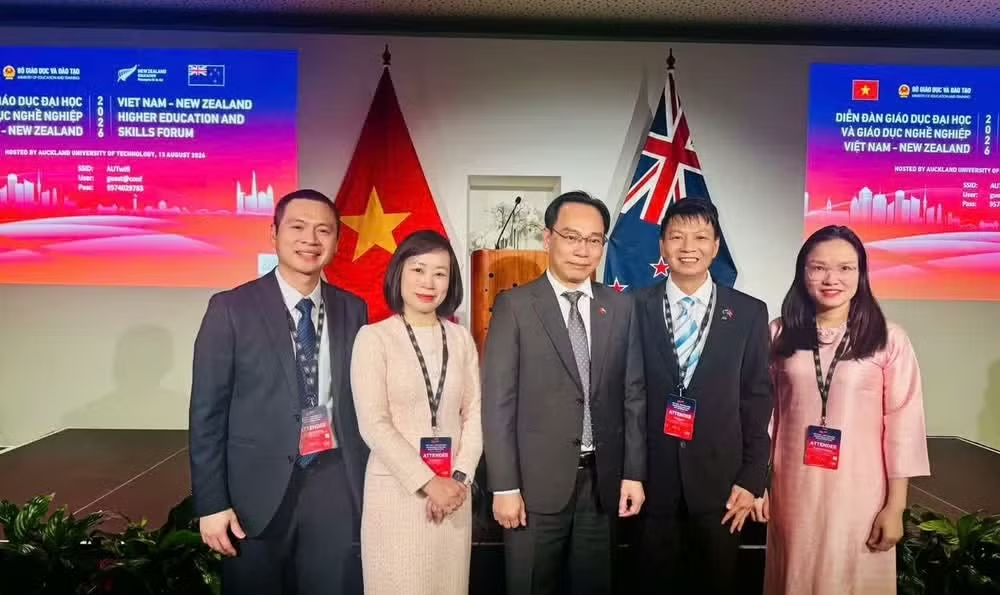
From a broader perspective, Nguyen Lam Giang said the establishment of the Vietnamese Knowledge Network in New Zealand is a concrete action to realise the spirit of Resolution 23, turning the intellectual resources of overseas Vietnamese into concrete connections, initiatives, and projects for the homeland.
If this is done effectively, the Vietnamese Knowledge Network in New Zealand can not only bring value to the Vietnamese community but also become an important bridge for knowledge and human resources, contributing to deepening the Viet Nam-New Zealand Comprehensive Strategic Partnership and generating concrete, long-term results.
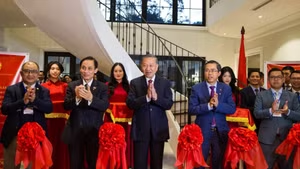
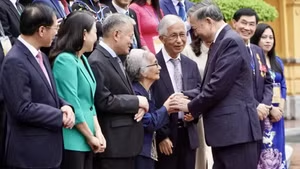
Highlighting the significance of General Secretary and President To Lam taking the time to meet with the Vietnamese community in New Zealand during his State visit to New Zealand in August, Nguyen Lam Giang said the meeting took place shortly after the Politburo issued Resolution 23, making it even more meaningful as a concrete continuation linking policies and guidelines with the community’s life.
Reflecting a new vision in line with international integration and Viet Nam’s development
Like Nguyen Lam Giang, Nguyen Van Thai, Chairman of the Vietnamese Association in Wellington, New Zealand, expressed his enthusiasm and high expectations for Resolution 23.
According to Nguyen Van Thai, a particularly important new point in Resolution 23 is a major shift in thinking from primarily mobilising, bringing together, and caring for the community to accompanying overseas Vietnamese, creating mechanisms, and mobilising their resources so that they can participate more deeply in the cause of national construction and development.
Accordingly, Nguyen Van Thai particularly appreciates the resolution’s view that overseas Vietnamese are an integral part of the Vietnamese national community, as well as one of the country’s important strategic resources and a bridge between Viet Nam and the world. This is not merely an expression of emotional recognition but also reflects a new vision that is highly consistent with the trend of international integration and Viet Nam’s development in the new period.
Nguyen Van Thai said that although the Vietnamese community in New Zealand is not large, currently numbering around 15,000, it has many strengths in knowledge, education, business, science and technology, and international connectivity. Thai expressed his hope that Resolution 23 would continue to open more specific, favourable, and substantive mechanisms, enabling every Vietnamese living abroad to contribute to the homeland, according to their abilities and circumstances.
“I hope the resolution will create more bridges connecting overseas Vietnamese with agencies, localities, businesses, universities, and organisations in Viet Nam so that the ideas, initiatives, experience, and resources of Vietnamese people abroad can return to Viet Nam more quickly and conveniently and generate more practical value. Simply, I hope overseas Vietnamese will not only be seen as people who look towards their homeland but will truly become partners accompanying the homeland on its development journey,” Nguyen Van Thai said.
Sharing his views on the impact of the new points in Resolution 23 on the Vietnamese community abroad and their direct participation in national construction and development in the new period, Nguyen Van Thai said the resolution’s greatest impact is to bring about a change in the position and manner of participation of overseas Vietnamese.
Previously, when discussing the contributions of Vietnamese people abroad, we often thought of remittances, charitable activities, investment, or programmes oriented towards the homeland. Such contributions are highly valued. However, in the new period, the resources of overseas Vietnamese are much greater. They include knowledge, science and technology, management experience, international networks, trade relations, innovation capacity, and, in particular, the ability to connect Viet Nam with the world.
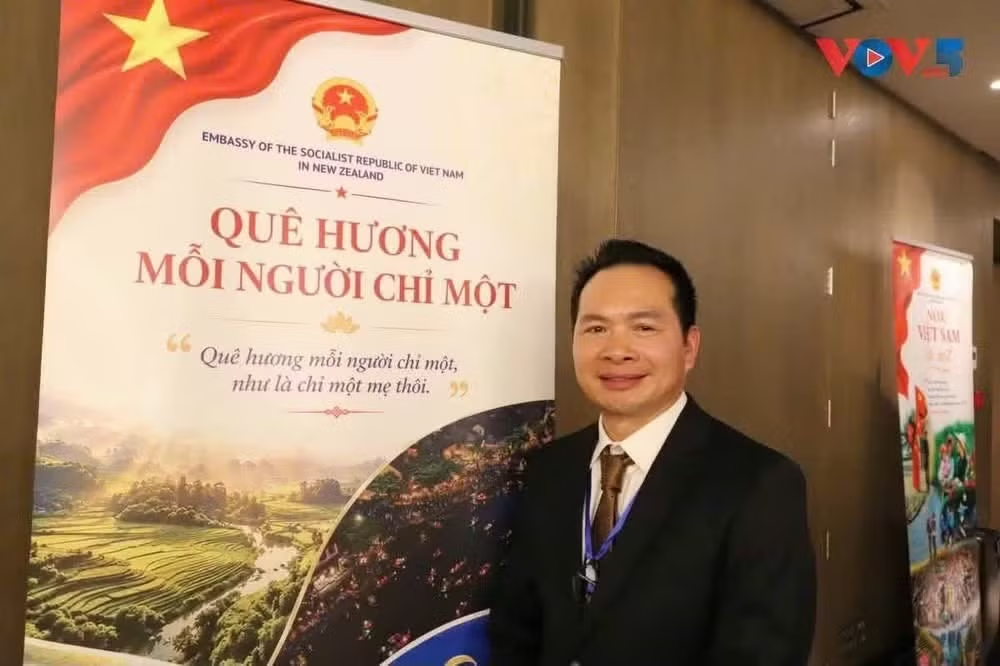
Nguyen Van Thai stressed that Resolution 23 has raised the issue of developing breakthrough mechanisms and policies to attract, connect, and promote the resources of experts, intellectuals, scientists, entrepreneurs, artists, and young Vietnamese people abroad. At the same time, the resolution emphasises the formation of sustainable global networks connecting Vietnamese people. This is also an issue of great interest to the Vietnamese community in New Zealand.
According to Nguyen Van Thai, New Zealand has strengths in education, science, high-tech agriculture, the green economy, governance, and sustainable development. If effective connection mechanisms can be established, Vietnamese people in New Zealand can fully become a bridge for knowledge and cooperation between the two countries.
For example, a Vietnamese expert in New Zealand could connect a New Zealand university with a Vietnamese university; a businessperson could help Vietnamese products gain access to the New Zealand market; a scientist could participate in joint research projects; and a young person could connect start-up, innovation, and cultural exchange activities between young people in the two countries.
What Nguyen Van Thai wants is for the contributions of overseas Vietnamese to be transformed from individual activities into organised cooperation programmes with clearly identified partners and concrete results.
“When the State creates an open, transparent, and favourable mechanism, while overseas Vietnamese promote their sense of responsibility and national pride, geographical distance will no longer be an obstacle. Whether living in New Zealand, Australia, Europe, North America, or anywhere else, Vietnamese people can contribute to a common goal: building an increasingly prosperous, civilised, and modern Viet Nam with a stronger position on the international stage,” Nguyen Van Thai stated with confidence.