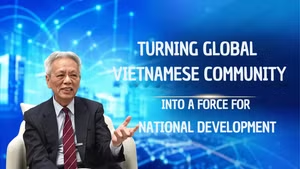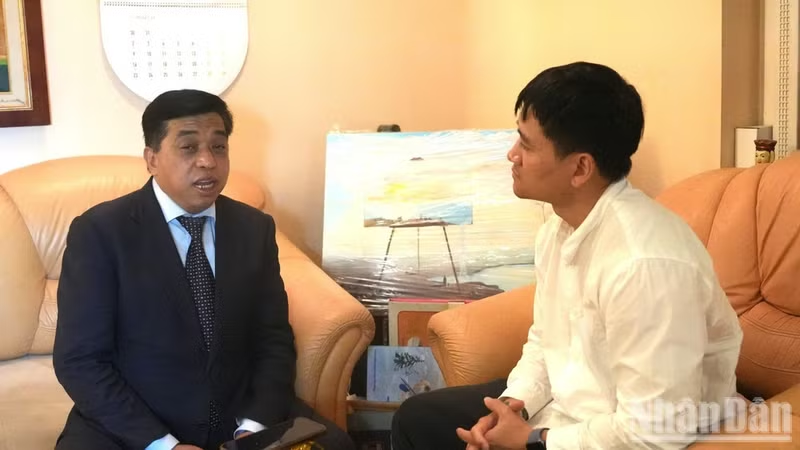
Speaking to a correspondent of Nhan Dan Newspaper in Russia about the new aspects of Resolution 23, Tran Phu Thuan said that one of the important changes was a shift in perceptions of the position, role, and resources of the overseas Vietnamese community.
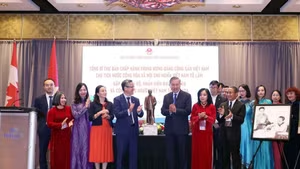
According to him, while Resolution No. 36-NQ/TW (issued in 2004) defined Vietnamese people overseas as an inseparable part of the Vietnamese national community, Resolution 23 further elevates this understanding by identifying overseas Vietnamese as one of the important strategic resources contributing to strengthening the country's overall national strength.
The overseas Vietnamese community currently numbers around 6.5 million, nearly double the figure compared to when Resolution 36 was issued. Alongside the increase in numbers, the quality of the community's resources has also improved, with large numbers of scientists, experts, entrepreneurs, young intellectuals, and people with experience in management and international relations.
“In the past, we mainly mobilised, brought together, and supported our compatriots so that they could turn towards their homeland. Now, we must identify the need to harness the knowledge, expertise, and all the resources of overseas Vietnamese to contribute to national development and defence,” Tran Phu Thuan stressed.
Building a global overseas Vietnamese ecosystem
One of the provisions that Tran Phu Thuan highly values is the policy of building an overseas Vietnamese ecosystem around the world, establishing community networks by field of expertise.
According to him, instead of connecting overseas Vietnamese only through conferences, seminars or community organisations, it is necessary to establish regular networks bringing together Vietnamese scientists, entrepreneurs, parliamentarians, experts, and younger generations in many countries.
This model would enable Vietnamese experts and intellectuals overseas to contribute to the country without necessarily returning to Viet Nam to work full-time.

“Experts and intellectuals do not need to return home. They can continue their work in their host countries while still making highly effective contributions to the country through mechanisms and direct commissions from the state. When they participate in a network, their contributions can be made on a regular basis. Whenever there is a new proposal, it can quickly be brought to the network for consultation, discussion, and promotion,” he said.
According to him, this has major practical significance. Scientists can provide consultancy, transfer technology, conduct research, and address specific national issues from where they live and work.
This also helps remove some of the barriers that existed in the past, when some scientists and experts wishing to contribute to Viet Nam had to choose between returning home and potentially giving up their jobs and research environments in their host countries.
“Now, with the creation of a global network, they can work in parallel without being required to return to Viet Nam,” Tran Phu Thuan said.
From preserving identity to promoting soft power
Another new aspect that Tran Phu Thuan particularly values is the approach to culture. According to him, work related to overseas Vietnamese people should not stop at preserving national cultural identity within the community but should also aim to promote soft power and Viet Nam’s image around the world.
Under this approach, every overseas Vietnamese person can become an “ambassador”, helping introduce the country, people, and culture of Viet Nam to international friends.
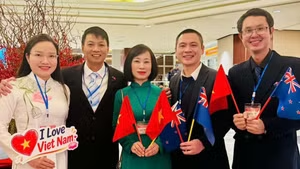
He said that younger generations, particularly Vietnamese students studying overseas, have many advantages in performing this role. They have international friendship networks and study and live alongside people in their host countries, giving them opportunities to introduce Viet Nam in a natural and effective way.
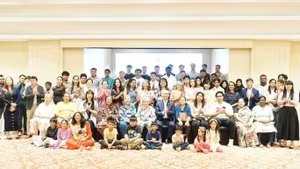
According to Tran Phu Thuan, the Vietnamese community in Russia was established a long time ago, has a strong spirit of solidarity and regularly organises activities aimed at promoting Viet Nam’s image. Vietnamese cultural activities held in Russia attract considerable interest from local people.
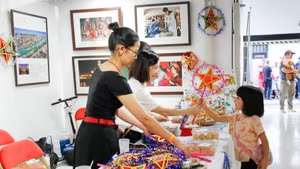
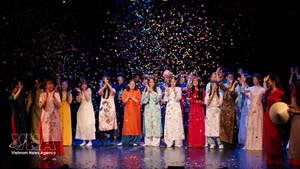
Specifically, in Russia, the Vietnamese community regularly organises cultural, artistic, and sporting activities, as well as exchanges with local people. Programmes introducing Vietnamese culture at universities, activities held on the occasions of the traditional Tet holiday and Mid-Autumn Festival, Viet Nam Cultural Day, and friendship events provide opportunities for Vietnamese students to directly introduce Vietnamese traditions, cuisine, and folk arts.
According to Tran Phu Thuan, Vietnamese students in Russia can also promote Vietnamese tourism through everyday activities, such as introducing destinations and attractions that match the interests of their Russian friends.
“We do not go abroad merely as individuals. Behind us is the entire Vietnamese community in Russia and, more broadly, the image of Viet Nam,” he said.
Leveraging the advantages of Viet Nam-Russia cooperation
From the perspective of the Vietnamese community in Russia, Tran Phu Thuan said that Resolution 23 is being implemented at a time when Viet Nam-Russia relations have many favourable conditions.
Russia has strengths in many fields in which Viet Nam needs cooperation, including science, technology, energy, nuclear physics, transport, and digital transformation.
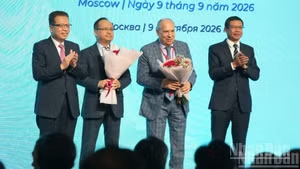
Tran Phu Thuan, Vice Chairman and Secretary-General of the Union of Vietnamese Organisations in Russia, said that the Vietnamese community in Russia, particularly the intellectuals who study and conduct research there, can serve as a bridge and contribute to promoting cooperation between the two countries.
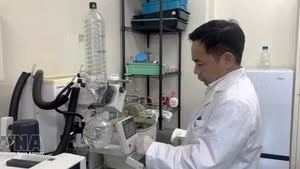
As a scientist who studied and taught railway engineering in Moscow, Tran Phu Thuan is particularly hopeful about Viet Nam-Russia cooperation in developing urban railways.
According to him, Ha Noi and Ho Chi Minh City have major demand for metro system development. Russia has considerable experience and strengths in railways, metro systems, and related technologies. “As a scientist, I hope our state will take very specific steps to make cooperation with Russia effective at an early date,” he said.
Tran Phu Thuan also said that selecting Russia’s areas of strength for cooperation, while making full use of the Vietnamese experts and scientists living and working in Russia, would help bring Resolution 23 into practical and meaningful implementation.
The younger generation must become worthy “ambassadors”
For Vietnamese students in Russia, Tran Phu Thuan expressed three wishes.
First, students sent abroad to study by the state should strive to study well, fulfil their responsibilities, and become exemplary and outstanding individuals.
Second, each student should become a worthy “ambassador” of Viet Nam, proactively participating in collective activities, cultural exchanges, and efforts to promote the country’s image. According to him, collective activities are also an important environment for young people to develop skills, gain experience, and mature.
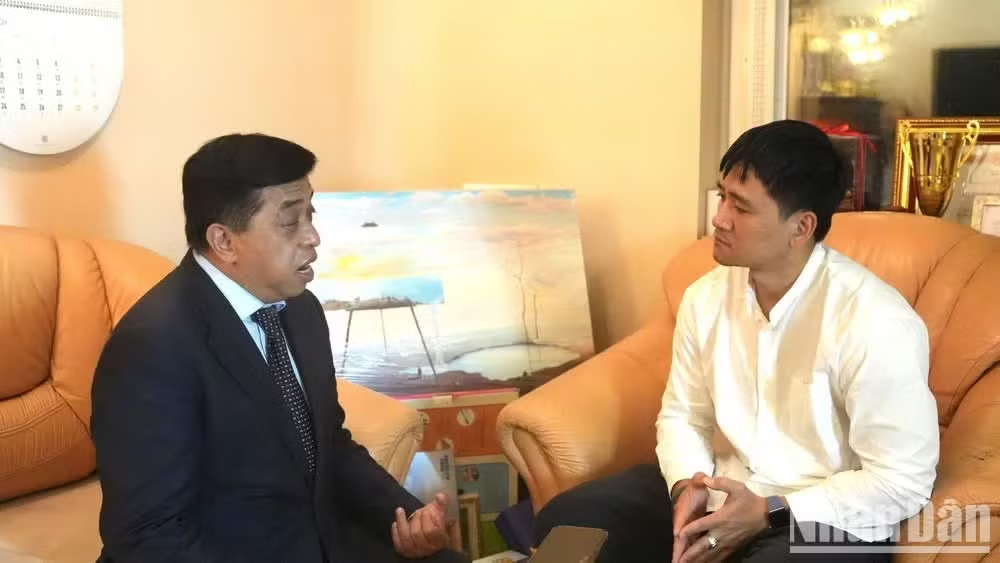
Third, wherever they study and work, every young person should always remember that they are Vietnamese and proactively introduce the country’s good values and cultural heritage to international friends.
“Always remember that you are Vietnamese. Introduce the beauty of Viet Nam to your friends and learn from their finest qualities to return to and build the country,” Tran Phu Thuan stressed.
According to him, this is also a key spirit of Resolution 23, creating conditions for the Vietnamese community overseas not only to look towards their homeland but also to truly become a resource for national development and a bridge helping strengthen friendship and cooperation between Viet Nam and countries around the world.