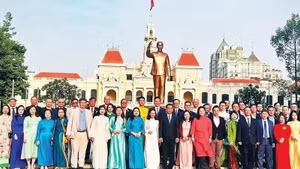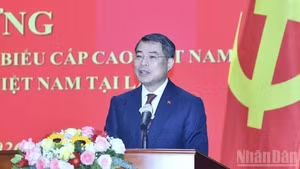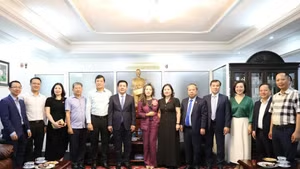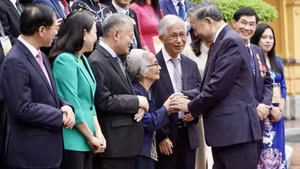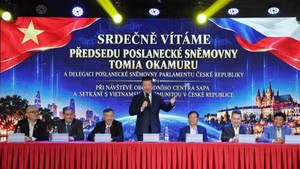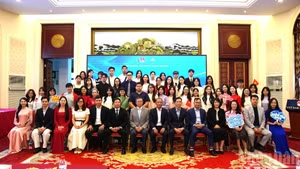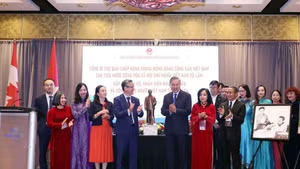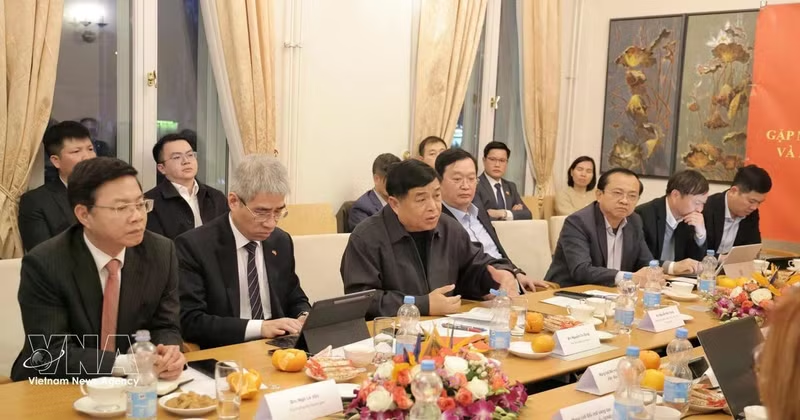
He made the call at a working session on March 22 with staff of the Vietnamese Embassy, members of the Viet Nam–Germany Innovation Network (VGI), and Vietnamese experts, intellectuals and entrepreneurs in Germany and across Europe, during his working visit to the country.
The Deputy PM noted that after nearly four decades of Doi moi (renewal), Viet Nam has achieved significant progress, ranking among the world’s 32 largest economies, the top 15 developing countries attracting the most foreign direct investment (FDI), and the top 20 in global trade. GDP per capita has surpassed 5,100 USD, placing the country in the upper-middle-income group by World Bank standards.
He stressed that the 14th National Party Congress set ambitious goals, with the major challenge being to mobilise resources, sustain rapid and sustainable growth, and achieve the goal of becoming a high-income developed country by 2045. Science and technology, innovation and digital transformation were identified as key drivers for breakthroughs.
Praising the National Innovation Centre (NIC) and relevant agencies for building the innovation network and connecting experts in strategic technologies, Dung said cooperation potential remains substantial and should be further tapped.
He underscored the need to prioritise research and mastery of core, foundational and source technologies, while ensuring that science and technology activities align with local conditions and practical demands. Research efforts should focus on 11 technology groups and 35 strategic product groups identified by the Government to form strong research teams and drive economic breakthroughs.
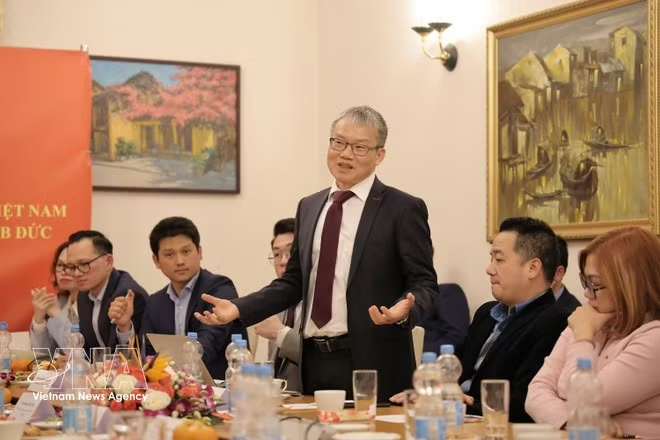
The Deputy PM tasked the Ministry of Science and Technology, the Vietnamese Embassy in Germany and NIC with strengthening connections with Vietnamese intellectuals and experts in Germany and Europe in order to translate their ideas into concrete programmes.
He affirmed that the Party, State and Government always support and expect contributions from overseas Vietnamese intellectuals, pledging favourable conditions for them to maximise their potential and contribute to national development while maintaining close ties with their homeland.
Ambassador Nguyen Dac Thanh reported that the representative agencies has prioritised cooperation in science, technology and innovation, adding that the embassy will continue fulfilling tasks assigned by the Party and State to further strengthen bilateral ties.
Professor Dr. Nguyen Xuan Thinh of TU Dortmund University, also President of VGI, along with Vietnamese experts and entrepreneurs, shared insights into Germany’s experience in developing artificial intelligence (AI) and its potential applications in Viet Nam. They also discussed the use of AI in construction, healthcare and high-speed rail, energy storage solutions, and mechanisms to connect global Vietnamese intellectual and business networks.