Universities: The core role in human resource training
Politburo Resolution No. 71-NQ/TW, issued on August 22, 2025, identifies higher education as the core of developing highly qualified human resources and talent, while promoting science, technology, and innovation. One year on, the orientations set out in the resolution have begun to be concretised through policies and training programmes.
According to an assessment of the results after one year of implementing Resolution No. 71-NQ/TW, the number of university students enrolling in Science, Technology, Engineering, and Mathematics (STEM) disciplines in 2026 increased by 33.6%; around 110,000 students are studying key engineering and strategic technology fields. Notably, 90 training programmes for talented STEM engineers and master's students have been launched across 23 higher education institutions. These figures show that higher education resources are gradually being directed more strongly towards fields where the economy and scientific and technological development are creating urgent demand.
In 2026, Viet Nam National University, Ha Noi (VNU) did not use upper-secondary school academic records in admissions, while stepping up admissions through competency assessment examinations. Instead of expanding fields of study across the board, the university has focused resources on improving existing programmes, particularly in engineering, technology, and STEM talent training programmes. As of August 2026, VNU had registered 27 training programmes with the Ministry of Education and Training, including 15 approved STEM talent training programmes.
Fields such as artificial intelligence, semiconductors, and strategic technologies continue to be expanded. The university has also identified increasing practical training and internships at businesses, aligning programmes with learning outcomes, and stepping up the application of AI and digital transformation in training. Prof, DSc Nguyen Dinh Duc, former Chairman of the University Council of VNU University of Engineering and Technology, said the next stage needs to shift from “opening the way” to “delivering results”, with measurable changes in the quality of learners, staff, research, and innovation.
At VNU, alongside developing talented programmes, the university is moving towards increasing practical courses, projects, and internships at businesses linked to learning outcomes; strengthening links between training and scientific research; and developing a digital university ecosystem, data-based governance, and greater internationalisation.
From the learners’ perspective, these changes require technology students not merely to study to complete their credits but also to know how to conduct research, work with data, use technology, solve problems, and adapt to real working environments. This represents a shift from a STEM student pool to a STEM workforce.
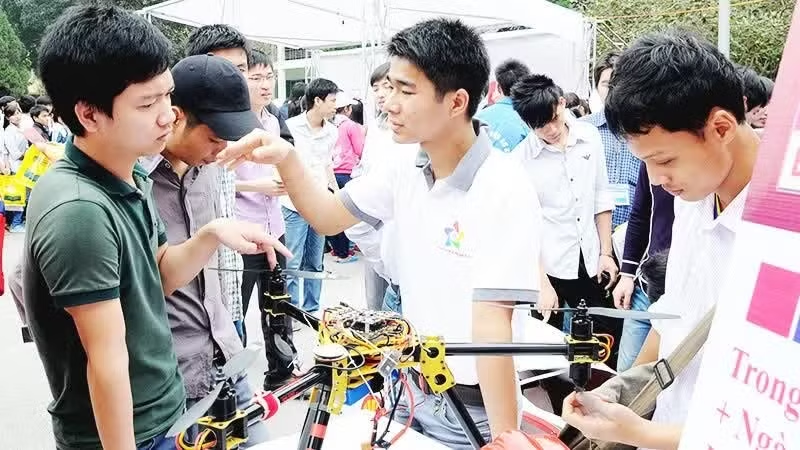
Creating an environment for development
Resolution 71 sets the goal of developing highly qualified human resources and talent. For universities, this does not stop at recruiting good students but also requires creating an environment in which their abilities can continue to develop. The Ha Noi University of Science and Technology (HUST) is a case that clearly illustrates this requirement.
In 2026, the scholarship policy under Decree No. 179/2026/ND-CP was implemented for 55 programmes in fields including talented training, semiconductor integrated circuits, basic sciences, and key engineering and strategic technologies. Among them, talented programmes in Electronics and Telecommunications and Control and Automation Engineering continue to be implemented. The talented Electronics and Telecommunications programme is expected to last five years, integrating bachelor’s and master’s degrees.
Prof, Dr Le Anh Tuan, President of HUST, said that to turn the STEM student pool into a highly qualified technology workforce, universities must address bottlenecks related to lecturers and leading experts, modern laboratories, computing infrastructure, and the gap between training and businesses’ needs. HUST is adjusting its training organisation towards increasing interdisciplinary and talented programmes and internationalisation, while expanding postgraduate training linked to research and businesses.
Thus, the challenge of training talent is not merely about bringing talented people into universities but also about creating an environment in which they can continue to develop. A student with strong abilities in mathematics, physics, or computer science will find it difficult to become a high-tech engineer without access to equipment, laboratories, and real-world problems. Similarly, a student with research ability needs to work with teachers who have sufficiently strong professional and research capabilities to provide guidance.
This is why investment in talented training must go hand in hand with investment in staff and the research environment. This approach is also reflected at Phenikaa University. In 2026, the university recruited 65 students nationwide for two talented training programmes in Computer Science and Semiconductor Science and Technology. The two programmes are organised under an integrated bachelor’s-master’s model over five years. Students gain early access to scientific research and work under the guidance of professors, scientists, and experts, with opportunities to participate in ministerial-, national-, and international-level research projects.
Under the Semiconductor Science and Technology programme, students are equipped with an interdisciplinary foundation spanning Mathematics, Physics, Chemistry, Materials Science, Electronics, and Simulation, with a focus on developing their ability to design, manufacture, and optimise semiconductor materials, structures, and devices.
The changes in higher education must ultimately be reflected in learners. Ha Tai Thanh, a K16 student in the Talented Computer Science programme at Phenikaa University, is an example. Alongside his studies, Thanh participates in optimisation research at ORLab and serves as Chairman of the Phenikaa Music Club.
This story is notable not merely for the activities of one student but also for how a university environment can open multiple spaces for young people to develop: studying their specialism, conducting research, working in teams, organising activities, and pursuing individual capabilities.
Talent training cannot begin only with recruiting good students. Behind every talented programme must be a sufficiently strong team of lecturers and experts, laboratories and research ecosystem. According to Prof, DSc, Dr Duong Quy Sy, a member of the National Council for Education and Human Resource Development, the development of STEM disciplines and strategic technology fields must be linked to teaching staff, scientific research, laboratories, innovation, and human resource needs; universities must become centres for training highly qualified human resources while also generating knowledge and technology for the country.
The past year of implementing Resolution 71 has shown relatively clear initial steps: policies are beginning to be translated into training programmes; more resources are being focused on STEM; talented programmes are being expanded; scholarships are being designed to attract learners to priority fields; and universities are beginning to adjust their curricula and training methods while strengthening links with businesses and research.
However, bottlenecks remain. According to Prof Duong Quy Sy, the gaps between orientations and institutions, between institutions and implementation, and between policies and actual outcomes for learners still need to be narrowed. The next stage must shift strongly from “policy issuance” to “results-based governance”, with clear objectives, indicators, roadmaps, resources, and responsible parties.
Ultimately, the impact of the resolution must be reflected in learners’ capabilities when they leave the lecture hall: What can they do, what can they research, what can they create, and how can they contribute to the fields in which the country has placed its expectations?