The main solution that the locality is resolutely implementing is attracting investment and boosting exports, with a focus on attracting investment with modern, environmentally friendly technology to create a foundation for rapid and sustainable development.
Despite many fluctuations in the global situation, in the first four months of this year, Thai Nguyen province attracted over 7.75 billion USD in foreign direct investment (FDI), equivalent to 60% of the total for previous years combined; at the same time, exports reached over 12 billion USD, becoming a bright spot in investment attraction and export.
Creating new opportunities
Thai Nguyen’s favourable geographical location, adjacent to Ha Noi, bordering the industrially developed provinces of Bac Ninh and Phu Tho, near airports and seaports, and being the third-largest center for high-quality human resource training in the country, are favorable factors for the province to attract investment.
On the other hand, the province has been investing in opening and upgrading many large-scale internal and inter-provincial/inter-regional roads, not only strengthening transportation connectivity but also creating new development opportunities.
When the roads in the southern part of the province, namely the Bac Ninh-Thai Nguyen-Phu Tho regional road and the Ha Noi Capital Region’s Ring Road 5 connecting the Ha Noi-Thai Nguyen expressway through industrial zones and clusters in the south and Bac Ninh province, were built and put into use, it truly opened up new development opportunities for Thai Nguyen province.
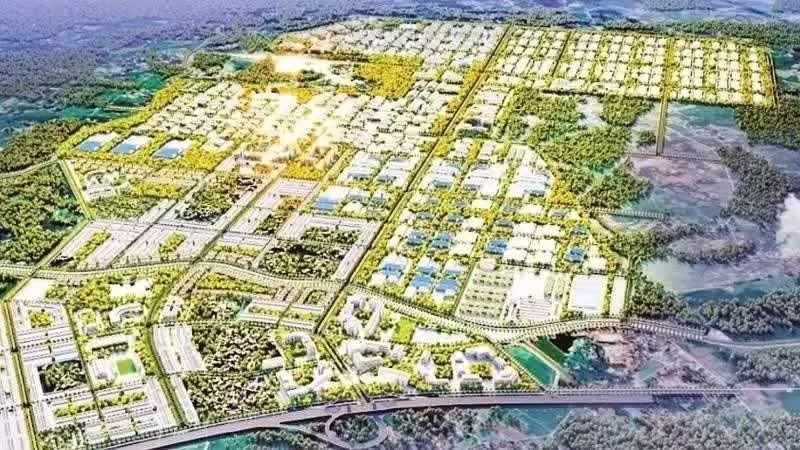
According to Nguyen The Hoan, Head of the Provincial Industrial Parks Management Board, to create room for attracting investment, in addition to highly connected transportation routes, Thai Nguyen has planned 37 industrial parks and one information technology industrial park with a total area of nearly 14,000 hectares.
Currently, six industrial parks are under infrastructure construction with an area of over 2,000 hectares to create clean land for investment attraction. By June 30th, detailed planning for 16 more industrial parks will be approved, creating a basis for approving investment policies and selecting investors to build infrastructure, he noted.
Drawing on practical experience, Thai Nguyen province has recently selected investors with experience, financial capacity, and reputation, so the construction of industrial park infrastructure has been implemented quickly and with high quality.
For example, the Song Cong II Industrial Park, Phase 2, covers nearly 300 hectares with an investment of nearly 4 trillion VND, developed by Viracera Thai Nguyen Joint Stock Company. One year after its commencement, it has created 120 hectares of cleared land with complete infrastructure and has so far attracted 350 million USD from secondary investors with modern technology.
It is expected that by the end of 2026, this industrial park will complete its infrastructure construction to create land reserves for attracting investment. The Yen Binh II Industrial Park, with a total area of 299 hectares and a total investment of 3,650 billion VND, is currently under infrastructure construction but has already attracted billions of USD in FDI.
Nguyen Trung Kien, Deputy General Director of Yen Binh Investment and Development Company, the investor of Yen Binh II Industrial Park, stated that cleared land will be handed over to secondary investors for factory construction in June 2026.
Along with creating opportunities to attract investment, Vuong Quoc Tuan, Member of the Party Central Committee, Deputy Secretary of the Provincial Party Committee, and Chairman of the People’s Committee of Thai Nguyen Province, pledged: “The province will continue to improve the investment environment, creating the most favourable conditions for the business community to invest in the province. Because attracting investment is the main driving force for local socio-economic development.”
In recent times, Thai Nguyen has resolutely reformed its administrative procedures through the “24-hour green channel” and “60% green channel” mechanisms to reduce the time and costs of compliance for businesses, creating favourable conditions for investors. For example, in the first quarter of 2026, all administrative dossiers were processed correctly and ahead of schedule.
According to Nguyen Van Thoi, Chairman of the Provincial Business Association, recently, the governance method of Thai Nguyen province has fundamentally changed, shifting strongly from management to service, creating a favorable environment for development. Specifically, instead of leaving businesses to fend for themselves, relevant authorities and agencies have partnered with businesses in resolving administrative procedures, land clearance, and land issues.
The Thai Nguyen Industrial Parks Management Board has provided practical support to investors, such as assisting with administrative procedures related to land, construction permits, investment, labor, and connecting businesses with relevant departments and agencies, thus giving investors a genuine sense of partnership.
According to the Head of the Provincial Industrial Parks Management Board, Nguyen The Hoan, from the beginning of the year to May 15th, Thai Nguyen’s industrial parks attracted over 7.75 billion USD in FDI, the highest in the country. It is projected that by the end of the second quarter of 2026, approximately 8 billion USD will be attracted, bringing the total FDI invested in industrial parks in the province to over 18.7 billion USD.
In addition, the province is decisively directing departments, agencies, and localities to create the most favorable conditions for investors to accelerate the disbursement of this capital, bringing factories into production and business as soon as possible to create more jobs and export goods.
Boosting exports
In the context of geopolitical instability, especially conflicts in the Middle East, Thai Nguyen not only proactively invites the shift of FDI investment and connects production supply chains, but also adapts, consolidates, and expands export markets to the US, Europe, the Republic of Korea, Japan, the Middle East, etc., so the province’s export value has achieved impressive results.
Specifically, in the first four months of 2026, the province’s goods exports reached 12.2 billion USD, an increase of more than 19% compared to the same period, with a trade surplus of 4.3 billion USD. Goods produced using modern technology such as mobile phones, tablets, and electronic products accounted for a large proportion and showed continuous growth for many years.
In addition, imports of machinery, equipment, components, and raw materials for export production increased by 18.6% in the past four months compared to the same period last year. This shows that the local government and business community are making efforts to increase production and expand export markets.
As one of the centres for garment exports with approximately 40,000 workers, despite fluctuations in gasoline and oil prices affecting transportation and supply chains, garment businesses in Thai Nguyen have proactively worked with suppliers of materials and raw materials, and transportation companies to meet the increased demand for production and export.
Therefore, in the first four months of this year, Thai Nguyen’s garment export value reached 178 million USD, an increase of nearly 13% compared to the same period last year, stabilizing employment and the lives of workers.
To date, many businesses have secured orders for the rest of the year, such as TNG Investment and Trading Joint Stock Company, the largest garment company in the area with nearly 20,000 workers, which has long-term orders and aims for a growth rate of over 10% in 2026, with revenue reaching 9.5 trillion VND and after-tax profit of 450 billion USD.
This shows that the export market is recovering, and businesses are able to leverage trade agreements and adapt to global trade fluctuations, enabling the province to aim for 33.5 billion USD in exports this year.
Thai Nguyen is also accelerating the construction of approximately 60,000 social housing units, not only addressing social welfare issues but also contributing to a significant workforce in the industrial sector, the main export production force, and contributing to attracting investment and sustainable development in the coming years.