A strategic shift to elevate foreign investment
Commenting on the changing pattern of FDI inflows, Nguyen Van Duoc, Member of the Party Central Committee and Chairman of the Ho Chi Minh City People's Committee, said that the city is fundamentally transforming its investment attraction strategy. Priority is now being given to projects with advanced technologies, high added value, strong research and development (R&D) capabilities, technology transfer potential, and significant spillover effects for the business community. This marks a strategic transition from attracting capital alone to attracting knowledge, technology, and advanced management expertise.
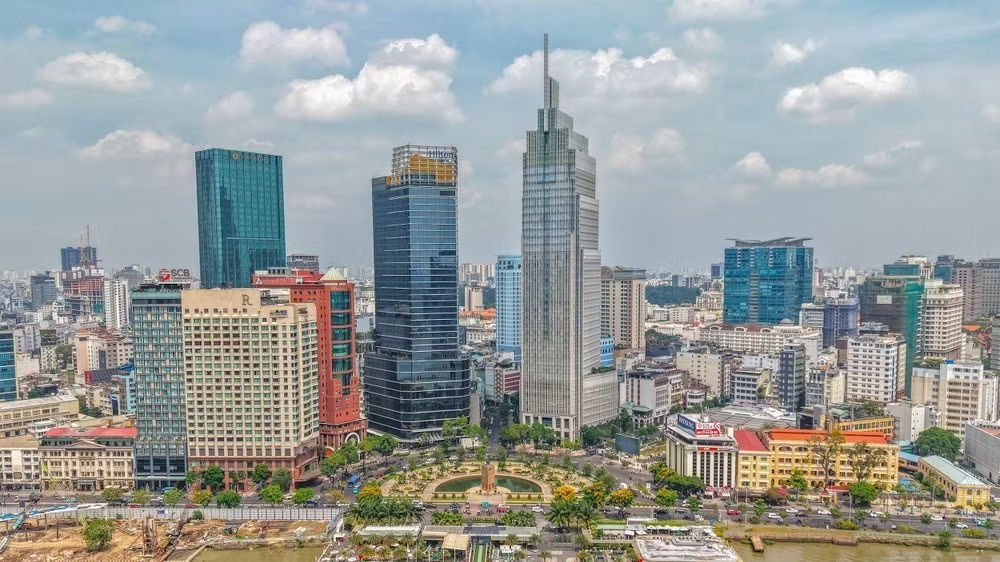
During the first six months of 2026, Ho Chi Minh City remained one of Viet Nam’s leading destinations for FDI, attracting more than 6.8 billion USD, more than double the figure recorded during the same period in 2025. Notably, investment has seen a marked shift towards high-tech industries, finance, artificial intelligence (AI), the semiconductor industry, logistics services, and research and development centres.
According to projections by the Department of Finance, total FDI inflow into the city could reach 10–12 billion USD by the end of the third quarter of 2026. To accommodate this investment, the city is no longer expanding industrial parks under the traditional model but is instead focusing on developing new growth poles based on technology, innovation, and international financial services.
The city has prioritised the development of a Strategic Technology Development Centre within the Ho Chi Minh City High-Tech Park. According to the High-Tech Park Management Board, planning is being finalised for a nearly 53-hectare site designed in accordance with green, clean, and digital standards. The development will comprise dedicated zones for pilot high-tech manufacturing, artificial intelligence, data centres, as well as training, research, and business incubation. The project is expected to become a core platform linking manufacturing, research, and start-up activities.
A distinctive feature of the new strategy is the city's adoption of more stringent requirements for major investors, including commitments to research and development, local workforce training, higher localisation rates, and the application of regulatory sandbox mechanisms for emerging technologies.
Assessing the city's FDI performance, Vu Binh Minh, Director of Global Markets Sales under the Global Banking and Markets Division of HSBC Vietnam, said that during the first half of 2026, foreign direct investment continued to represent a strong vote of confidence in Viet Nam’s economy. Despite macroeconomic challenges such as exchange rate and interest rate pressures and structural growth drivers, including public investment and high-quality capital inflow, would provide solid support for economic growth.
This is an important driving force that will help domestic enterprises improve their competitiveness, integrate more deeply into global value chains, and provide the foundation for Ho Chi Minh City to maintain its role as the country’s economic locomotive in a new era of development.
Vu Binh Minh, Director of Global Markets Sales, Global Banking and Markets Division, HSBC Viet Nam.
Developments on the ground indicate that the new generation of foreign direct investment brings not only financial capital but also advanced technologies, modern management capabilities and internationally recognised standards.
International financial centre to attract high-quality FDI
Alongside high technology, the establishment of the Viet Nam International Financial Centre in Ho Chi Minh City (VIFC-HCMC) has been identified as the second strategic pillar for attracting high-quality foreign investment.
Estimates indicate that between 2026 and 2035, Viet Nam will require approximately 1.5–1.6 trillion USD in investment capital to achieve its sustainable development objectives. Of this, Ho Chi Minh City alone will need to mobilise around 3.2 quadrillion VND during the 2026–2030 period. Meeting this demand requires a modern financial institution capable of connecting effectively with international capital markets.
Nguyen Van Duoc affirmed that the International Financial Centre will bring together global investment banks, financial institutions and investment funds, serving as a bridge for advanced management technologies, transparency standards, data resources and international networks of experts.
The International Financial Centre will bring together investment banks, financial institutions and global investment funds, serving as a bridge for advanced management technologies, transparency standards, data and international networks of experts.
Nguyen Van Duoc, Member of the Party Central Committee and Chairman of the Ho Chi Minh City People's Committee.
The initiative has received strong international support. During the Finance Roundtable held in mid-July 2026 at Columbia University in New York, the US, chaired by Nguyen Cong Vinh, Vice Chairman of the Ho Chi Minh City People's Committee, and moderated by Richard McClellan, Chief Executive Officer of VIFC-HCMC, leading financial institutions and technology corporations held extensive discussions on the roadmap for developing the centre.
At the event, Qualcomm submitted a letter of intent expressing its wish to become a member of VIFC-HCMC and expand its investment in the city. This interest reflects the clear shift among multinational corporations from expanding manufacturing alone towards investment in research and development, artificial intelligence, semiconductors, data centres and financial technology (fintech). Ho Chi Minh City is gradually moving beyond its traditional role as an industrial hub to become a regional centre for knowledge, technology and finance.
Supportive government policies, particularly Resolution No. 10-NQ/TW, issued by the Politburo on June 8, 2026, on the development of the foreign-invested sector, have further strengthened the confidence of the international business community in a stable and transparent investment environment. In addition, with a range of special policy mechanisms and the Law on Urban Development, which is expected to be considered for adoption by the National Assembly by the end of 2026, the city is establishing a solid legal framework to accelerate its next phase of development.
![[Infographic] GRDP growth scenarios for 34 provinces and cities in fourth quarter of 2026](https://en-cdn.nhandan.vn/images/nyM650OGFWrOVWc-xajqN-rTZ68Rlmc1fiGJOhBRYHFSa4DhrHNDxEFdnz313Vk5dNJuxdkHglPA3rLeaPeiaUheNuCI723k2lNssd-YLJuKR58epWq7s21lV5WjM-HR2-Qpbi4MwAzqt9wRjL4WjGkfEz7RO9qhcwg8o8LQFK8/grdp-growth-scenarios-for-34-provinces-and-cities-in-q42026-anh-dai-dien.jpg.avif)