Accelerating project licensing
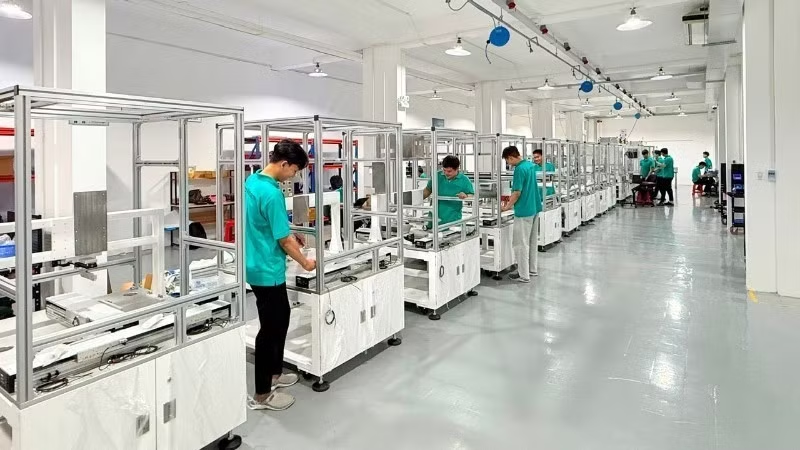
Recently, the Ho Chi Minh City Export Processing and Industrial Zones Authority (Hepza) granted an investment licence to Automation Technologies Viet Nam, a subsidiary of Singapore’s Ito Group, for a project in Linh Trung 1 Export Processing Zone with investment capital of approximately 8 million USD. Construction of the new factory is expected to begin in August 2026 and be completed and put into operation in January 2027. Covering around 12,000m², it will be Ito Group’s second manufacturing plant specialising in the design and production of automation machinery, including control electrical systems, robots, visual inspection systems, measurement sensors and production data management.
Nguyen Huy Hoang, Executive Director of Ito Viet Nam Co., Ltd., said the “greening” of production lines must be linked to investment efficiency, meaning more effective production, greater savings, less waste and higher value generated from the same resources. Although the company’s factory operated 14 years ago on an area of just 2,600m², it generates average annual revenue of 4-5 million USD with only 120 engineers. Ito’s factory in Viet Nam is also the group’s global “stronghold”, as it is the only production facility of its kind, underscoring the position and importance Ito Group attaches to its manufacturing investment in Viet Nam.
Hepza’s Investment Division assessed that Ito Viet Nam operates in the design and manufacture of automation machinery and smart production lines. This is a highly technical field focused on knowledge-intensive activities, suited to attracting new-generation FDI models and reducing labour intensity. This is also the first new FDI project to be licensed under Hepza’s special “green lane” procedure, aimed at shortening investment approval procedures.
Hoang said: “The investment environment in Ho Chi Minh City is improving very positively, especially for FDI enterprises pursuing long-term investment in technology, automation and high value-added industrial production. From the time Ito Viet Nam began submitting its dossier in early March until the licence was granted on June 26, the processing progressed very efficiently.”
Similarly, in an effort to optimise investment flows and create a “green” manufacturing ecosystem, Worldon Viet Nam Co., Ltd., a subsidiary of China’s Shenzhou Group specialising in garment production and located in Dong Nam Industrial Park, has operated a closed-loop smart manufacturing model with investment of up to 12.6 million USD.
In 2022, Worldon partnered with Nike to build a Flyknit shoe upper design centre within the company’s premises, with the aim of strengthening its position in the partner’s supply chain. According to the company’s management board, the partnership was intended not only to optimise material use from the outset and reduce industrial waste, but also to create more efficient products from FDI capital.
Attracting high-quality capital
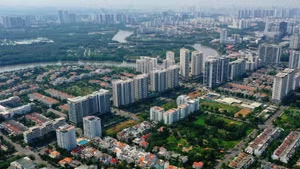
To date, Ho Chi Minh City has attracted 20,259 FDI projects with total registered capital of nearly 142 billion USD from 152 countries and territories. In the first half of 2026, the city attracted more than 6.8 billion USD in FDI, equivalent to 62% of the annual target.
Tran Viet Ha, Deputy Head of Hepza, said Ho Chi Minh City’s FDI sector accounts for about 20% of total social investment and more than

50% of export turnover, making it an important driver of economic restructuring, higher labour productivity and the city’s international integration. The city is therefore redirecting investment attraction towards high technology and digital technology, while developing industrial parks under green and eco-industrial models.
FDI investors are increasingly demanding digital infrastructure, green energy and smart supply chains capable of generating higher industrial value. A representative of Truong Hai Group Corporation (THACO) said one bottleneck is that most FDI enterprises still have to import raw materials, components and supplies because domestic suppliers have yet to meet requirements in terms of quantity, quality and technical standards.
Vietnamese enterprises must therefore become capable actors able to absorb technology, gradually move up the supply chains of FDI companies and participate more deeply in global value chains by forming industry clusters within industrial parks, especially for high-tech products. This would help reduce logistics costs and strengthen links among domestic businesses, FDI enterprises and international partners.
Ha said one current limitation making FDI enterprises hesitant about Ho Chi Minh City is the restricted supply of ready-to-lease industrial land. Infrastructure in some industrial parks also remains inconsistent and has yet to fully meet the requirements of large-scale, high-tech projects.
This requires the city to promptly implement key solutions such as attracting strategic projects, with priority given to electronics and semiconductors, artificial intelligence, big data, biotechnology, new materials and renewable energy; accelerating the transformation of older-generation industrial parks; and strengthening links between FDI and domestic enterprises to help local businesses participate more deeply in supply chains and share in the benefits.
According to Chairman of the Ho Chi Minh City People’s Committee Nguyen Van Duoc, the city is the country’s largest economic, financial, trade, services, science and technology, and innovation centre, bringing together businesses, human resources, markets, service infrastructure and international connectivity.
The city therefore has a responsibility to take the lead in implementing Resolution No. 10-NQ/TW, particularly by building a new model to attract new-generation foreign investment through the Viet Nam International Financial Centre in Ho Chi Minh City. The centre will enable the city to capture the “intangible value” of FDI, including financial technology, advanced management capacity, international transparency standards, data systems, expert networks and connections to global value chains.
“New-generation FDI does not seek only low costs or tax incentives. Strategic investors today are more concerned with institutional stability, infrastructure quality, access to capital, environmental, social and governance standards, human resource quality, innovation capacity, technology ecosystems, modern financial services and connectivity with regional and global markets,” Nguyen Van Duoc emphasised.