According to the National Statistics Office, total FDI inflows reached 24.81 billion USD as of May 31, up 34.9% year-on-year. Newly registered capital accounted for 14.84 billion USD across 1,576 licensed projects, while foreign investors contributed 4.19 billion USD through capital contributions and share purchases, an increase of 46.7%. Adjusted capital, however, declined by 32.1%.
Opportunities for next-generation FDI
Manufacturing and processing remained the leading destination for foreign investment, attracting 70.4% of newly registered and additional capital. Singapore was the largest investor among 58 countries and territories with newly licensed projects in Viet Nam during the period, committing 6.8 billion USD, or 45.9% of total investment. It was followed by the Republic of Korea, China and Japan.
Disbursed FDI also reached its highest level for the corresponding period in the past five years, rising 9.6% to 9.75 billion USD.
The Foreign Investment Agency noted that strong disbursement growth reflects investor confidence and the effective implementation of investment commitments, even as global capital flows remain cautious. Investment continued to concentrate in manufacturing as well as electricity, gas, water and air-conditioning supply, highlighting sustained demand for energy and production infrastructure.
Beyond its scale, FDI inflows are increasingly shifting towards higher-value sectors, including green technology, semiconductors and electronics, driven by major investors such as LG, Samsung and Foxconn.
Attracting FDI in the country’s new development phase should not be aimed solely at job creation, but also at fostering high-tech industries and green transformation, thereby enhancing the competitiveness of the economy. If Viet Nam can capitalise on the ongoing global supply-chain realignment and attract a new generation of FDI, it will be well positioned to move up the value chain in the emerging technological cycle.
Nguyen Anh Tuan, Chairman of the Viet Nam Association of Foreign Invested Enterprises (VAFIE)
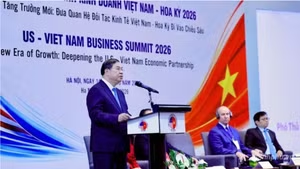
Nguyen Anh Tuan, Chairman of the Viet Nam Association of Foreign Invested Enterprises (VAFIE), said that attracting FDI in the country’s new development phase should not be aimed solely at job creation, but also at fostering high-tech industries and green transformation, thereby enhancing the competitiveness of the economy. If Viet Nam can capitalise on the ongoing global supply-chain realignment and attract a new generation of FDI, it will be well positioned to move up the value chain in the emerging technological cycle.
Strengthening linkages
Despite its significant contribution to the economy, FDI has yet to generate the expected spillover effects, largely due to weak linkages between foreign-invested firms and domestic enterprises.
According to Pham Van Quan, Deputy Director of the Agency for Industry under the Ministry of Industry and Trade, the FDI sector accounts for 70–72% of Viet Nam’s total export turnover, produces the majority of the country’s high-tech products and contributes around 20% of GDP. However, localisation rates remain modest across many key industries, while Vietnamese enterprises continue to face difficulties in integrating more deeply into global value chains and supply chains.
To address this challenge, the Ministry of Industry and Trade plans to support domestic enterprises in moving beyond assembly and processing towards mastering technology, materials, components and design capabilities. Measures will include promoting research and development, improving testing and certification infrastructure, developing a highly skilled workforce, and accelerating digital and green transformation.
Policies are also aimed at building a stronger domestic business ecosystem capable of participating more deeply in global value chains, creating greater added value and improving resilience to external shocks.
Enhancing the competitiveness of supporting-industry enterprises is crucial to reducing reliance on imports, strengthening the economy’s resilience and contributing to the country's goal of achieving double-digit economic growth.
Dr Nguyen Minh Thao, the Institute for Economic and Financial Strategy and Policy
Nguyen Minh Thao noted that next-generation FDI investors place increasing emphasis on quality standards, governance and international technological benchmarks rather than simply low labour costs. Vietnamese firms therefore need to strengthen management capabilities and meet emerging standards to secure positions within global supply chains.
For the State, support policies should be designed with sufficient flexibility and stability, enabling businesses to access and benefit from them, and ultimately convert that support into a driver of growth. At the same time, collaboration between enterprises and universities and vocational training institutions in developing a highly skilled workforce should be strengthened and made more practical, ensuring that training programmes genuinely meet industry needs.
According to Dr Nguyen Minh Thao, enhancing the competitiveness of supporting industries is essential to reducing dependence on imports, strengthening the economy’s resilience and contributing to the country’s goal of achieving double-digit economic growth.