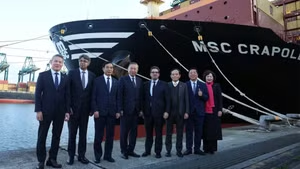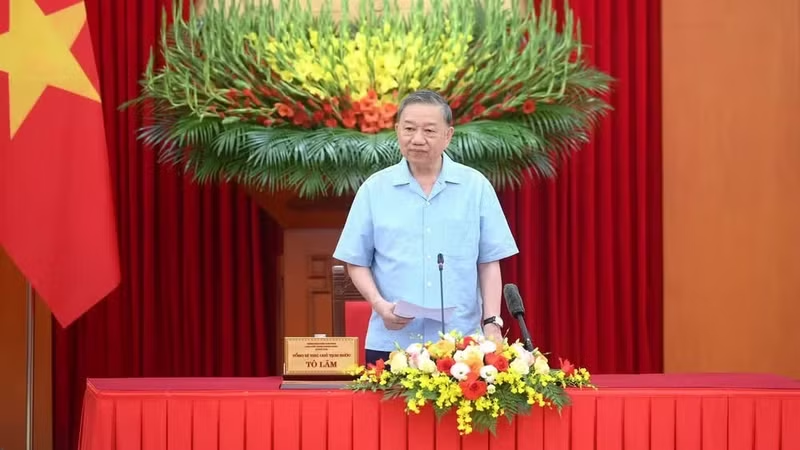
On behalf of the Politburo, General Secretary and President To Lam signed and promulgated Resolution No. 10-NQ/TW of the Politburo on “the development of the foreign-invested economy” on June 8 2026. This marks a significant shift in Viet Nam’s thinking on attracting FDI.
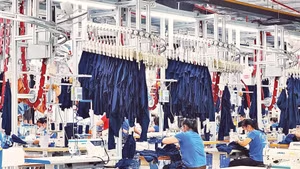
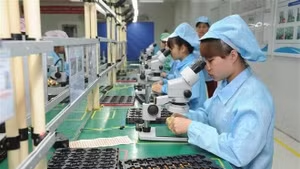
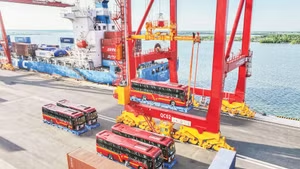
After nearly 40 years of renewal, the FDI sector has become an important part of the economy, helping supplement investment resources, promoting economic restructuring, expanding export markets, and enabling Viet Nam to participate more deeply in the global value chain.
However, limitations such as low localisation rates, limited linkages between FDI enterprises and domestic firms, and inadequate technology transfer activities necessitate a change in approach.
Resolution No. 10, therefore, clearly defines a strong shift from a mindset primarily focused on attracting capital to building a national strategic investment foundation, using quality, efficiency, technology transfer, innovation, supply chain linkages, and added value as core criteria to enhance the competitiveness and strategic autonomy of the economy.
Shifting from “broad attraction” to “deep development”
According to Professor Hoang Van Cuong, Vice President of the Viet Nam Economic Science Association, Viet Nam’s previous FDI attraction goals were mainly aimed at supplementing foreign investment capital.
Foreign investors took advantage of cheap labour and used technologies that were not yet truly advanced to organise production. However, this strategy is revealing its limitations.
“If we maintain the same methods of attracting FDI as before, the domestic business sector will forever remain on par with the foreign-invested business sector. Domestic workers will only participate in low value-added stages, failing to create breakthroughs in labour productivity and economic growth,” Professor Hoang Van Cuong emphasised.
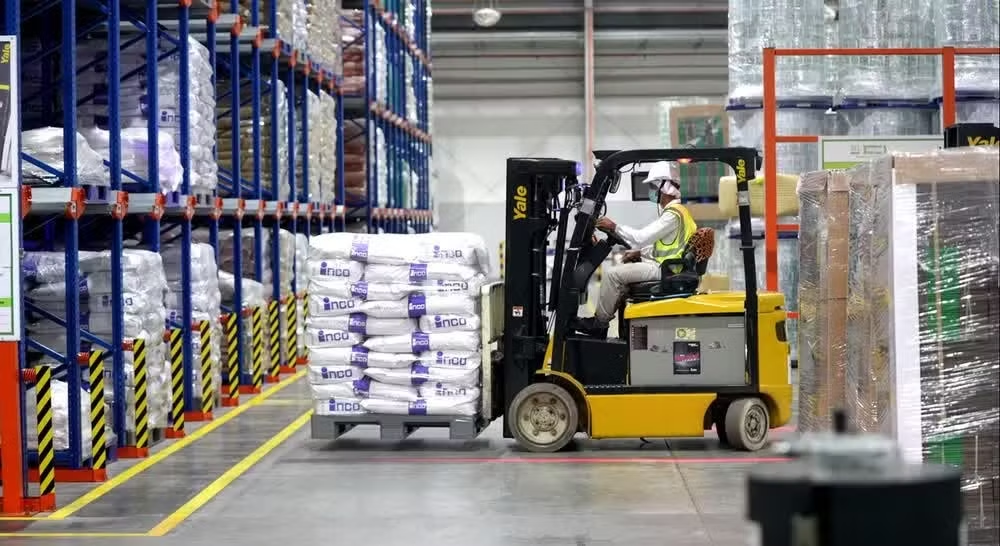
However, the connection between FDI enterprises and domestic businesses remains quite weak. Many domestic businesses are still outside the global supply chain, while the localisation rate in many key industries is low.
Therefore, according to experts, Viet Nam needs to move to a new generation of investment attraction, not just focusing on receiving capital, but also on acquiring advanced technology and management knowledge, and creating a genuine spillover effect between the FDI sector and domestic businesses. The ultimate goal is to form a unified economy where Vietnamese businesses are capable of collaborating with FDI enterprises, instead of existing as two separate sectors.
From a policy perspective, Dr. Bui Quy Thuan, from the School of Economics, Phenikaa University, and Head of the General Research Committee of the Viet Nam Industrial Park Finance Association (VIPFA), believes that Resolution No. 10-NQ/TW represents a pivotal shift.
Previously, Viet Nam primarily pursued a strategy of “broad attraction,” but now it has shifted to a “deep development” mindset, viewing FDI as a crucial driver for promoting a new growth model based on science and technology, innovation, and digital transformation.
Accordingly, Viet Nam is no longer positioning itself as a provider of cheap production space and labour at the end of the global value chain, but is gradually moving towards becoming a regional centre for research, design, management, and innovation.
The resolution also shows a significant shift in the approach to development space. Instead of attracting investment based on administrative boundaries, Viet Nam will prioritise development based on industry clusters, value chains, and innovation ecosystems.
FDI will no longer stand alone but will be placed within a synchronised overall framework, linked to high-tech zones, international financial centres, free trade zones, and modern digital infrastructure. This is seen as the foundation for forming new growth poles, promoting technology diffusion, and enhancing national competitiveness.
Vietnamese businesses cannot stand aside
A notable new point is the fundamental shift in how incentive policies for FDI enterprises are designed. According to Professor Hoang Van Cuong, Viet Nam should no longer base support policies on the scale of investment capital, but rather on the results achieved.
The criteria need to be specifically quantified, such as the level of technology transfer, the rate of domestic enterprise utilisation, the ability to create segments for Vietnamese businesses to participate in the supply chain, or the localisation rate.
“When support policies are designed based on performance results, FDI enterprises will see the clear benefits of sharing, cooperating, and linking with domestic businesses,” Cuong noted.
For new FDI projects, right from the investor selection stage, businesses should be required to commit to technology transfer, build a roadmap for utilising domestic enterprises, and gradually integrate Vietnamese businesses into the production chain. Preferential policies on taxes, land rent, and other support must also be closely linked to the implementation of commitments.
Businesses will receive corresponding incentives based on their performance. Conversely, if they fail to fulfil their commitments, support policies will not be applied. This approach also creates a strict post-audit mechanism, limiting the widespread granting of preferential treatment and improving the efficient use of national resources.
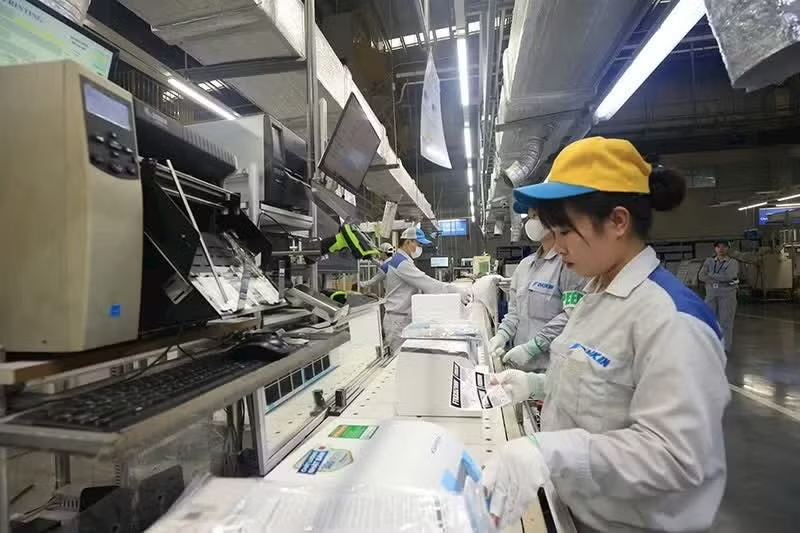
Beyond raising the standards of FDI capital flows, enhancing the capacity of domestic enterprises is a vital requirement. In reality, internal capacity remains a major “bottleneck” for Vietnamese businesses. Many surveys show that about 60 to 70% of businesses are still using outdated technology, are small in scale, and lack the resources to invest in upgrades.
According to experts, to participate deeply in the global supply chain, Vietnamese businesses need stronger support in terms of capital, science and technology, innovation, and training of high-quality human resources. At the same time, it is necessary to identify clearly areas where Viet Nam has advantages to focus investment resources, instead of spreading resources thinly.
Professor Hoang Van Cuong believes that domestic enterprises must also proactively link with each other to form value chains capable of meeting the requirements of the FDI sector. Simultaneously, human resources need to be more thoroughly prepared to undertake high value-added jobs, gradually replacing foreign workers in highly specialised positions.
From “inviting” to “creating an ecosystem”
According to Dr. Bui Quy Thuan, the core point of Resolution No. 10-NQ/TW is to change the mindset from “attracting” to “creating.” Viet Nam is no longer open to simply waiting for natural capital flows, but is proactively building a list of priority strategic technologies such as semiconductor chips, artificial intelligence (AI), big data, biotechnology, and other high-tech fields.
Simultaneously, special investment mechanisms will be applied to strategic investors, while aiming to integrate approximately 10,000 domestic enterprises deeply into the supply chains of FDI sectors before 2030. This is a crucial step towards creating a symbiotic relationship between domestic and foreign businesses, rather than merely remaining at the level of outsourcing and low-cost supply.
From a business perspective, many FDI corporations are also showing a trend of long-term partnership with Viet Nam. Shin JuBack, General Director of LOTTE MART Viet Nam, believed that FDI should not only be seen as a source of capital, but also as a bridge for technology, management, operating standards, and a connection to international markets.
Meanwhile, Vietnamese businesses have the advantage of rapid adaptation, market understanding, and a spirit of innovation. This combination, if designed correctly, will create new momentum for the economy.
After nearly four decades of accompanying the reform process, FDI is facing a new mission in Viet Nam. If it continues to rely on the advantage of cheap labour and mass incentives, the economy will find it difficult to create a leap forward in productivity and added value.
Conversely, if we boldly change our mindset, choose high-quality capital flows, and focus on technology, innovation, green transformation, and domestic business linkages, the FDI sector will not only be a driving force for growth but also a “launching pad” for enhancing the endogenous capacity of the economy.
Therefore, Resolution No. 10-NQ/TW is not simply a document on attracting foreign investment. It is a blueprint for a new development model, where foreign capital is positioned as a catalyst to promote innovation, improve productivity, and strengthen national strategic autonomy.
Then, the door will open not only to new capital flows, but also to knowledge, technology, and national competitiveness, bringing Viet Nam closer to its goal of becoming a developed, high-income country by 2045.