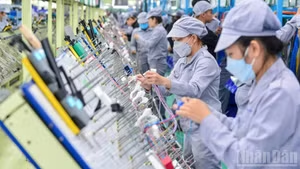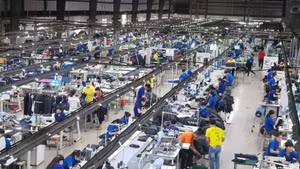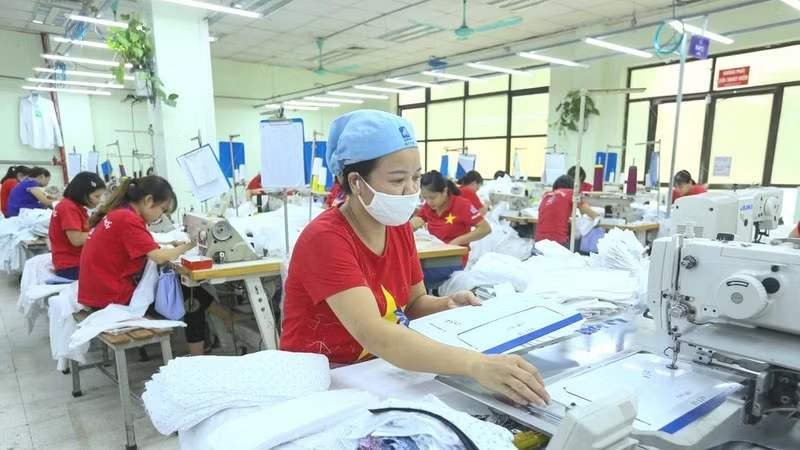
To maintain stable production and business operations, Vietnamese textile and garment enterprises need to adopt flexible measures to respond to market volatility while ensuring employment and increasing workers' incomes to retain their workforce.
Facing multiple pressures
Hoang Manh Cam, Chief of Office of the Board of Directors of the Viet Nam National Textile and Garment Group (Vinatex), said that after the 150-day period of applying the temporary 10% tariff ended on July 24, the US began applying tariffs under Section 301 related to forced labour. These are divided into three main groups (added directly to the Most Favoured Nation (MFN) tariff): a 10% tariff group, a fixed-rate group of 10% or 12.5%, and a 12.5% tariff group. Under this calculation method, Viet Nam is now among the countries facing the highest tariff rates and will certainly be at a competitive disadvantage in exporting goods compared with countries subject to lower tariffs.
"The new tariff structure not only changes the competitive balance among textile and garment exporting countries but also affects finished apparel, potentially accelerating the relocation of orders and supply chains for yarn, fabric, and raw materials. Therefore, businesses need to reassess their competitive advantages by product category, market, and position within the value chain, rather than simply comparing average tariff rates among countries," Hoang Manh Cam emphasised.
The global economy continues to grow cautiously as major central banks maintain relatively tight monetary policies. Interest rates in the US, Europe, and Japan remain high, putting pressure on consumption, investment, and corporate financing costs.
Against this backdrop, Viet Nam's textile and garment exports have maintained growth momentum, with total export turnover exceeding 23 billion USD in the first six months of the year, up 6.2% compared with the same period in 2025.
The US remains the largest export market for Viet Nam's textile and garment products, followed by the EU, Japan, China, and ASEAN. Exports to China and the EU recorded solid growth, indicating signs of recovery while also reflecting enterprises' efforts to diversify their markets.
Regarding business performance, Vinatex’ Chief Executive Officer Cao Huu Hieu affirmed that although the group's production and business results over the past seven months had been relatively positive, profit margins in both the yarn and garment sectors were narrowing due to fluctuations in raw material prices, selling prices, order structures, and input costs.
Therefore, member companies need to closely monitor market developments and proactively build and operate according to scenarios covering orders, raw materials, exchange rates, and logistics. At the same time, they should maintain disciplined management, strictly control costs, cash flow, receivables, inventories, and working capital, while improving labour productivity, ensuring product quality, and delivery schedules to meet consumer demand.
Vu Ngoc Tuan, Chief Executive Officer of Nam Dinh Textile Garment Joint Stock Corporation, said that the company has recently faced numerous difficulties due to market volatility — particularly rising transport costs and raw material prices, which have affected business operational efficiency.
However, thanks to the efforts of employees throughout the corporation, revenue in the past six months reached 662.2 billion VND, up 14%, while pre-tax profit reached 15.2 billion VND, compared with a loss of 12.5 billion VND in the same period, achieving 169% of the annual plan.
The market is expected to remain unpredictable and carry many risks in the coming period. Therefore, the corporation will focus its operations on efficiency and cash flow while improving labour productivity, product quality, and continuing to improve working conditions, ensure employment, and raise workers' incomes to retain its workforce.
Implementing three strategic pillars
Although Viet Nam's textile and garment industry exports goods worth tens of billions USD each year, the value generated remains relatively low. The main reason is its dependence on imported raw materials, particularly high-grade materials and premium accessories. It is estimated that around 70-80% of raw materials need to be imported from overseas markets. This represents a substantial cost that could be reduced if the domestic supporting industry were better developed.
According to Dr Nguyen Van Duc, Vice Rector of Ha Noi University of Industry and Trade, the biggest bottleneck in the textile and garment industry currently lies in the dyeing stage, while Viet Nam's yarn production and garment manufacturing are relatively strong.
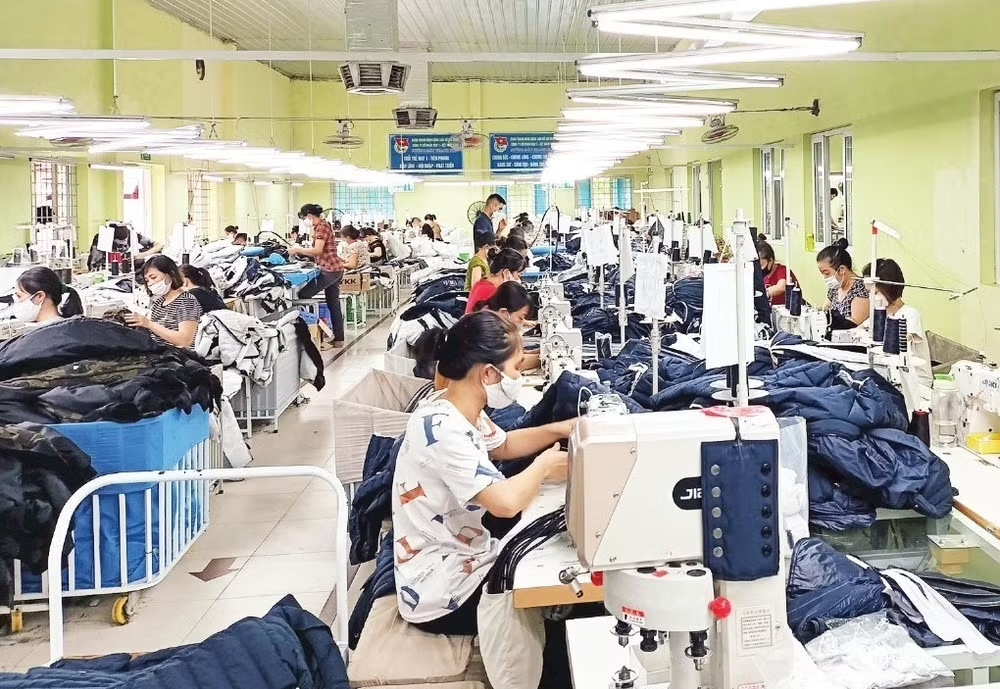
Completing the supply chain from yarn production, weaving, dyeing, and garment manufacturing would enable enterprises not only to take greater control of production but also to enhance competitiveness and increase product value. At present, a small number of companies have invested in building integrated supply chains, but these are mainly large enterprises within the Vinatex system.
To improve competitiveness, particularly in order to make full use of opportunities brought by new-generation free trade agreements, it is essential to strengthen chain linkages by establishing concentrated industrial parks, thereby creating complete supply chains that help reduce business costs.
To achieve this, the State needs to introduce incentive mechanisms and policies to attract businesses. In addition, training programmes should be developed to build a high-quality workforce capable of meeting development requirements in the new era.
In recent years, Viet Nam's textile and garment industry has faced many challenges as global supply chains have been disrupted, logistics costs have risen sharply, international brands have imposed increasingly stringent requirements, and purchasing policies in many major markets have changed rapidly, thereby forcing businesses to adapt continuously.
In response to these challenges, the industry has successfully established and implemented three fundamental strategic pillars: diversifying products, markets, and customers. Elaborating on the industry's development strategy, Vu Duc Giang, Chairman of the Viet Nam Textile and Apparel Association (VITAS), affirmed that, from relying heavily on several traditional markets, Vietnamese textile and garment products are now present in 138 markets worldwide, thereby reducing risks and increasing resilience against external shocks.
The strategy of diversifying partners and customers has helped businesses become more proactive in negotiations, adapt to changing purchasing methods, and reduce dependence on a small number of major brands. Product diversification has also facilitated a gradual shift from simple processing products to products that better meet the increasingly diverse demands of the market and align with new consumer trends.
To realise these strategic pillars, Viet Nam's textile and garment industry is focusing on several key solutions, including accelerating its green transformation programme. Sustainable development is regarded not only as a compliance requirement but also as a vital condition for participating more deeply in the global value chain.
At the same time, the industry is promoting the application of science and technology, automation, robotics, and the gradual integration of artificial intelligence into production and supply chains. This is considered the key to improving productivity and quality as well as strengthening long-term competitiveness.