Fragile growth
Although the textile and garment industry has maintained positive year-on-year results, growth momentum remains fragile amid weakening consumer demand.
Nguyen Hung Quy, General Director of Vinatex Southern Corporation (VSC), said that market volatility and declining consumer demand had slowed the flow of incoming orders, with some orders reduced or cancelled outright. Orders in the second quarter are expected to fall by around 20-25% compared with the same period in 2025.
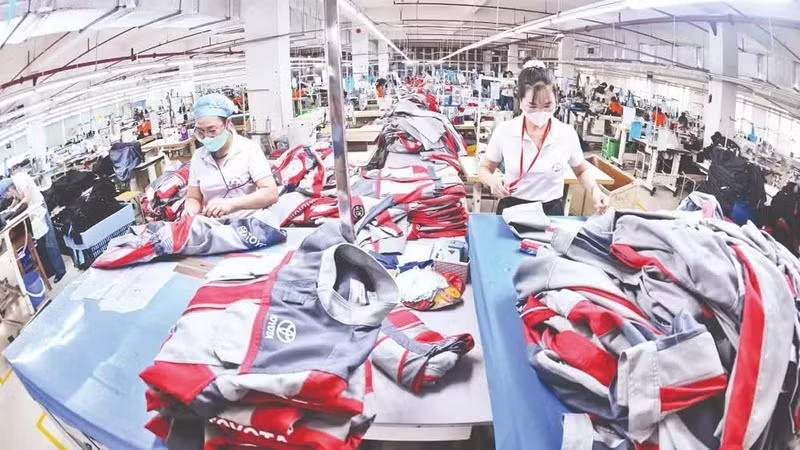
At the same time, supply chain disruptions and delays in raw materials and trimmings imported from China have affected production and business plans. Enterprises have had to accelerate output and arrange overtime shifts to meet tighter delivery deadlines, while continuously revising their sourcing strategies.
Customers are also demanding more competitive prices, putting further pressure on profit margins in the second and third quarters. “To sustain operations and drive growth, the company will continue diversifying its markets and customer base, gradually reducing dependence on the US market and proactively expanding into the EU, Japan and other markets, while securing new buyers to offset order shortfalls resulting from market volatility,” said Nguyen Hung Quy.
Nguyen Hong Lien, General Director of Hue Textile and Garment Joint Stock Company, added that amid the slowdown and increasing fragmentation of the global textile and garment market, the company has, since the beginning of the second quarter of 2026, put contingency plans in place, making cost management and quality control the twin priorities across all operations.
In the yarn sector, the company avoids concentrating excessively large orders with a single customer in order to minimise the risk of cancellations or price pressure in volatile market conditions.
The company also fulfils orders in smaller volumes for established customers with reliable payment records, while limiting engagement with new customers who have no transaction history during this period of market instability.
The company is also purchasing cotton and fibre when prices are favourable and accepting only orders within its production capacity to mitigate supply and pricing risks.
For the garment sector, orders have already been secured through August, and negotiations are continuing for year-end contracts. Contract manufacturing prices have improved significantly, but FOB orders, where the company sources its own materials and sells finished goods, are delivering shrinking profit margins as material and transport costs continue to rise.
The company has also recognised that long-term FOB contracts will require advance yarn price agreements to lock in input costs for grey fabric production and hedge against fluctuating yarn prices.
In addition, the company is capitalising on its strengths in productivity and quality to renegotiate better processing prices, ensuring stable cash flow across the business, while refraining from taking on orders beyond its production capacity to avoid cancellations should market conditions deteriorate.
According to Doan Minh Duc, Deputy General Director of Nha Be Garment Corporation, rising input costs, rapidly shifting client requirements and competitive pressure are forcing enterprises to remain flexible in reallocating equipment and shifting production across product lines to avoid order cancellations.
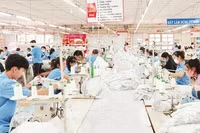
Flexible response measures
Statistics from the Viet Nam Textile and Apparel Association (Vitas) show that total export revenue in the first four months of the year reached 14.53 billion USD, up 4.3% year-on-year. Of that total, textile yarn exports reached 2.62 billion USD, an increase of 20.1%, while garment exports totalled 11.9 billion USD, up 1.3%. Viet Nam continues to hold the largest market share in the US at 21.4%, significantly ahead of Bangladesh at 11.1% and China at 8.7%.
However, the industry is facing mounting difficulties amid global market volatility. The Russia-Ukraine conflict and tensions involving the US, Israel and Iran are expected to persist and potentially intensify, disrupting supply chains and putting pressure on global oil markets. Meanwhile, global container shipping costs continue to rise due to increasing surcharges.
Commenting on the outlook, Cao Huu Hieu, General Director of the Viet Nam National Textile and Garment Group (Vinatex), said that the coming months would continue to bring numerous unpredictable developments likely to have a significant impact on business performance.
He added that enterprises therefore need to draw up production plans to maximise productivity and efficiency in the second quarter, building momentum for the second half of the year, while closely monitoring market developments to respond swiftly when needed.
Hieu further noted that the industry’s performance in the opening months of the year had continued the positive trajectory seen in 2025. Notably, all 12 yarn-producing units within the group recorded profits in April.
However, the current upturn in the yarn sector is short-term in nature and largely driven by lower-cost cotton stockpiles. Businesses should therefore continue maximising profits while the advantage of low-cost raw materials holds, and closely monitor the market to capitalise on favourable conditions.
“Conditions in 2026 bear many similarities to 2022, when results in the first half of the year were relatively favourable but deteriorated sharply in the second half. With geopolitical tensions and import demand as the two key variables, the market is expected to face considerable headwinds in the final six months of the year,” said the Vinatex leader.
Hieu noted that given prevailing market uncertainty, even orders already secured through the third quarter cannot be taken as guaranteed. Enterprises therefore need to accelerate production, strengthen governance and cut costs in order to meet their targets as early as possible.