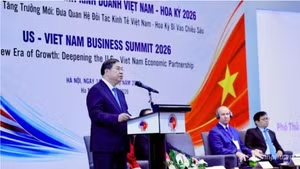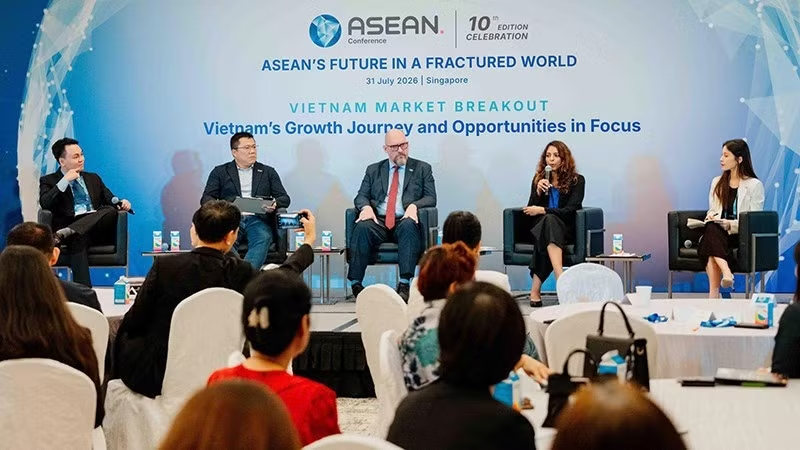
The consultation session, themed “Viet Nam’s Growth Journey and Opportunities in Focus”, brought together representatives from government agencies, diplomatic missions, trade promotion organisations, financial institutions, technology corporations, infrastructure developers, and the international investment community.
This marked the first time that the VPSF has extended its consultation activities overseas, enabling it to gather perspectives from regional and global business communities on Viet Nam’s policy environment, investment climate, and new growth drivers.
In his opening remarks, Victor Ngo Vinh Tri, Chief Executive Officer of UOB Viet Nam, said that the decision to dedicate a specialised Viet Nam-focused session at the ASEAN Conference 2026 reflects the growing interest among regional businesses and investors in the country’s economic prospects.
Meanwhile, Vu Ba Phu, Director of the Viet Nam Trade Promotion Agency, stressed that Viet Nam is entering a new phase in which it must shift from a growth model driven primarily by labour, contract manufacturing, and cost advantages to one based on productivity, technology, innovation, and business competitiveness.
He noted that opportunities in infrastructure development, logistics, the digital economy, green energy, financial services, and high-tech industries could only be translated into concrete projects through close coordination among government agencies, trade and investment promotion organisations, financial institutions, business associations, and the private sector.
Therefore, trade and investment promotion activities in the new period should move beyond simply showcasing potential towards matching genuine market demand with suitable partners and accompanying investors during project implementation.
During the consultation session, participants agreed on several key policy recommendations.
These include continuing institutional reforms to create a more stable, transparent, and predictable regulatory environment; accelerating the development of strategic and digital infrastructure; expanding the public-private partnership market; and enhancing enterprises’ capacity to absorb new technologies, particularly among small and medium-sized enterprises.
Other recommendations are developing a more competitive and flexible energy market to facilitate private investment in energy storage, renewable energy, power grids, and electricity trading mechanisms; and shifting from attracting individual projects to building comprehensive investment ecosystems.
According to Tran Anh Dung, Deputy Head of the International Cooperation Board of the Viet Nam Young Entrepreneurs Association, the consultation session in Singapore was organised to broaden input from international investors, multinational corporations, and experts who are directly engaged with or closely monitoring the Vietnamese market.
All recommendations gathered during the consultation will be compiled and analysed by the organising committee before being incorporated into a report to be submitted to the government at the high-level session of VPSF 2026.
The aim is to put forward practical policy proposals that are aligned with international best practices and capable of effective implementation.