On August 28, 2026, the Politburo issued Resolution No. 27-NQ/TW on regional development and the organisation of national development space in the new stage.
Institutional breakthrough in national development space
The resolution was issued in the context of the country having completed the rearrangement of administrative units and implemented the two-tier local government model. To turn macro-level orientations into substantive development momentum, it is necessary to objectively assess the achievements and bottlenecks in connectivity and the exploitation of growth space among localities.
Entering 2026, the GRDP picture recorded the rise of many localities with impressive growth rates. In the first six months of the year, Ha Tinh posted growth of 12.79%, followed by Ninh Binh at 11.44%, Hung Yen at 10.72%, Phu Tho at 10.18%, Tay Ninh at 10.12%, and Thai Nguyen at 10.01%. Behind these figures are contributions from production, industrial investment, and investment attraction, although the level and drivers of growth differ among localities.
In Ha Tinh, large-scale industrial projects, especially the VinFast electric motorbike production complex and Vung Ang II Thermal Power Plant, have helped drive growth. Together with projects in Vung Ang Economic Zone, these facilities have helped consolidate the locality’s industrial and energy foundations, while also creating a need to improve the effectiveness of linkages between projects, businesses, and regional supply chains.
Hung Yen also demonstrates the role of planning and industrial park infrastructure development in attracting investment. Industrial parks such as Thang Long II, Pho Noi A, and Yen My have helped form concentrated production spaces, attract FDI flows, and promote economic restructuring.
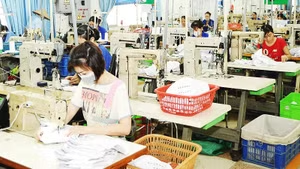
However, the economy also faces the risk of K-shaped divergence. The upward branch belongs to the FDI sector and domestic corporations capable of close linkage with large-scale public investment projects, easier access to capital, and major incentives from specific policies. The downward branch consists of small and medium-sized enterprises, which account for more than 98% of all businesses, along with around 5 million household businesses. This domestic economic sector is going through a difficult period as it simultaneously faces rising input costs, slow recovery in the domestic market, and policy risks from a rapid succession of newly issued standards.
This divergence raises a major question about the sustainability of growth, requiring Viet Nam to assess growth quality through productivity, business health, and people’s income and livelihoods. Accordingly, it is necessary to change the frame of reference for development governance with new growth poles and growth spaces. Viet Nam can no longer continue pursuing mere output but must place business health and the endogenous capacity of the economy at the centre of all policy decisions.
Shifting from administrative planning to integrated planning
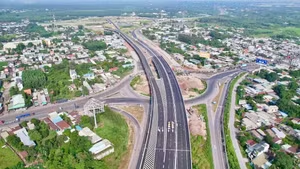
The second bottleneck is the lack of synchronisation between industrial development and urban planning and social infrastructure in the three key economic regions. In the northern key economic region, the Lao Cai-Ha Noi-Hai Phong-Quang Ninh economic corridor has attracted large FDI flows and formed a network of industrial parks along strategic transport routes. However, urban planning and social infrastructure have not kept pace with industrialisation, leading to spontaneous urbanisation in some areas, while housing for workers and health and education services have yet to fully meet the demand.
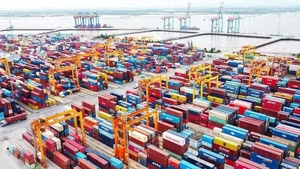
In the southern key economic region, industrial development in areas adjacent to Ho Chi Minh City, such as Binh Duong, Dong Nai, and Long An, has placed great pressure on urban systems and infrastructure. Areas such as Bien Hoa, Di An, and Thuan An are facing pressure from population growth, traffic congestion, and environmental pollution. Meanwhile, inter-regional transport links and public transport remain unsynchronised, increasing commuting and logistics costs.
In the central key economic region, coastal economic zones such as Dung Quat, Chu Lai, and Chan May-Lang Co have advantages in industrial infrastructure but still face challenges in connecting with urban, service, and human resource training centres. Service ecosystems and social amenities in some areas have not developed commensurately, making it difficult to attract and retain experts, engineers, and high-quality workers, thereby affecting the capacity for comprehensive development across the region.
The two-tier local government model opens opportunities to streamline the administrative apparatus while also requiring the reorganisation of development space towards integration and regional connectivity. What matters is shifting from a closed planning mindset within administrative boundaries to planning based on economic corridors and the linkage advantages among localities.
The root cause of this situation stems from previous fragmentation and localism in state management by region and territory. Industrial sector plans were often prioritised by localities in pursuit of short-term budget revenue targets or aligned with strategic transport infrastructure planning, while remaining entirely separate from, and unsynchronised with, construction and urban planning, which were themselves subject to the pressures of specialised management objectives.
What is missing is proper tools for integrated inter-regional spatial planning. Each province has remained a planning “island”, trying to maximise benefits within its own geographical boundaries instead of paying attention to the integrity of the entire economic corridor.
The two-tier local government model opens opportunities to streamline the administrative apparatus, while also requiring the reorganisation of development space towards integration and regional connectivity. What matters is shifting from a closed planning mindset within administrative boundaries to planning based on economic corridors and the linkage advantages among localities.
For growth poles to deliver substantive effectiveness, it is necessary to reform criteria for evaluating the performance of local governments, with attention paid to growth quality, productivity, innovation, and the level of economic connectivity. Growth poles must also shift from a model based mainly on capital, cheap labour, and resource exploitation to one based on science, technology, innovation, and the digital economy.
With a vision to 2030 and 2045, the effective organisation of national development space should aim towards smart, green, and sustainable dynamic regions, promoting the role of the digital economy, data economy, and circular economy. When administrative boundaries are no longer barriers to the flow of resources and production linkages, localities will be better able to exploit complementary advantages, enhance competitiveness, and create long-term growth momentum.
The goal of double-digit economic growth and escaping the middle-income trap can hardly be achieved if growth poles are regarded merely as production centres. Growth poles need to bring together three elements: rule-of-law institutions that protect property rights; a business environment that enables domestic enterprises to develop; and integrated, humane, and people-centred spatial planning.




![[Infographic] GRDP growth scenarios for 34 provinces and cities in fourth quarter of 2026](https://en-cdn.nhandan.vn/images/nyM650OGFWrOVWc-xajqN-rTZ68Rlmc1fiGJOhBRYHFSa4DhrHNDxEFdnz313Vk5dNJuxdkHglPA3rLeaPeiaUheNuCI723k2lNssd-YLJuKR58epWq7s21lV5WjM-HR2-Qpbi4MwAzqt9wRjL4WjGkfEz7RO9qhcwg8o8LQFK8/grdp-growth-scenarios-for-34-provinces-and-cities-in-q42026-anh-dai-dien.jpg.avif)