Strong credit flows into key economic sectors
According to figures from the State Bank of Viet Nam’s Regional Branch 2, total outstanding credit in Ho Chi Minh City reached 5.8 quadrillion VND at the end of September, up 11.4% from the end of 2025 and 18.7% year on year. Meanwhile, total mobilised capital was estimated at 5.74 quadrillion VND, up 9.1% from the end of the previous year, reflecting steady growth in the local money market.
Assessing banking activities in Ho Chi Minh City during the first nine months of 2026, Nguyen Duc Lenh, Deputy Director of the State Bank of Viet Nam’s Regional Branch 2, said the results clearly demonstrated the effectiveness of monetary policy mechanisms and the State Bank of Viet Nam’s Directive No. 01 on banking tasks and solutions for 2026, including support for the city’s socio-economic growth.
Credit allocation has shifted positively, with capital mainly directed towards production, business activities, and priority sectors. Outstanding loans to small and medium-sized enterprises (SMEs) reached 1.3 quadrillion VND, while loans to the export sector totalled 301 trillion VND, and lending to supporting industries stood at 109 trillion VND.
By economic sector, manufacturing and processing industries, which make a major contribution to the city’s gross regional domestic product (GRDP), recorded outstanding loans of 767 trillion VND, up 10.2% from the end of 2025. Wholesale and retail trade, along with the repair of cars and motorcycles, accounted for 765 trillion VND, up 7.8%, while construction loans reached 310.5 trillion VND, up 17.8%.

Commenting on the direction of credit flows, Nguyen Duc Lenh said lending in the city had continued to focus on production and business activities in recent quarters. Manufacturing and processing was among the sectors receiving the largest amount of capital, with nearly 899 trillion VND in outstanding loans, up 10.7% from the end of the previous year. Credit to logistics reached approximately 160 trillion VND, up 7.3%. In supporting industries alone, outstanding loans had reached 183.8 trillion VND by mid-2026, nearly double the figure at the end of 2025.
The expansion of bank credit has gone hand in hand with a wave of investment in industrial parks and export processing zones. According to the Ho Chi Minh City Export Processing and Industrial Zones Authority (HEPZA), these zones attracted more than 5.57 billion USD in investment during the first nine months of 2026, up 29.13% year on year. Of this, foreign direct investment (FDI) exceeded 4.2 billion USD, up 62.22%.
Banks strengthen capacity to absorb and spread credit flows
To improve the ability of businesses in supply chains to access and absorb capital, relevant authorities and industrial park management boards have stressed the need to strengthen links between domestic businesses and the FDI sector. This requires support for private enterprises to improve production capacity and meet global technical standards.
On the policy front, a draft decree amending Decree No. 111/2015/ND-CP on supporting industry development proposes extending incentives to businesses, organisations, and individuals directly manufacturing products on the priority list. The key proposals include covering up to 50% of costs for green transformation, energy efficiency, and wastewater treatment, and up to 70% of costs for joint ventures and partnerships between domestic supporting-industry enterprises and foreign partners.
Commercial banks have also adopted more flexible credit provision methods, focusing on cash flows, contracts, and receivables, while designing financing packages tailored to value chains.
For example, Vietcombank is implementing a 50 trillion VND credit programme for priority sectors and growth drivers, including supporting industries, processing and manufacturing, high technology, and green projects. Other banks, such as the Joint Stock Commercial Bank for Investment and Development of Viet Nam (BIDV), have introduced the SCFast 2026 programme, worth 15 trillion VND, to provide transaction-based financing linked to business between core enterprises and satellite businesses. The Asia Commercial Joint Stock Bank (ACB) has developed financing solutions based on the cash flows and contracts of SMEs.
As of the end of September, capital mobilised by Nam A Bank from economic organisations and the public, together with the issuance of valuable papers, reached nearly 254 trillion VND, up almost 20% from the end of 2025. Its outstanding credit increased by 10.8% from the beginning of the year, focusing on sectors with integrated value chains and high export turnover, such as tea, seafood, coffee, and rubber, as well as education and healthcare, while reducing the proportion of lending to real estate.
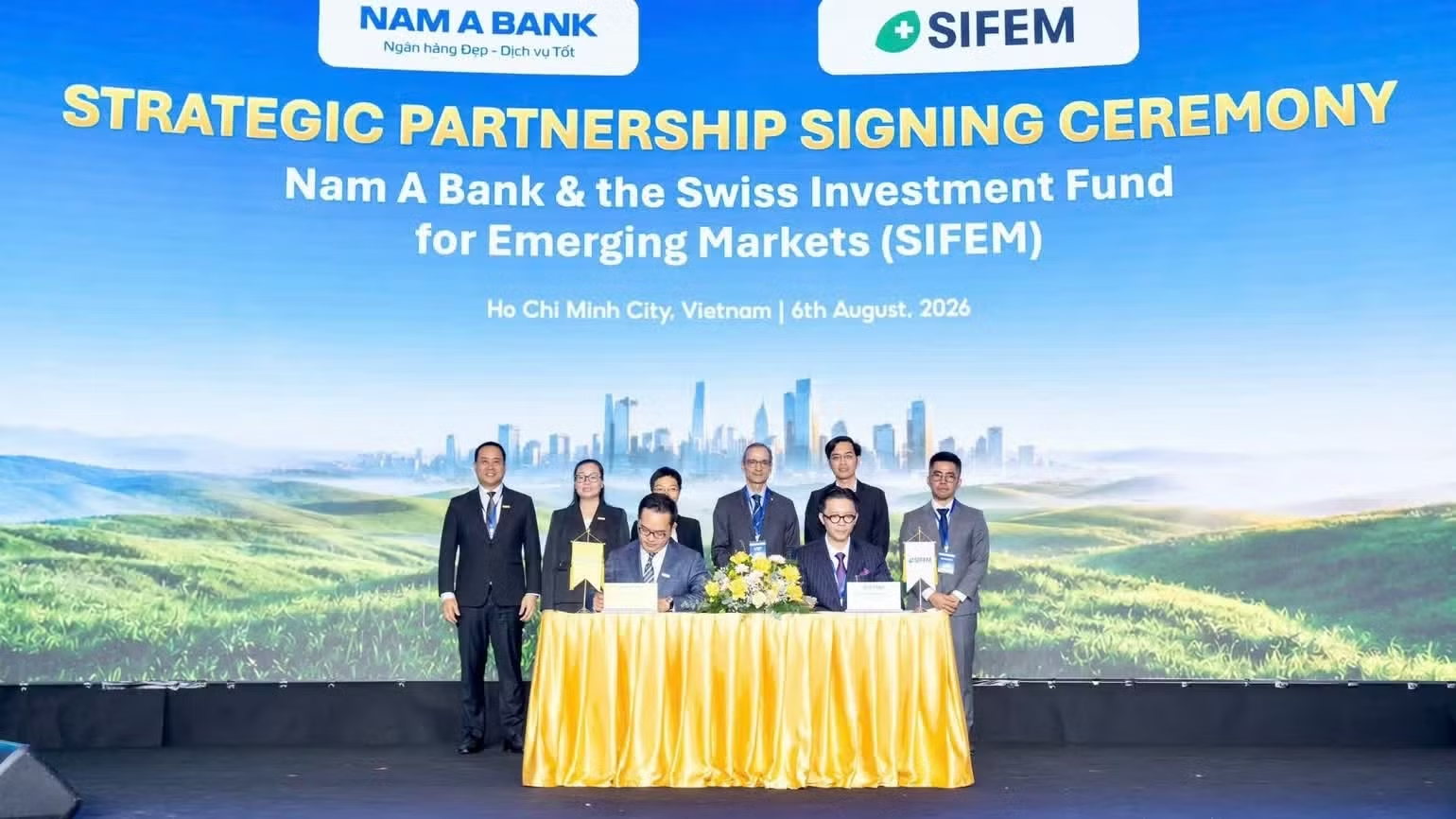
As of June 2026, Nam A Bank had successfully mobilised nearly 350 million USD in international funding from institutions including the International Finance Corporation (IFC), the Asian Development Bank (ADB), Proparco, and FMO, to strengthen resources for trade finance, green finance, and support for SMEs.
The combination of stable monetary policy, the expansion of supply chain-based credit products by commercial banks, and higher standards among manufacturing enterprises has helped capital flow more effectively into the economy.
This provides an important foundation for the banking sector in Ho Chi Minh City to continue supporting production and business activities, while contributing to sustainable socio-economic development.
Nguyen Duc Lenh emphasised: “The results achieved by banking activities in the city provide a solid foundation for the sector to continue fulfilling its tasks in the remaining months of the year and meeting its annual targets, with the key priority being to support the city’s double-digit economic growth target for 2026.”