The province has consistently sought solutions to connect these existing strengths in order to create new momentum for development, enabling local businesses to participate more deeply in major projects and emerging supply chains while fostering the sustainable growth of the private sector.
A remarkable leap forward
According to statistics from the Department of Finance, the province's business community has continued to expand in both scale and its contribution to the economy in recent years. The total number of active enterprises has reached nearly 11,000. The private sector currently accounts for approximately 60% of the province's Gross Regional Domestic Product (GRDP), contributes 65% of budget revenues, and provides employment for around 98,000 workers.
In addition, nearly 40,000 household businesses are currently operating across the province, with 71.6% engaged in the service sector and 28.4% in industry and construction.
Pham Minh Van, Deputy General Director of Phu Tai Duc Group Joint Stock Company, said that as one of the pioneering enterprises operating in the trade and service sector—including Toyota automobile dealerships, motorcycle sales, hotels and tourism services—the company has not only proactively adapted to changing market conditions to maintain stable growth, but has also consistently implemented measures to improve customer service, strengthen competitiveness and expand its market presence. Particular emphasis has been placed on applying science and technology and digital transformation in corporate governance, management and business operations. As a result, the company has maintained sustainable long-term growth while providing stable employment for more than 500 local workers.
Recognising technological innovation as a key solution for improving productivity and optimising costs, thereby enabling expansion and greater market competitiveness, Tran Van Viet, Chairman of the Members' Council and General Director of Viet Hai Trading and Transport Services Company Limited, said the company currently operates eight manufacturing facilities producing and trading construction materials, including cement, steel, ready-mix concrete, concrete piles, drainage pipes, unbaked bricks and roofing tiles.
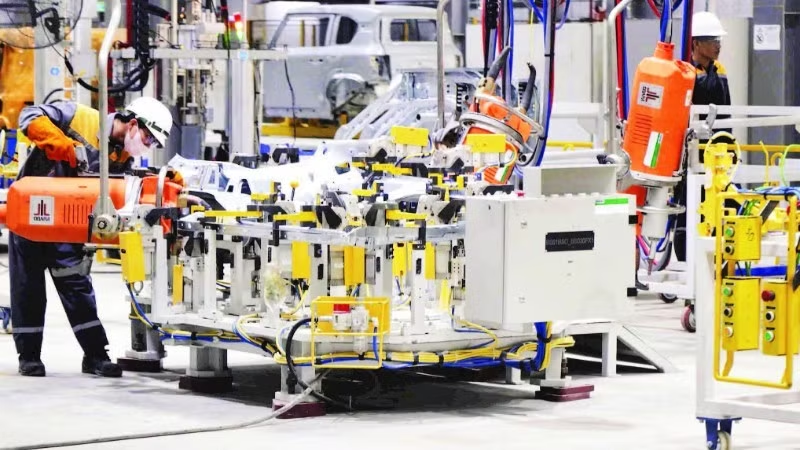
Its bold investment in modern, high-tech production lines has reduced labour requirements while increasing production capacity and product quality. The company's products have become deeply integrated into local production and business supply chains and are gradually expanding into other provinces and cities nationwide.
According to Tran Van Viet, even before the Politburo issued Resolution No. 68-NQ/TW on private sector development, Ha Tinh had consistently accompanied businesses and entrepreneurs by introducing mechanisms and policies to remove obstacles, improve the investment and business environment, and create favourable conditions for local enterprises to operate with confidence.
"We firmly believe that the orientations and mechanisms set out in Resolution No. 68-NQ/TW, together with the province's open and attractive investment policies, will enable the private sector to achieve remarkable growth, commensurate with the position and expectations of the State and the people," Tran Van Viet emphasised.
According to leaders of the Department of Finance, with the goal of becoming one of the major growth poles of the North Central Region and the country as a whole, Ha Tinh has in recent years focused on implementing a range of breakthrough initiatives, particularly in enterprise development and investment attraction.
To date, the province has attracted more than 1,500 investment projects with total registered capital of approximately 700,000 billion VND, including 71 foreign direct investment (FDI) projects worth 16.5 billion USD. In 2025, the province approved investment policies for 54 domestic projects with total registered capital of nearly 128,000 billion VND (approximately 5 billion USD). During the first six months of 2026, it approved investment policies for 28 domestic projects with total registered capital exceeding 155,000 billion VND, along with four FDI projects worth 412.6 million USD.
Creating new drivers of growth
Although Ha Tinh's private sector has made significant progress in recent years, its development has also revealed a number of bottlenecks and limitations.
Notably, around 98% of enterprises in the province are small and medium-sized enterprises (SMEs). Many still face constraints in corporate governance, financial capacity, technological innovation, digital transformation and green transition. Access to land, production sites, credit, highly skilled human resources, and stronger linkages with large enterprises, FDI companies, supply chains and international markets remains below the province's potential.
For innovative start-ups, the principal bottleneck is not merely limited start-up capital, but also the gap between an idea and a finished product, and between an initial product and a commercially competitive business model.
Representatives of provincial departments, agencies, local authorities and the business community also noted that access to key development resources—including land, production premises, credit, technology and highly qualified human resources—remains difficult. Some enterprises fail to meet lending requirements because they lack collateral, have insufficiently transparent financial statements, or possess limited capacity to prepare viable business plans.
Many issues relating to investment, land, construction, environmental protection, procurement, public-private partnerships (PPP), public asset management, utilisation of surplus land resources, and the development of industrial parks, industrial clusters and logistics infrastructure continue to depend on regulations and guidance issued by central authorities.
To address these challenges, representatives of the Provincial People's Committee reaffirmed the province's consistent commitment that Ha Tinh values, listens to and stands alongside the business community.
In the future, the province will continue to accelerate administrative reform while strengthening implementation discipline. It will review and reduce administrative procedures, compliance costs and unnecessary business conditions; publicise planning schemes, support policies and inspection plans; expand online public services; minimise unnecessary direct contact between businesses and government agencies. The province will also continue to unlock essential resources for businesses by reviewing land funds, public assets and infrastructure in economic zones, industrial parks and industrial clusters; accelerate site clearance and resolve delayed projects; strengthen credit linkages, improve the effectiveness of credit guarantee schemes, and assist enterprises in standardising their financial management and accounting systems to facilitate easier access to financing. At the same time, it will provide practical support for SMEs, household businesses and start-ups, with priority given to improving corporate governance, legal compliance, taxation, accounting, quality standards, intellectual property protection, digital transformation and green transition.