Investment in infrastructure, together with a growing emphasis on improving quality of life, is enabling a number of emerging cities to climb the rankings of Savills' Resilient Cities Index.
In recent years, Transit-Oriented Development (TOD) has increasingly been viewed in Viet Nam as a planning tool for optimising land use and guiding urban expansion at a time when cities are becoming ever more densely populated.
TOD and connectivity create new urban experiences
Metro systems do far more than make travel more convenient. They also reshape the way people experience and interact with the city. As access to central districts becomes faster and more efficient, residents enjoy greater flexibility in choosing where to work, shop, dine, socialise and participate in cultural activities. This increases interaction between people and urban spaces while encouraging longer visits and higher spending in areas with a high concentration of commercial and social activity.
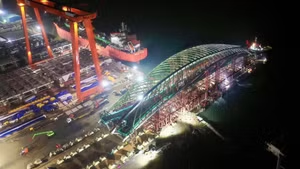
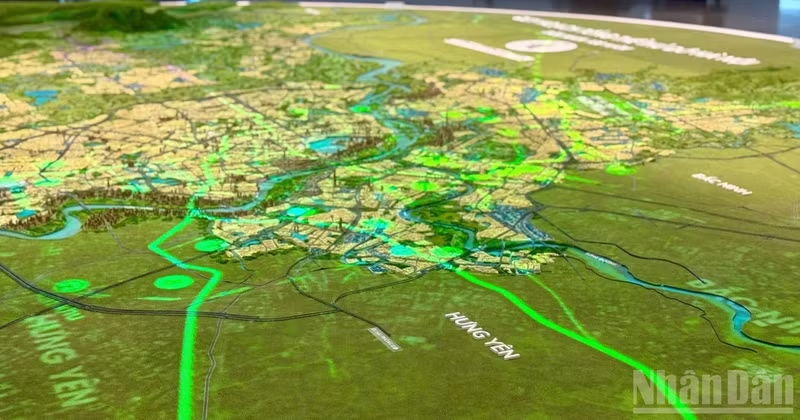
Ha Noi has commenced construction of five metro lines extending more than 300 kilometres, with a preliminary investment of over 1.3 quadrillion VND. The network is expected to be substantially completed by 2030. Once operational, the new lines will provide direct connections between Noi Bai International Airport, Ha Noi Railway Station, Ngoc Hoi, Hoa Lac, Thu Lam, Co Loa, Ocean Park, and other key growth areas of the capital.
(Source: National Planning).
According to the Savills Impacts 2026 report, connectivity has become one of the defining indicators of a city's competitiveness. Cities seeking to attract foreign direct investment (FDI), highly skilled workers and international visitors increasingly depend on their ability to provide environments that are convenient to live in, work in and experience—a competitive advantage that delivers long-term value.
From this perspective, the value of transport infrastructure extends well beyond reducing travel times. Its real significance lies in its capacity to stimulate economic and social activity within the urban environment. Improved connectivity increases the intensity of urban use and creates favourable conditions for the development of retail, commercial, hospitality and experiential services around public transport hubs.
TOD and new perspective on urban investment opportunities
For many years, transport infrastructure has primarily been viewed in terms of its ability to improve connectivity and reduce travel times. However, in many cities around the world, its role has expanded well beyond the provision of transport alone.
A common feature of these development models is the use of public transport infrastructure as a catalyst for enhancing a city's attractiveness, supporting the emergence of new activity centres and increasing the intensity of use within existing urban districts.
Cities with strong competitive advantages invest not only in physical infrastructure but also in creating high-quality living environments, enhancing urban experiences and fostering more dynamic economic activity. Examples include Dubai, which has developed Expo City into a new hub for business, events and tourism; Abu Dhabi, which has invested heavily in cultural districts; Madrid, which has strengthened its visitor services ecosystem; and Seoul, which has prioritised improvements to public spaces and the overall urban experience.
(Source: Savills Impacts – Resilient Cities 2026 Report).
As accessibility improves, residents and visitors alike tend to spend more time shopping, dining, enjoying cultural activities and using a wider range of leisure and lifestyle services. This approach seeks to integrate transport with economic activity and urban experiences within a single development framework. Rather than simply creating new destinations, it focuses on increasing the vitality of existing districts, revitalising city centres and expanding opportunities for commerce, services and consumer activity.
Cities ranking more highly in the Resilient Cities Index also tend to attract significantly greater volumes of real estate investment. This correlation suggests that, alongside traditional economic indicators, investors are increasingly paying attention to factors that signal a city's ability to sustain long-term demand, including transport connectivity, quality of life and the maturity of its service ecosystem.

According to Nguyen Le Dung, Head of Investment Advisory at Savills Ha Noi, investors are placing growing emphasis on the factors that enable cities to remain attractive over the long term, rather than focusing solely on short-term growth.
She said: "TOD model demonstrates that infrastructure can play a much broader role than simply facilitating transport. When connectivity improves and is accompanied by the growth of commercial, cultural and service activities, cities generate greater value from the same urban space. This also provides an important foundation for strengthening competitiveness and attracting future investment."
In practice, one of the greatest challenges for investors is not identifying opportunities but determining whether demand can be sustained over the next 10 to 20 years. Consequently, when cities unveil development strategies centred on metro networks, public spaces and new activity hubs, investors gain valuable insight into how population flows, business activity and market demand are likely to evolve over time.
Such strategies also signal how cities are laying the foundations for their next phase of growth—one in which infrastructure, urban experience and economic activity are planned and developed as integral components of a single long-term development strategy.