Around the world, many large-scale transport hubs have evolved beyond their traditional transit function to become new centres of commerce, culture, entertainment and tourism. This trend reflects the evolution of transit-oriented development (TOD) models, from a focus on transport connectivity to the creation of integrated urban ecosystems capable of continuous operation and long-term economic value generation.
Experience as a driver of urban development
While earlier TOD models primarily focused on public transport connectivity, the new generation of TOD developments is being shaped around multifunctional integration, where stations become the centrepieces of ecosystems encompassing retail, workplaces, accommodation and urban experiences.
According to Savills' global research on the “experience economy”, consumer behaviour worldwide is undergoing a marked shift, with people increasingly prioritising values associated with experiences, lifestyles and community-oriented spaces. This is driving demand for urban developments capable of integrating multiple functions simultaneously, rather than serving purely transport-related purposes.
According to Neil MacGregor, Managing Director of Savills Viet Nam, combining public transport infrastructure with distinctive experiential elements is the key to transforming an ordinary transport station into a super-destination capable of attracting tourism and stimulating global commerce.
In practice, many successful international developments have followed the same principle: infrastructure serves as the foundation, while experiences and urban operational capacity provide the long-term appeal.
The rise of new “urban magnets”
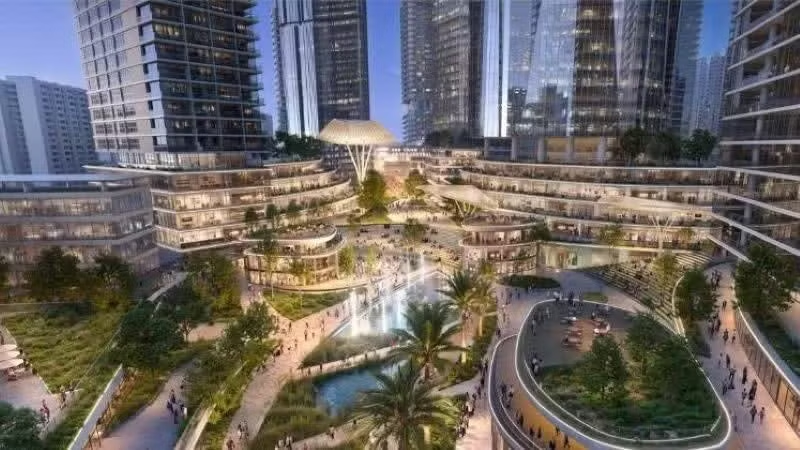
Experiential attractions are playing an increasingly important role in the development strategies of next-generation TOD projects. These may include iconic architecture, large-scale public spaces, green landscapes, art installations, interactive technologies, or integrated retail and entertainment ecosystems. Such features not only enhance visual appeal but also help extend visitor dwell time, increase repeat visits and sustain vibrant activity throughout an entire urban district.
Combining public transport infrastructure with distinctive experiential elements is the key to transforming an ordinary transport station into a super-destination capable of attracting tourism and stimulating global commerce.
Neil MacGregor, Managing Director of Savills Viet Nam
In London, developments such as King's Cross and Battersea Power Station demonstrate how cities can redevelop areas surrounding transport infrastructure into major centres of commerce, culture and public life.
Meanwhile, in Singapore, Jewel Changi Airport and ION Orchard exemplify the integration of transport, retail, services and urban experiences, helping to maintain high visitor volumes and generate sustained demand across the surrounding area.
According to Savills, the common characteristic of these models lies in their ability to create destination ecosystems, where transport, retail, hospitality, office and entertainment functions are seamlessly connected within an integrated urban environment.
In next-generation TOD developments, experiential attractions and innovative public spaces not only draw first-time visitors but also encourage longer stays, stimulate spending on retail, food and beverage services, and entertainment activities, while enhancing the image of the wider urban area. This approach is increasingly being pursued by Asian cities amid growing competition to attract investment, international tourists and highly skilled talent.
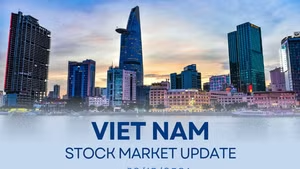
As Ho Chi Minh City accelerates investment in public transport infrastructure and promotes TOD-based urban development, the Thu Thiem area is widely regarded as having significant potential to evolve into a large-scale integrated urban centre in the future.
Over the long term, competition among cities will no longer be determined solely by investment volumes or the height of buildings, but by their ability to create “urban magnets” capable of attracting capital, talent and global communities. New-generation TOD models are therefore increasingly viewed as one of the strategic directions for urban development across Asia in the years ahead.