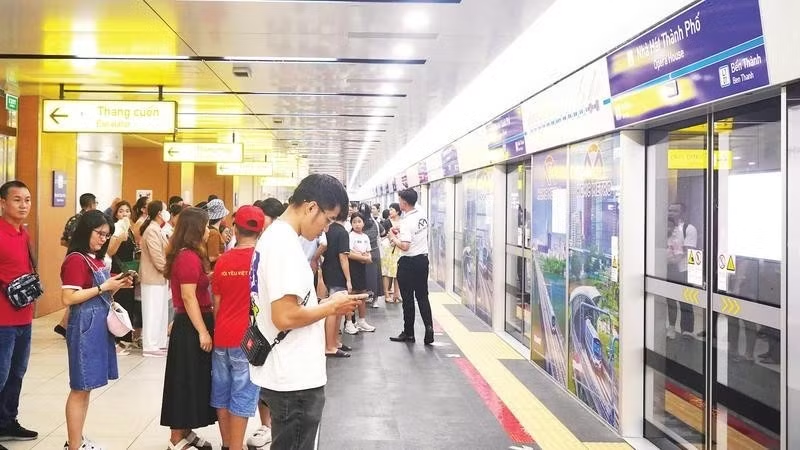
Under the city’s public transport development plan, metro services are expected to account for 20-30% of passenger travel demand by 2030, 35-50% by 2035, and 50-60% by 2045.
Therefore, accelerating investment in the metro system is not merely a transport task but a strategic solution to restructure the city’s urban space, economy, and living environment.
In terms of planning, between now and 2035 the city will build 28 metro lines, with a total length of around 1,024 km. Of these, the pre-merger Ho Chi Minh City area will have 13 lines totalling about 582 km. The former Binh Duong area will have 12 lines, totalling approximately 305 km, while the former Ba Ria-Vung Tau area will have three lines, totalling about 125 km.
Notably, the city is studying the Thu Thiem-Long Thanh metro line, linking the new Thu Thiem centre with Long Thanh International Airport. This line will not only serve passenger transport but also carry strategic significance in shaping an inter-regional economic-services-logistics corridor between Ho Chi Minh City and Dong Nai Province.
These metro lines will form a high-capacity public transport system and ease pressure on the already overloaded road network. Notably, many investors have proposed participating in metro projects under public-private partnership (PPP) arrangements. Lines currently under study include Lines 2, 3, 4, and 5, as well as the Thu Thiem-Long Thanh Line.
Opening the 2025-2030 phase, the city has recently officially commenced construction of Metro Line 2 (Ben Thanh-Tham Luong), with a total length of about 11.3 km, including 9.3 km underground and 2 km elevated, comprising 10 underground stations, one elevated station, and a depot.
Funded by the city budget, the project is regarded as strategically significant for establishing the city’s urban rail network and gradually shaping multi-centred urban and economic development spaces.
Ho Chi Minh City Vice Chairman Bui Xuan Cuong emphasised that once completed, Line 2 will become an important component of the city’s modern infrastructure, creating a seamless public transport axis between Tan Son Nhat Airport and Long Thanh Airport. In doing so, it will help improve people’s quality of life, promote socio-economic development, and reaffirm Ho Chi Minh City’s role in a new development phase.
The groundbreaking of Line 2 is of particular significance, as it is also the city’s first project implemented under special tailored mechanisms and policies for urban rail development.
The city has identified that, before 2035, priority will be given to nine metro lines, including seven already approved lines connecting the city centre with urban areas, industrial zones, and the former Binh Duong area. According to the plan, feasibility studies and FEED designs will be completed in 2026-2027, land clearance undertaken in 2027-2028, and construction implemented between 2027 and 2035.
Ho Chi Minh City Party Committee Secretary Tran Luu Quang affirmed that the city’s current flexible mechanisms for metro investment stem from special resolutions of the central government.
With these mechanisms, the city may apply direct appointment of contractors instead of competitive bidding, while proactively adopting streamlined procedures for many investment and construction processes. This helps shorten project timelines and creates stronger incentives for investors to participate.
Therefore, the city must demonstrate even greater determination in investing in the metro system, viewing it as a fundamental solution to the long-term challenge of traffic congestion.
According to urban experts, metro systems cannot realise their full effectiveness if developed piecemeal, line by line. The city needs to pursue the simultaneous development of multiple lines, quickly establishing a connected network to cultivate public transport usage habits. Once the network reaches a minimum scale, operational efficiency will increase exponentially.
If advanced with breakthrough thinking and consistent action, urban rail will not merely be a means of transport, it will also be a pathway enabling Ho Chi Minh City to continue playing its locomotive role, driving growth in the southern key economic region and the nation as a whole in the decades to come.

![[Video] Renewal and growth milestones of Ha Noi through the lens](https://en-cdn.nhandan.vn/images/1XgBTSIw0KyfD4abQsg-hd4ly6fBUHXC7_OAKyN4YwPfAhBw0Xs6rVX3rF0up9Tr6rLNn30Muc4bzp90E7yOqg/10-10-hanoi-cover.jpg.avif)