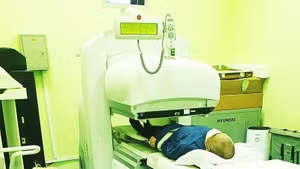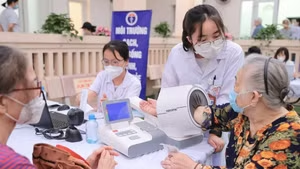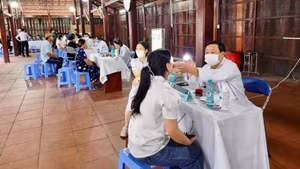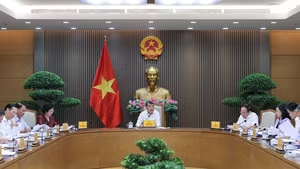
In recent times, although facing many difficulties, under the close leadership of the Party and the Government, as well as the spirit of overcoming challenges, the health sector has created strong transformations. Statistics show that in the 2021–2025 term, the sector has completed and exceeded many important targets assigned by the National Assembly and the Government. The legal corridor has been cleared, creating conditions for hospitals to improve the quality of healthcare service provision; disease prevention has been carried out early, from afar and from the grassroots; the grassroots health system has continued to receive attention and investment in both quantity and quality.
The health sector has strived to standardize hospital quality; strongly shifting from an administrative management model to professional and modern service. The application of hospital quality criteria associated with independent evaluation has created a fundamental change in appearance and service culture. Hospitals have accelerated the application of electronic medical records, connecting personal health information with the VNeID application and the national population database, helping to optimize examination and treatment processes and minimize cumbersome administrative procedures for people.
In recent times, many key projects of the health sector have been accelerated, completed and put into operation, meeting the increasingly high demand for medical examination and treatment of the people. Along with that, the organizational structure of the sector has been arranged in a streamlined, effective and efficient direction...
Besides the achieved results, the work of protecting, caring for and improving people’s health still faces limitations, difficulties and challenges. These include the living environment, food safety and nutrition not being given due attention; preventive medicine not being adequately invested in and not fully meeting the requirements of disease prevention and control; grassroots health not yet providing all primary healthcare services, and screening for early disease detection not being widely implemented; failure to create trust among patients, leading to bypassing lower levels of care and causing overload at higher levels. The quality of medical examination and treatment and access to healthcare services remain uneven among professional levels and regions; medical human resources in some localities and at the grassroots level do not meet requirements in terms of quantity, qualifications and quality.
Faced with practical requirements, the work of protecting, caring for and improving people’s health needs to be strongly changed in thinking, awareness and action. In recent times, many mechanisms and policies have been issued to gradually remove bottlenecks and constraints, establishing breakthrough solutions for the development of the health sector. Among them, Resolution No. 72-NQ/TW issued by the Politburo is a breakthrough orientation, a milestone of turning-point significance, creating a foundation for the cause of caring for, protecting and improving people’s health.
This is a strategic, comprehensive and long-term resolution, action-oriented in nature, with many policies supplemented to meet the requirements of sustainable national development and the expectations of the people. The Resolution is approached on the basis that people’s health is the most precious asset and the central focus for serving and implementing tasks and solutions in the health sector. The Resolution sets out breakthrough solutions for three main bottlenecks:
First, removing the bottleneck in thinking and awareness. The Resolution has created a revolution in thinking, “strongly shifting from a mindset focused on medical examination and treatment to proactive disease prevention, emphasizing comprehensive, continuous health protection, care and improvement throughout the life cycle”; shifting from a state of “passively coping with diseases” to “proactively creating health.” Notably, protecting, caring for and improving people’s health is not only the responsibility of the health sector but of the entire political system; placing the people at the center and considering health as the most precious asset to be prioritized in development strategies.
Second, removing bottlenecks in institutions and resources. With the important orientation of synchronously perfecting the legal system (in the fields of health insurance, disease prevention, population...). At the same time, the Resolution introduces breakthrough financial mechanisms to mobilize social resources, combine public–private partnerships, while affirming that the state budget plays the leading role for preventive and grassroots health, ensuring equity in access to services, reducing the burden of medical costs for people, implementing a roadmap toward hospital fee exemption to limit out-of-pocket payments when seeking medical examination and treatment.
Third, removing difficulties in medical human resources. Building and implementing superior remuneration policies, considering the medical profession as a special profession that requires special recruitment, use and treatment. Policies on professional allowances and specialized training are set out to attract and retain talent, ensuring the sustainable operation of the health system from its foundation.
Resolution No. 72-NQ/TW has created an important political basis to complete the legal corridor and necessary conditions for the health sector to fulfill its mission of caring for the health of the entire population in the new era, as well as to mobilize the entire political system and society to participate in developing a modern, equitable and sustainable healthcare system. Up to now, after six months of implementing Resolution No. 72-NQ/TW, under the decisive direction and administration of the Government and the close coordination of ministries and sectors, the implementation work has been strongly promoted, creating initial changes. In localities, there have been clear movements in developing programs and plans to concretize the spirit of the Resolution in line with practical conditions of each area.
The 14th National Party Congress, with its important documents, opens new vision and expectations for the country’s development as well as for the health sector. The strategic orientations and development goals set out by the Congress will serve as guiding principles for the health sector to innovate more strongly, proactively and effectively in the coming period. To successfully implement the Congress Resolution and realize the set objectives, the health sector will focus on implementing breakthrough solutions to improve the effectiveness and quality of protecting, caring for and improving people’s health.
In the coming time, the Ministry of Health will build breakthrough policies in thinking and action in leadership, direction and organization of the work of protecting, caring for and improving people’s health. Along with that are breakthrough policies on institutions and legal frameworks toward focusing on completing the healthcare legal system, with priority given to timely institutionalizing Party guidelines to create a synchronous and transparent legal corridor; and promptly bringing laws and resolutions into life.
The health sector and localities will synchronously implement solutions to enhance the capacity of the health system, develop grassroots and preventive health; effectively implement the national target program on healthcare, population and development, ensuring that every commune health station has enough doctors trained according to requirements, sufficient essential medicines and basic equipment.
Regarding financial mechanisms, healthcare finance will be strongly reformed toward developing effective and sustainable health insurance as the financial pillar ensuring health security. At the same time, a roadmap for implementing the policy of hospital fee exemption will be built. The health sector will focus on strongly innovating policies on training and employing medical human resources associated with improving service quality. Comprehensive renewal of service style, spirit and attitude toward serving people and patients will be linked with enhancing professional capacity of medical staff. A salary and allowance mechanism commensurate with the contributions of physicians will be developed. The medical education system will be consolidated to meet international standards, linking training with substantive practice through the National Medical Council.
The health sector will carry out strong digital transformation, developing toward smart healthcare; determined to build universal electronic medical records and electronic health records integrated with the national population database. At the same time, strongly develop the telemedicine system to bring the expertise of leading specialists to remote, border and island areas. This is not only a technical solution but a revolution in the method of serving the people in the digital age.